
Worm Gearbox for Feed Mixer: A Complete Guide for Australian Operators
Feed mixers — both Total Mixed Ration (TMR) mixer wagons and stationary feed-lot mixers — are the daily workhorses of Australian dairies and beef finishing feedlots, from Gippsland dairy farms to the Darling Downs beef feedlots. The worm reducer driving the mixer auger or paddle takes the full brunt of every feed batch: hay fibres, molasses, minerals, and sometimes rocks and baling wire accidentally included. Reliability here means the cattle eat on time — every day, 365 days a year.
Our worm gear reducer Australia range for feed mixing applications is engineered around the realities of Australian farm operation: dusty sheds, frequent wash-downs, aggressive feed chemistry and surge-loaded starting. We use wear-resistant cast iron housings with rust-inhibiting surface treatment, heavy thrust bearings and synthetic PAG oil, giving feed mixers the bulletproof drive they need for a decade of service.
Reliability on a livestock feed mixer is not luck — it is the cumulative outcome of correct sizing, appropriate materials, sealing suited to the climate, and lubrication matched to duty.
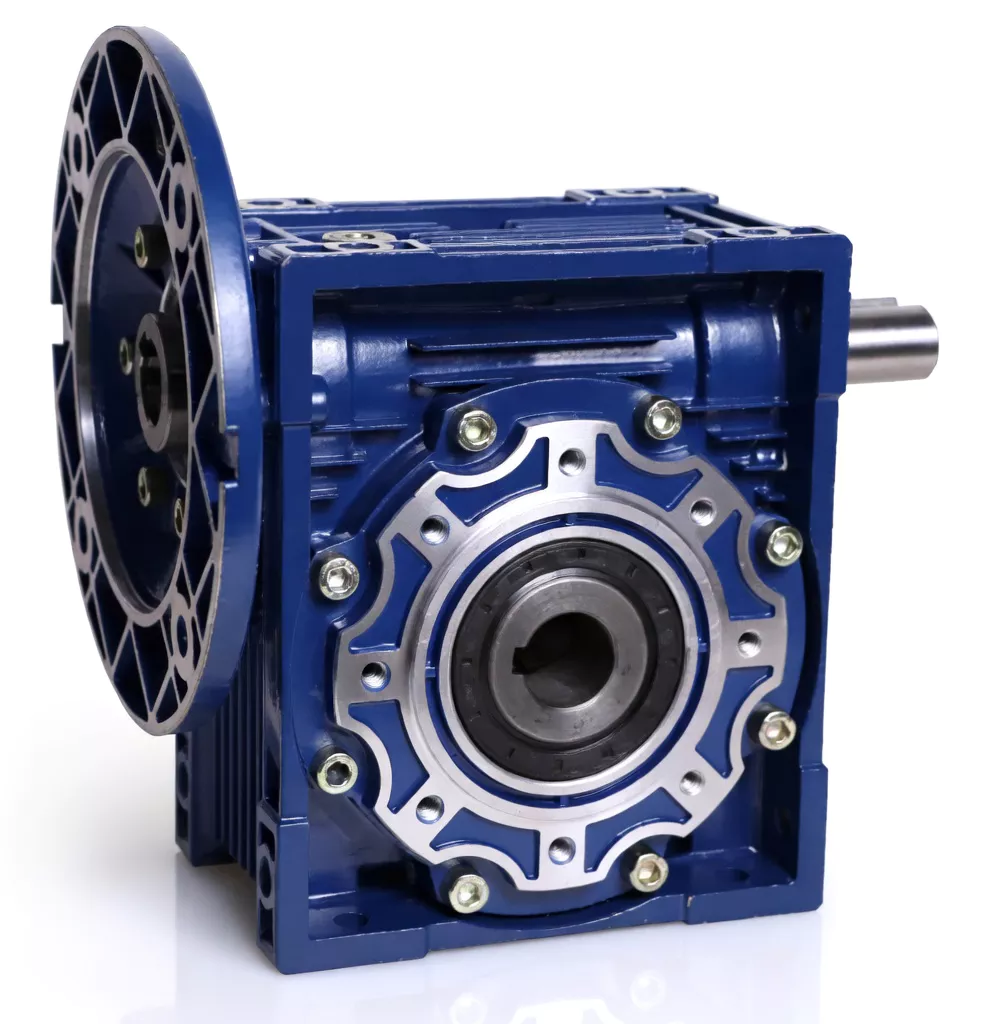
Typical worm gearbox configuration for livestock feed mixer duty
Understanding the Role of the Worm Reducer in Your Livestock Feed Mixer
On a vertical TMR mixer the gearbox sits under the tub, driving a single or twin vertical auger with chopping knives welded to the flighting. The torque demand peaks at start-up (feed bed compressed overnight) and during the chopping phase when knives engage hay bales. A stationary mixer uses horizontal paddles driven through a side-mounted worm reducer. In both cases the gearbox must take full axial load from the auger/paddle, shock loads from feed chunks, and continuous duty.
Housings are wear-resistant cast iron (EN-GJL-300) finished with a rust-inhibiting coating that survives frequent wash-downs with alkaline detergents. The worm is case-hardened alloy steel, ground and run-in against a tin bronze wheel designed for shock-load tolerance. Output shafts are oversized for the axial load of a 3-tonne feed column, and bearing preload is set at the factory for integrated thrust support.
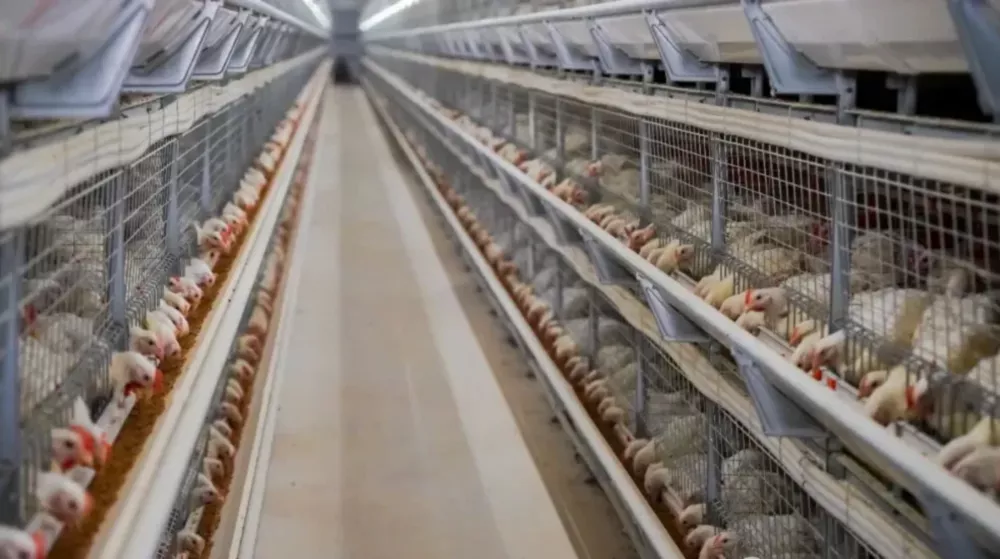
| Key construction: wear-resistant cast iron housing with rust-inhibiting surface treatment. |
Keyword focus: worm gearbox for livestock feed mixer Australia.
Proven Performance — Australian Case Studies
These are real Australian deployments where our worm gear reducers solved documented site problems. Names and exact locations are withheld for commercial confidentiality.
Asset: Twin-auger vertical TMR mixer, 55 kW drive. Problem: Existing gearbox failed on shock load when hay string wound around auger. Action: Upgraded to high service factor (2.2) size 200 unit with shear-pin input coupling. Result: Gearbox passed 20,000 hours of duty without issue.
Asset: Stationary mixer, 75 kW drive, 3 batches per hour. Problem: Continuous duty caused thermal failure by 9 months. Action: Specified PAG synthetic oil with external cooling fan. Result: Run temperature dropped 18 °C; no failures in 36 months.
Asset: Self-propelled TMR mixer wagon, 45 kW drive. Problem: Wash-down water infiltrated bottom-mount gearbox. Action: Sealed housing with IP66 boot and upgraded Viton breather. Result: No water in oil after 12 months; warranty maintained.
Asset: Paddle mixer, 18.5 kW drive. Problem: Acidic feed additives corroded gearbox paint prematurely. Action: Applied C5-I coating on housing and stainless steel fasteners. Result: Housing paint intact at 4-year inspection.
Asset: TMR cart, 30 kW drive, cold climate. Problem: Low-temperature starting overloaded standard drive. Action: Switched to PAO synthetic gear oil with -40 °C cold-start rating. Result: Cold-morning start-up issues eliminated.
Technical Specifications & Selection Guide
These are the working envelopes our standard range covers. Non-standard bores, specialised flanges, and custom torque-arm geometries are available as an OEM option — just get in touch.
| Parameter | Specification / Range |
|---|---|
| Ratio Range | 15:1 to 60:1 single stage, higher with pre-stage |
| Output Torque | 2,500 Nm to 45,000 Nm |
| Input Power | 7.5 kW to 110 kW |
| Input Shaft | IEC B5 / PTO interface option |
| Output Shaft | Solid flanged Ø70–Ø160 mm |
| Housing Material | Cast iron EN-GJL-300, rust-inhibiting finish |
| Mounting | Bottom-mount flange or side-mount foot |
| Protection | IP66, suitable for wash-down |
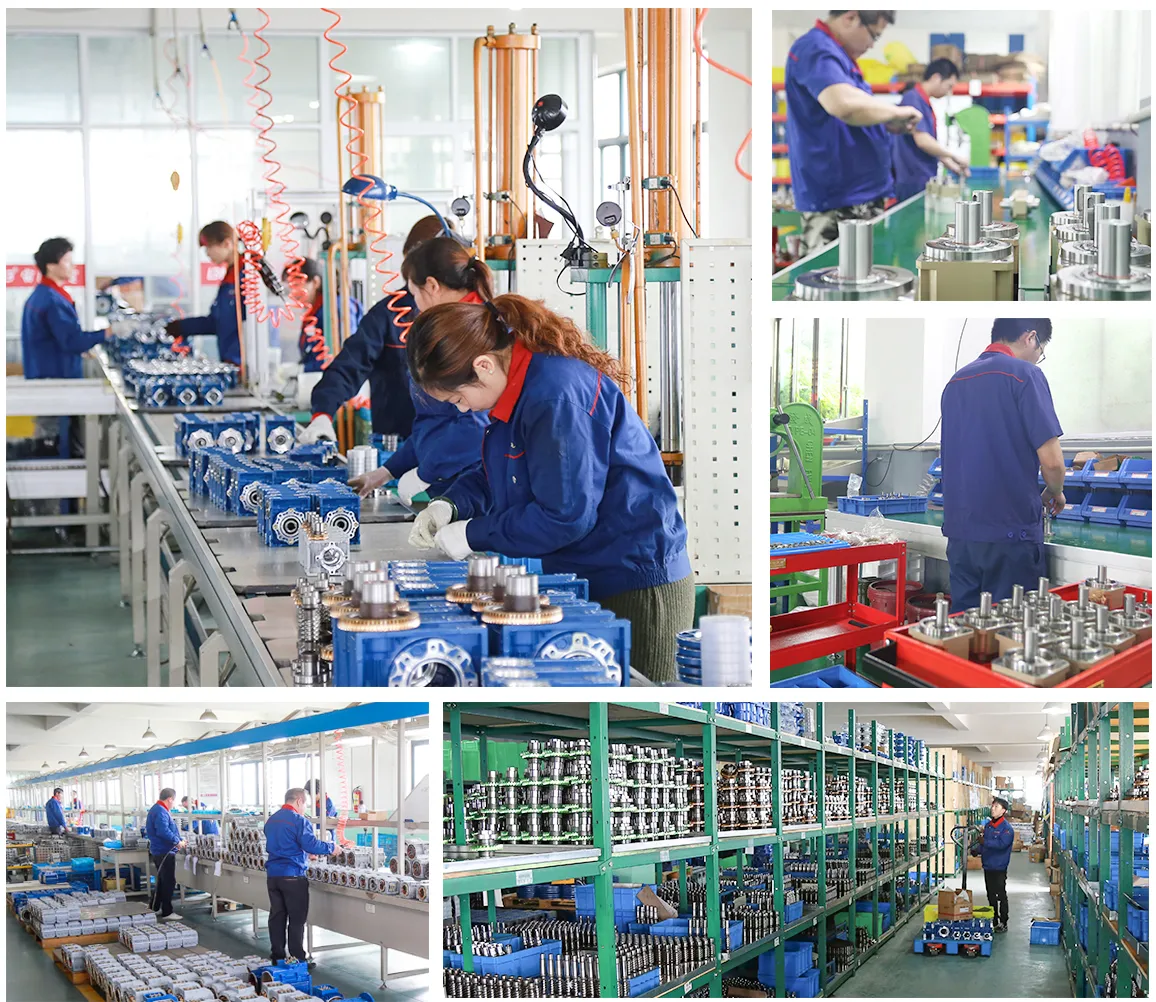
Standards & Certifications
Compliance is non-negotiable on Australian industrial sites. Our units carry the certifications and ingress ratings that site engineers and insurers expect.
You can learn more about us, browse our full range of worm gear motors, or jump straight to the detailed worm reducer page for technical downloads.
Why Australian Buyers Choose Us
Selecting the right supplier is as important as selecting the right gearbox. Here is what sets our team apart.
25+ Years Manufacturing Experience
Four generations of worm gear production know-how, with a dedicated engineering team serving mining, agriculture, food, water and construction clients across Australia.
Remote Technical Support
Australia-timezone engineering support via phone, email and video call, with selection calculators, drawing packs and installation guides available on request.
OEM / ODM Customisation
Non-standard shaft geometries, flange drillings, housing paint systems, and torque-arm designs are routine — our engineers will match your exact mechanical interface.
Outstanding Value for Money
Direct-from-factory pricing with logistics to any Australian capital and major regional centre, competitive against premium European brands while meeting the same specifications.
Australia-Ready Logistics
Regular sea-freight consolidation to Sydney, Melbourne, Brisbane, Perth and Adelaide, with in-country distribution partners for same-week delivery on stocked sizes.
100% Load-Tested
Every unit is bench-tested for noise, vibration, running temperature and oil seal integrity before it leaves the factory, with a test certificate shipped in the documentation pack.
Frequently Asked Questions
Common questions from Australian engineers, procurement managers and maintenance supervisors — answered in detail.
What service factor should I use for a TMR mixer gearbox?
For vertical auger TMR mixers we typically apply a service factor of 2.0 to 2.5, reflecting the shock load when the auger first engages a compacted feed column in the morning. For horizontal paddle mixers, 1.8 is usually sufficient as loading is more gradual.
Can the gearbox survive frequent wash-downs?
Yes. Our feed mixer gearboxes are specified with IP66 sealing and a rust-inhibiting coating that tolerates alkaline wash-down detergents. Avoid steam cleaning directly at seal lips; otherwise the unit shrugs off routine hosing.
What happens if baling wire or a rock gets into the auger?
These are foreign-object events — a shear pin or shear coupling on the input is the recommended protection. Our gearboxes are rated for up to 2.5× nominal torque momentarily, but allowing the drive to fully jam without a shear element risks bearing damage.
Do I need a cooling fan for continuous mixing duty?
For mixers running more than 6 hours per day continuously (typical of commercial feedlots), yes — a motor-mounted cooling fan on the gearbox or a PAG synthetic oil fill is recommended. Our team can run a thermal calculation for your specific duty cycle.
Is the gearbox suitable for PTO drive from a tractor?
Yes — we offer PTO input options with 540/1000 rpm splined shafts and a safety shield. This is common on self-propelled mixer wagons in Australian dairy operations.
How often should the oil be changed?
With synthetic PAG oil, every 8,000 hours. On farm operations this is typically an annual change. For fleet operations with running-hour counters, the change is triggered by hours rather than calendar.
Get the Right Gearbox — First Time
Our team will review your specification, cross-check your service factor, and propose the optimum model — typically within one business day.