
Worm Gearbox for Sorting Conveyor: A Complete Guide for Australian Operators
Australia’s e-commerce boom has transformed warehouses from sleepy distribution sheds into heavily automated sortation hubs. From Amazon’s Sydney fulfilment centre to Australia Post’s parcel super-hubs in Melbourne and Brisbane, high-speed sortation conveyors move tens of thousands of parcels per hour. Each diverter, belt and cross-belt is driven by a compact worm reducer that must be small enough to fit in the conveyor frame, quiet enough for the 24/7 operation, and robust enough for constant start-stop cycling.
Our compact worm speed reducer range for logistics is built for exactly this application. Lightweight die-cast aluminium housings, high-efficiency gear sets with low run-in friction, quiet operation under 65 dB(A), and frame sizes small enough to tuck between the conveyor stringers — these are the features that win specifications at the leading Australian automation integrators. Our worm gear reducer Australia range is designed to disappear into the infrastructure while delivering hundreds of millions of duty cycles.
Reliability on a warehouse sorting conveyor is not luck — it is the cumulative outcome of correct sizing, appropriate materials, sealing suited to the climate, and lubrication matched to duty.
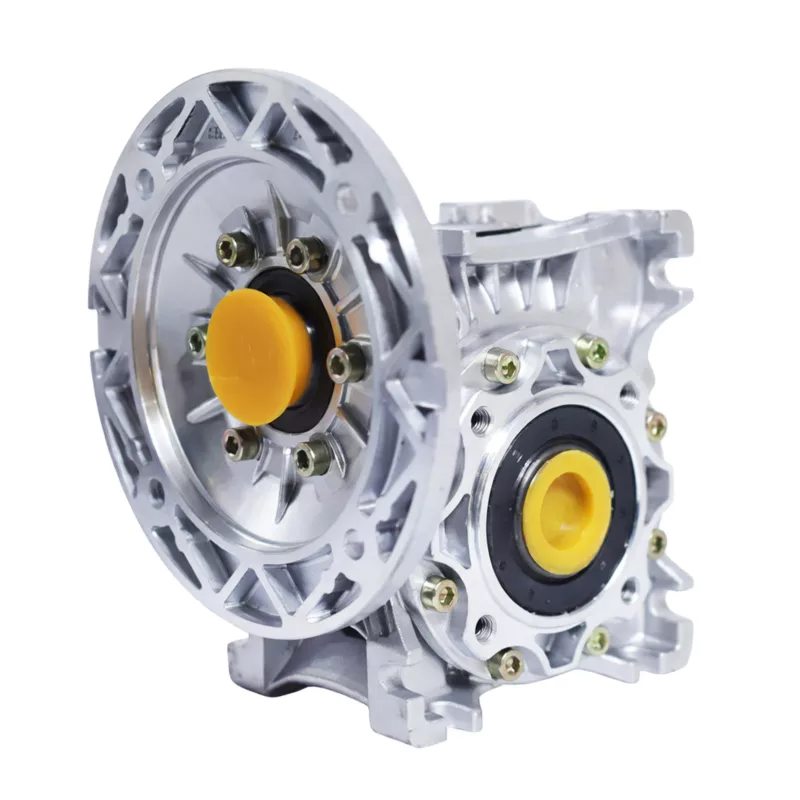
Typical worm gearbox configuration for warehouse sorting conveyor duty
Understanding the Role of the Worm Reducer in Your Warehouse Sorting Conveyor
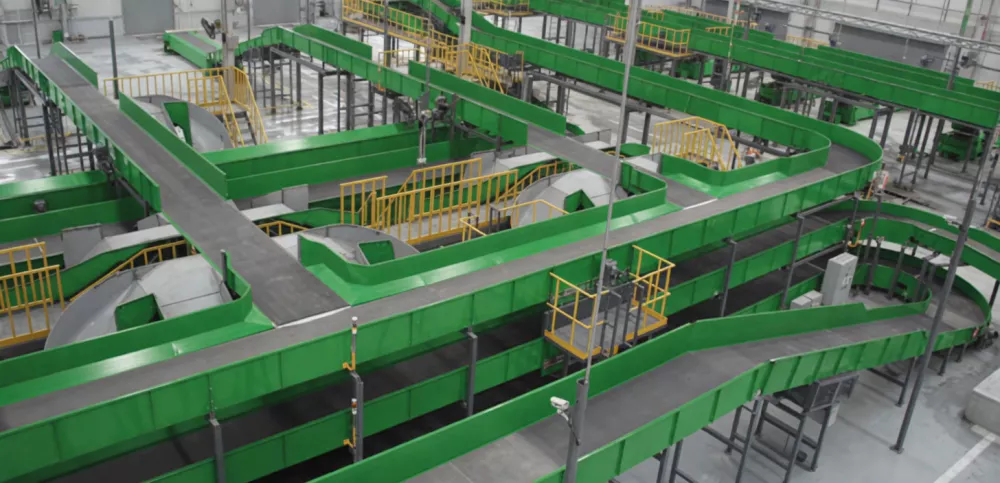
On a sortation conveyor, the worm gearbox drives the head roller of a short belt conveyor, a diverter roller in a cross-belt sorter, or the idler rollers on a smart-roll accumulation section. Powers are modest — typically 0.37 kW to 2.2 kW — but the duty cycle is punishing: dozens of direction changes per minute, instant accelerations, and no scheduled downtime to service the gearbox.
Lightweight die-cast aluminium housings offer an ideal balance of strength and thermal dissipation, with most frames weighing under 15 kg even at size 90. Inside, the usual worm-and-wheel pair is optimised for low start-up friction (ground DIN 3 worm, precision-lapped bronze wheel) to give both high efficiency and quiet operation. Output shafts are commonly hollow-bore for direct coupling to the conveyor roller, eliminating the need for a pedestal bearing.
| Key construction: lightweight die-cast aluminium alloy housing offering excellent heat dissipation and a compact footprint. |
Keyword focus: compact worm speed reducer for sorting conveyor.
Proven Performance — Australian Case Studies
These are real Australian deployments where our worm gear reducers solved documented site problems. Names and exact locations are withheld for commercial confidentiality.
Asset: Cross-belt sorter, 600 cells × 0.55 kW drives. Problem: Noisy gearboxes contributed to workplace dB(A) exceedances. Action: Replaced with precision-ground, low-noise aluminium worm units at 62 dB(A). Result: Facility noise level dropped from 82 to 76 dB(A); WHS compliance restored.
Asset: Divert conveyor, 2.2 kW drive, 120 cycles/min. Problem: Previous gearboxes failed at 8 months due to duty cycle fatigue. Action: Upgraded to heavy-duty bronze wheel with service factor 1.8. Result: Service life exceeded 36 months; integrator adopted for future installs.
Asset: Belt conveyor network, 400× 0.37 kW drives. Problem: Variability in OEM units caused uneven belt speeds. Action: Standardised on our aluminium worm gearmotor across the hub. Result: Belt synchronisation improved; parcel throughput up 6 %.
Asset: Accumulation conveyor, 0.75 kW drive, frequent jams. Problem: Jams in the downstream conveyor stalled upstream gearboxes. Action: Supplied units with over-torque protection coupling on input. Result: Drive trains unaffected by routine jams; MTTR reduced.
Asset: Pack-out conveyor, 1.1 kW drive. Problem: Warehouse cooling vented condensation into gearboxes. Action: Fitted desiccant breather and sealed drain plug to IP65. Result: Oil cleanliness maintained over 24 months.
Technical Specifications & Selection Guide
These are the working envelopes our standard range covers. Non-standard bores, specialised flanges, and custom torque-arm geometries are available as an OEM option — just get in touch.
| Parameter | Specification / Range |
|---|---|
| Ratio Range | 5:1 to 50:1 |
| Output Torque | 15 Nm to 350 Nm |
| Input Power | 0.12 kW to 2.2 kW |
| Output Shaft | Hollow Ø18–Ø30 mm or solid Ø16–Ø28 mm |
| Housing Material | Die-cast aluminium alloy |
| Noise Level | ≤65 dB(A) at 1 m |
| Cycles | >100 million rated duty cycles |
| Protection | IP54 (standard), IP65 optional |
Standards & Certifications
Compliance is non-negotiable on Australian industrial sites. Our units carry the certifications and ingress ratings that site engineers and insurers expect.
You can learn more about us, browse our full range of worm gear motors, or jump straight to the detailed worm reducer page for technical downloads.
Why Partner With Us
If you are new to specifying worm gear units, here is the shortest possible case for working with our team.
Four generations of worm gear production know-how, with a dedicated engineering team serving mining, agriculture, food, water and construction clients across Australia.
Australia-timezone engineering support via phone, email and video call, with selection calculators, drawing packs and installation guides available on request.
Non-standard shaft geometries, flange drillings, housing paint systems, and torque-arm designs are routine — our engineers will match your exact mechanical interface.
Direct-from-factory pricing with logistics to any Australian capital and major regional centre, competitive against premium European brands while meeting the same specifications.
Regular sea-freight consolidation to Sydney, Melbourne, Brisbane, Perth and Adelaide, with in-country distribution partners for same-week delivery on stocked sizes.
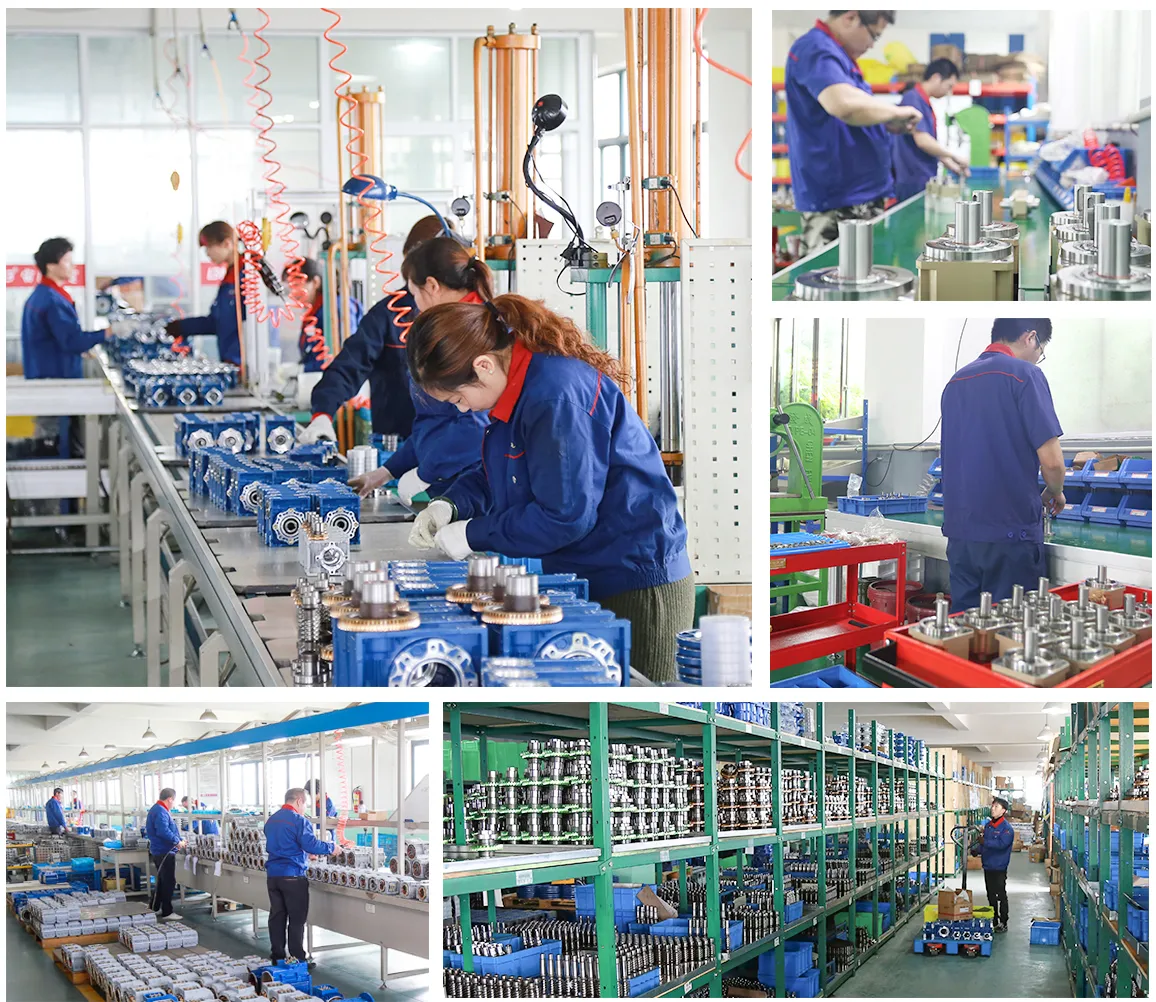
Every unit is bench-tested for noise, vibration, running temperature and oil seal integrity before it leaves the factory, with a test certificate shipped in the documentation pack.
Answers to Common Questions
Six detailed answers to the questions we are asked most often about this application.
Q: What noise level can I expect from an aluminium worm gearbox?
A: Our precision-ground units typically run at 60–65 dB(A) at 1 m from the gearbox, measured under load. This is well below the background noise of a typical Australian warehouse and meets most WHS noise requirements.
Q: Is the gearbox suitable for high-cycle duty?
A: Yes. Our aluminium worm range is tested to more than 100 million duty cycles in accelerated life tests, reflecting the reality of high-speed sortation. Correct specification of service factor is still required — our application team can run the calculation for your profile.
Q: Can I direct-mount the gearbox on the conveyor roller?
A: Yes. Our hollow-bore output is sized for common Australian conveyor roller diameters (50 mm and 60 mm shafts are standard). A shrink disc or keyway fixing then clamps the gearbox to the roller directly.
Q: How do I select between a worm gearbox and a helical or planetary unit?
A: For short belts, low power (<3 kW), and cost-sensitive applications, worm is ideal — cheaper and more compact. For higher power, higher efficiency, or quieter operation, a helical gearmotor may be a better fit. Our sales engineers can compare both options for your specification.
Q: What input voltages are available?
A: Standard three-phase 415 V 50 Hz for Australian sites, plus 400 V 50 Hz and 230 V single-phase for smaller motors. VFD-rated motors are available for variable-speed applications.
Q: Can you supply gearmotors with encoders for positioning?
A: Yes — we can supply a motor with an integrated incremental or absolute encoder for precise positioning, useful on high-speed divert conveyors. Contact our technical team for the motor specification.
Get the Right Gearbox — First Time
Our team will review your specification, cross-check your service factor, and propose the optimum model — typically within one business day.