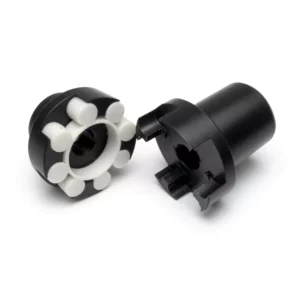
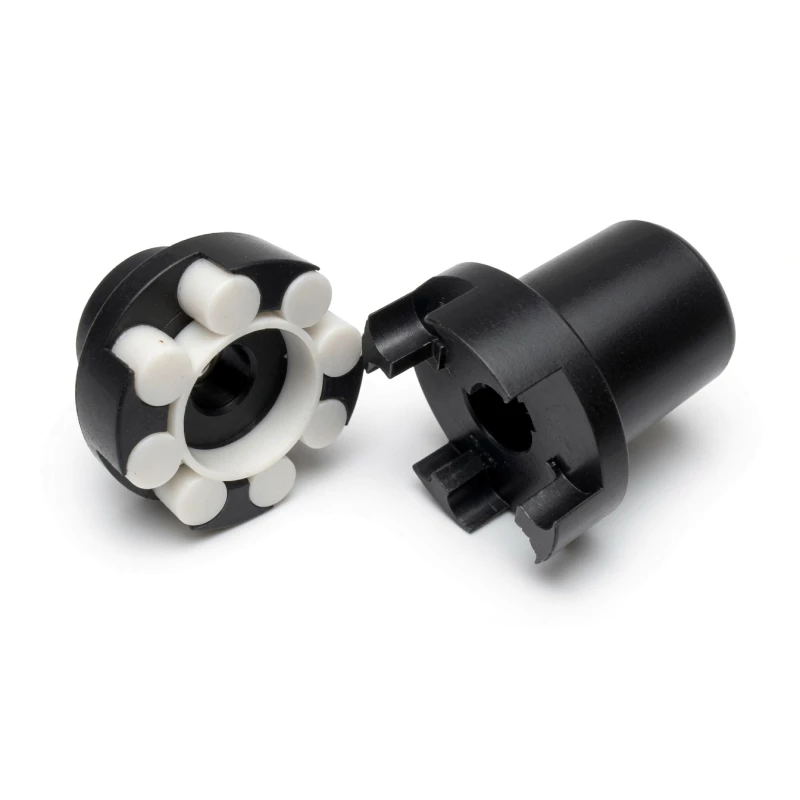
LM / ML Type Plum Blossom Jaw Coupling
The LM / ML Type Plum Blossom Jaw Coupling (GB/T5272-2002) is a three-piece flexible shaft coupling comprising two cast-iron or ductile-iron hubs and a polyurethane spider. Covering torque 16–8,000 N·m across 13 sizes with bore up to 160 mm, it provides vibration damping, misalignment compensation, and zero-lubrication operation for pumps, fans, conveyors, and general industrial drives.
MOQ: 50 pcs. Minimum order value USD 1,500; mixed orders and trial quantities welcome.
What Is an LM / ML Plum Blossom Jaw Coupling?
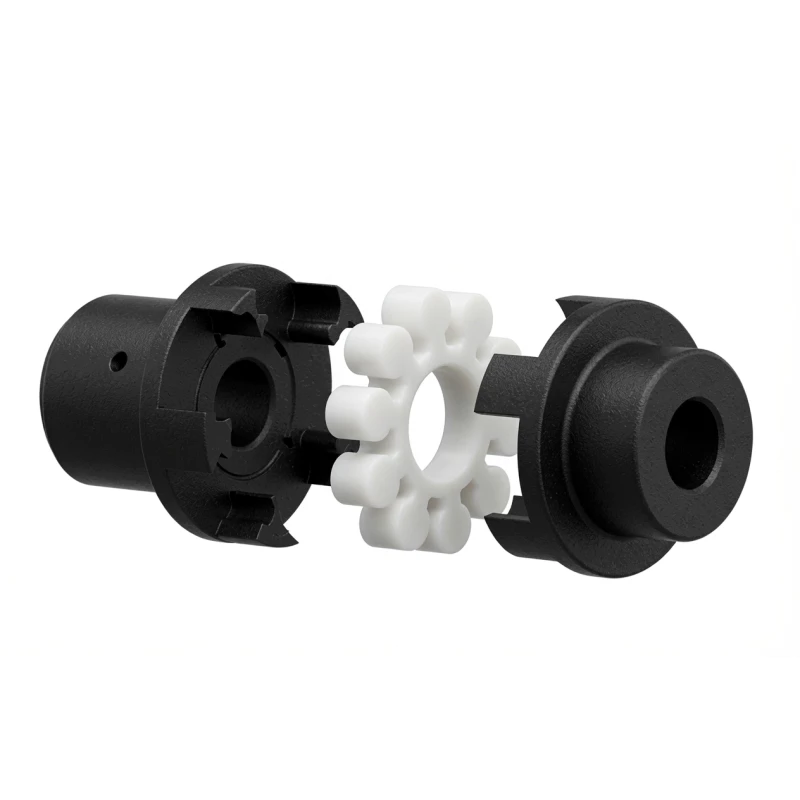
The LM / ML type plum blossom jaw coupling — also known as a spider coupling, claw coupling, or jaw-type flexible coupling — is the workhorse of industrial power transmission. Manufactured to GB/T5272-2002 (replacing GB5272-85), its three-piece design connects two rotating shafts while absorbing shock, attenuating vibration, and compensating for minor misalignment — all without grease or scheduled lubrication.
Three-Component Architecture
- Drive hub — keyed to the drive shaft. Grey iron for LM1–LM8; ductile iron for LM9–LM13.
- Driven hub — identical claw geometry, keyed to the driven shaft. No metal-to-metal contact between hubs.
- Polyurethane spider — the six-lobed elastomeric insert. Three hardness grades: shA (80±5), shB (92±5), shD (60±5). Operating range: −35 °C to +80 °C.
Torque Transmission & Misalignment Compensation
Drive claw faces compress the spider lobes, transferring torque to the driven hub without rigid metal contact. The compliant polyurethane simultaneously absorbs torsional shock, damps vibration, and accommodates angular misalignment (≤2°), radial offset (0.5–1.8 mm by size), and axial float (1.2–5.0 mm by size). The non-conductive spider also provides electrical isolation between shafts — a useful feature in mixed-metal drive trains.
LM / ML vs Other Coupling Types
| Feature | LM/ML Jaw | Disc / Membrane | Grid (Serpentine) | Elastic Pin (LX) |
|---|---|---|---|---|
| Lubrication | None | None | Grease | None |
| Vibration Damping | ★★★★☆ | ★★☆☆☆ | ★★★☆☆ | ★★★☆☆ |
| Spider replacement | In-situ, <15 min | Full strip-down | Partial strip | Hub removal |
| Max Speed (steel hub) | 15,300 rpm | Very high | Medium | 8,500 rpm |
| Relative cost | Low–Medium | High | Medium | Low–Medium |
LM / ML Jaw Coupling Specifications & Dimensions
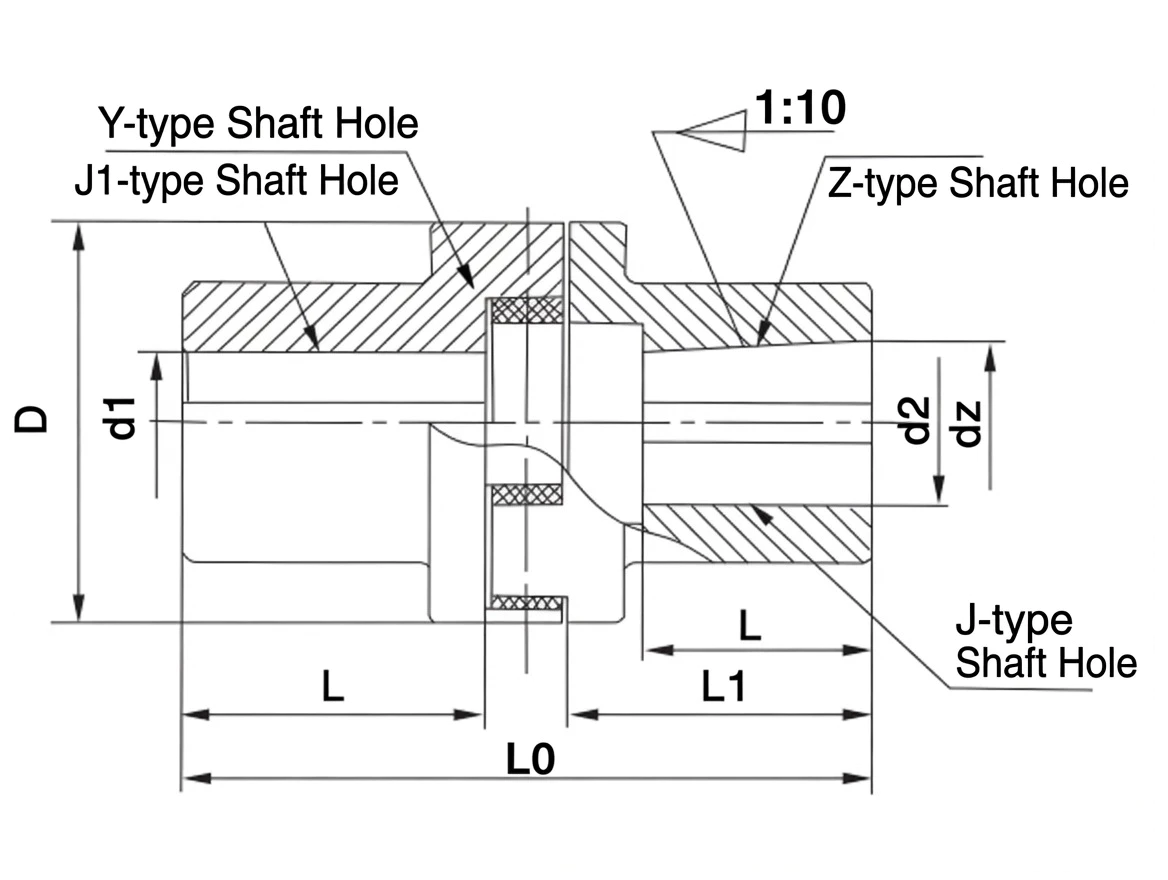
Elastomer Hardness Grades
| Grade | Shore | Best For | Torque vs shA | Damping |
|---|---|---|---|---|
| shA | 80±5 | General purpose — default choice | ×1.0 | ★★★★☆ |
| shB | 92±5 | High torque, low vibration concern | ×1.4–1.6 | ★★★☆☆ |
| shD | 60±5 | Maximum damping, sensitive equipment | ×1.0 | ★★★★★ |
Full Parameter Table — LM1 to LM13
Hub: cast iron (LM1–LM8) / ductile iron (LM9–LM13) · Spider: polyurethane −35 °C to +80 °C · * bore compatible with J / Z shaft hole types
| Type | Old | Nom. Torque N·m | Max Speed rpm | Bore d1,d2,dz mm | Bore Length mm | L0 mm | D mm | Compensation | ||||||
|---|---|---|---|---|---|---|---|---|---|---|---|---|---|---|
| shA | shB | shD | Iron | Steel | Y-type | Z/J-type | Axial mm | Radial mm | Angle ° | |||||
| LM1 | ML1 | 16 | 25 | 45 | 11,500 | 15,300 | 12–24 | 32–52 | 27–38 | 80–120 | 50 | 1.2 | 0.5 | 2.0 |
| LM2 | — | 63 | 100 | 200 | 8,200 | 10,900 | 20–32 | 52–82 | 38–60 | 127–187 | 70 | 1.5 | 0.8 | 2.0 |
| LM3 | ML2 | 90 | 140 | 280 | 6,700 | 9,000 | 22–38 | 52–82 | 38–60 | 128–188 | 85 | 2.0 | 0.8 | 2.0 |
| LM4 | MI3 | 140 | 250 | 400 | 5,500 | 7,300 | 25–42 | 62–112 | 44–84 | 151–251 | 105 | 2.5 | 0.8 | 2.0 |
| LM5 | ML4 | 250 | 400 | 710 | 4,600 | 6,100 | 30–48 | 82–112 | 60–84 | 197–257 | 125 | 3.0 | 1.0 | 1.5 |
| LM6 | ML5 | 400 | 630 | 1,120 | 4,000 | 5,300 | 30–55 | 82–112 | 60–84 | 203–263 | 145 | 3.0 | 1.0 | 1.5 |
| LM7 | ML6 | 710 | 1,120 | 2,240 | 3,400 | 4,500 | 45*–65 | 112–142 | 84–107 | 265–325 | 170 | 3.5 | 1.0 | 1.5 |
| LM8 | ML7 | 1,120 | 1,800 | 3,550 | 2,900 | 3,800 | 50*–75 | 112–142 | 84–107 | 272–332 | 200 | 4.0 | 1.5 | 1.5 |
| LM9 | MI8 | 1,800 | 2,800 | 5,600 | 2,500 | 3,300 | 60*–95 | 142–172 | 107–132 | 334–394 | 230 | 4.5 | 1.5 | 1.0 |
| LM10 | ML9 | 2,800 | 4,500 | 9,000 | 2,200 | 2,900 | 70*–110 | 142–212 | 107–167 | 344–484 | 260 | 5.0 | 1.5 | 1.0 |
| LM11 | MI10 | 4,000 | 6,300 | 12,500 | 1,900 | 2,500 | 80*–120 | 172–212 | 132–167 | 411–491 | 300 | 5.0 | 1.8 | 1.0 |
| LM12 | ML11 | 7,100 | 11,200 | 20,000 | 1,600 | 2,100 | 90*–130 | 172–252 | 132–202 | 417–577 | 360 | 5.0 | 1.8 | 1.0 |
| LM13 | MI12 | 8,000 | 12,500 | 2,500 | 1,400 | 1,900 | 100*–160 | 212–302 | 167–242 | 497–677 | 400 | 5.0 | 1.8 | 1.0 |
Plum Blossom Jaw Coupling Series — All Variants
GBC manufactures the complete GB/T5272-2002 plum blossom coupling family. Visit our full coupling catalogue for dimensional drawings and cross-reference tables.
Torque: 16–8,000 N·m · Bore: up to 160 mm · Speed: up to 15,300 rpm · Hub: grey/ductile iron
Torque: 25–25,000 N·m · Split design: spider replaceable without moving machinery
Torque: 250–25,000 N·m · Integrated split drum for shoe brakes · D0: 160–800 mm
Torque: 250–12,500 N·m · One-piece brake hub · Compact for drum brake drives
Torque: 630–1,800 N·m nominal · Disc ø355–560 mm · For disc brake systems
How to Select the Right LM / ML Coupling Size
Design Torque Formula
- K — service factor (see table)
- P — motor rated power, kW
- N — operating speed, rpm
- Tn — nominal torque of selected coupling (must satisfy TC ≤ Tn)
| Load Character | K | Typical Applications |
|---|---|---|
| Electric motor, smooth / uniform load | 1.25–1.50 | Centrifugal pumps, fans, light conveyors |
| Electric motor, moderate shock / cyclic | 1.50–2.00 | Compressors, mixers, reciprocating pumps |
| IC engine (4-cyl+), moderate shock | 2.00–2.50 | Diesel pump sets, generators |
| Heavy shock / frequent reversal | 2.50–3.00 | Crushers, vibrating screens, hoists |
Shaft Hole Types
| Type | Description | Typical Use |
|---|---|---|
| Y | Long cylindrical bore, standard keyway | Most common — motors and gearboxes |
| J / J1 | Short cylindrical bore (J with counterbore, J1 without) | Space-constrained assemblies |
| Z | Tapered bore 1:10 with counterbore | Precision fit, zero-backlash requirements |
Common Selection Mistakes
- Skipping the service factor: Selecting on nameplate motor torque alone without applying K causes chronic spider failure under shock or frequent-start duty.
- Defaulting to the stiffest spider: shB raises capacity but removes the vibration-damping benefit that justifies using a jaw coupling. Match hardness to the actual vibration requirement.
- Wrong bore type: Ordering Y-type for a tapered shaft requires costly rework. Always confirm shaft-end geometry before ordering.
- Ignoring axial float: Thermal growth or thrust loads that exceed the coupling's axial compensation range (1.2–5.0 mm by size) accelerate spider wear.
Industry Applications
LM3–LM7 drive centrifugal and submersible pumps. The lubrication-free spider prevents contamination in hygienic plant environments, while angular tolerance absorbs pump-motor alignment drift over years of service.
High-speed fan drives up to 15,300 rpm (LM1, steel hub). shD spiders damp resonance peaks on inverter-driven variable-speed fans, preventing fatigue in ductwork and structural supports.
LM5–LM9 absorb shock in start-stop conveyor drives and form-fill-seal machines. Minimal axial footprint suits gearbox-motor arrangements where space is at a premium.
LM10–LM13 (ductile iron, shB spider) sustain heavy loads on slurry pumps, ore belt drives, and thickener rakes. Ductile iron provides greater toughness than grey iron under impact.
Mixer and agitator drives. Electrical isolation prevents galvanic corrosion on dissimilar-metal shaft trains; no grease eliminates contamination risk in process environments.
Grain augers, seed lines, and food-grade pumps. Polyurethane requires no lubrication and withstands humidity and wash-down conditions typical of agricultural facilities.
For brake-integrated variants serving hoist and crane drives, see our LMZ and MLP coupling pages.
Installation & Maintenance
Installation Steps
- Shaft prep: Clean ends, check diameter and keyway against coupling bore data. Remove burrs.
- Hub fitting: Press or heat-fit hubs (induction heater ≤120 °C). Torque setscrews to specification.
- Alignment: Align shafts to within angular (≤2°) and radial tolerances. Laser alignment recommended for LM8+.
- Spider insertion: With hubs at correct gap (L0 dimension), slide spider between claw faces — no fasteners needed.
- Check: Rotate two full turns by hand; confirm smooth engagement, no spider pinching, correct axial position.
Spider Replacement (In-Situ)
Slide one hub axially along its shaft to open the claw gap, withdraw the worn spider radially, insert the new element, and return the hub. Typical downtime: under 15 minutes. No hub removal from shaft required. Inspect every 6–12 months; replace immediately on cracking, permanent set, or hardness loss.
Fault Diagnosis
| Symptom | Likely Cause | Action |
|---|---|---|
| Excessive vibration | Worn spider; shaft misalignment | Replace spider; re-align shafts |
| Spider cracking / set | Overload; wrong hardness; temperature exceedance | Recalculate TC; upgrade hardness grade |
| Knocking at start/stop | Lobe failure; excess backlash | Replace spider; consider shB |
| Hub bore fretting | Inadequate fit; loose setscrew | Verify tolerance; re-torque setscrews |
| Loss of damping / hardening | Chemical exposure; UV aging; oil contamination | Replace spider; shield from contaminants |
LM Jaw Coupling vs Alternative Coupling Types
| Criterion | LM / ML Jaw | LX Elastic Pin | DJM Membrane |
|---|---|---|---|
| Max torque | 8,000 N·m | 180,000 N·m | Very high |
| Vibration damping | ★★★★☆ | ★★★☆☆ | ★★☆☆☆ |
| Lubrication | None | None | None |
| Wear element cost | Very low | Low | Medium |
| In-situ replacement | ✓ Yes | ✗ No | ✗ No |
| Relative cost | Low–Medium | Low–Medium | High |
Customer Case Studies
Australia — Water Treatment
Replaced pin-type coupling on a 55 kW raw water pump with LM8 units. Bearing vibration dropped measurably in the first week. Eighteen months on — zero spider replacements, just annual inspections. The no-lubrication factor is a genuine win in our treatment plant.
Plant Maintenance Engineer, Queensland AU
★★★★★
Germany — Packaging OEM
Standardised on LM5/LM6 across our form-fill-seal range. Consistent bore tolerances let us pre-stock hubs; spider swaps happen during shift changes in under ten minutes. Handles 180 cycles/min start-stop with no degradation after 12 months.
Mechanical Design Lead, Baden-Württemberg DE
★★★★★
USA — HVAC Manufacturer
Sourced LM3/LM4 for commercial air-handling units. GB/T5272 dimensions align with our legacy metric specs. Short lead times, complete documentation, and the shD option was exactly what we needed for resonance control on VFD fans.
Procurement Manager, Ohio US
★★★★☆
South Africa — Mining
Running LM11/LM12 on slurry pump drives at a platinum processing site. Ductile iron hubs have held up against vibration and water ingress. We stock shB spiders on site — one person, no special tools. Total cost of ownership well below gear couplings.
Rotating Equipment Supervisor, North West Province ZA
★★★★★
Frequently Asked Questions
▶ What torque range does the LM / ML series cover?
The series runs from LM1 at 16 N·m (shA spider) to LM13 at 8,000 N·m (shA) or 12,500 N·m with shB — 13 standard sizes covering the widest torque range in this coupling class. Custom sizes are available on request.
▶ How do I calculate the correct LM coupling size?
Use TC = K × 9,550 × P / N. Apply the service factor K (1.25–3.0 per load type), P in kW, N in rpm. Select the size where nominal torque Tn ≥ TC, then verify bore range and speed rating.
▶ What is the difference between shA, shB, and shD spider grades?
shA (80±5 Shore) is the general-purpose default. shB (92±5) raises torque capacity ~40% with slightly less damping — ideal for high-load, low-vibration drives. shD (60±5) maximises vibration absorption for sensitive or resonance-prone applications.
▶ Can I replace the spider without removing the hubs from the shafts?
Yes — this is a key advantage of the jaw coupling design. Slide one hub axially to open the claw gap, withdraw the worn spider radially, insert the replacement, and return the hub. Typical time: under 15 minutes, one person, no special tools.
▶ What shaft hole types are available for LM / ML couplings?
Four types: Y (long cylindrical, most common), J (short with counterbore), J1 (short without counterbore), and Z (tapered 1:10 with counterbore for precision fit). Bores marked * in the parameter table are compatible with J and Z types.
Source LM / ML Jaw Couplings — Get a Quote Today
GBC supplies the complete 13-size LM / ML range — all three spider grades, all bore types — with competitive lead times and full GB/T5272-2002 documentation. Single pieces to full production batches welcome.
The LM / ML Type Plum Blossom Jaw Coupling (GB/T5272-2002) is a three-piece flexible shaft coupling comprising two cast-iron or ductile-iron hubs and a polyurethane spider. Covering torque 16–8,000 N·m across 13 sizes with bore up to 160 mm, it provides vibration damping, misalignment compensation, and zero-lubrication operation for pumps, fans, conveyors, and general industrial drives.
MOQ: 50 pcs. Minimum order value USD 1,500; mixed orders and trial quantities welcome.