
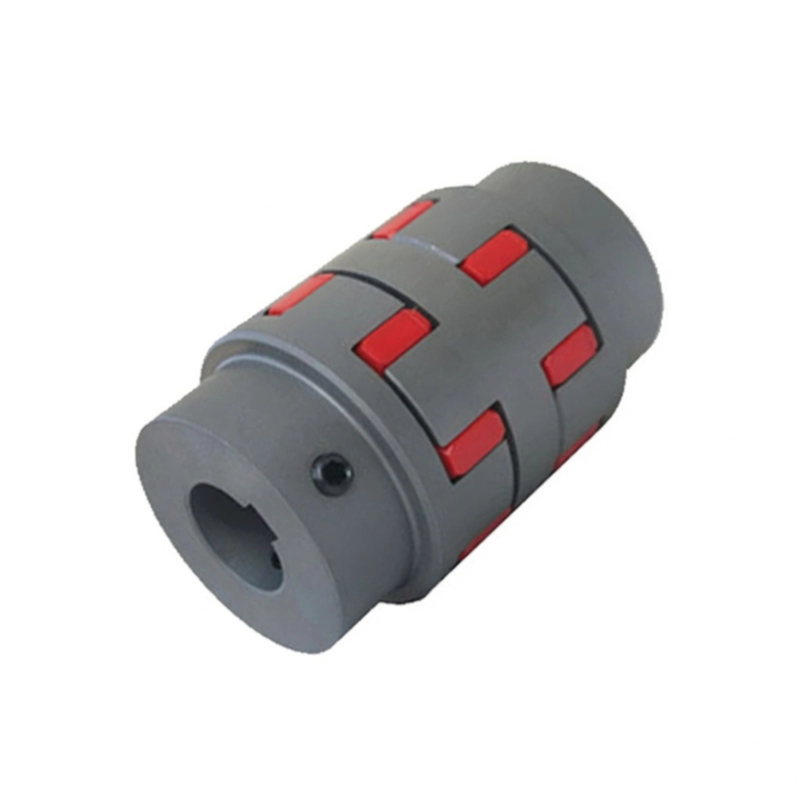
S Type Dual Elastomer Flexible Jaw Coupling
The S Type Dual Elastomer Flexible Jaw Coupling uses a three-piece double-elastomer structure to compensate for large installation misalignment, damp vibration, and reduce noise. Torque range 10–2,400 N·m, bore up to Ø100 mm, angular compensation up to 1.5°. Ideal for drives where shaft alignment cannot be precisely maintained.
MOQ: 50 pcs. Minimum order value USD 1,500; mixed orders and trial quantities welcome.
S Type Dual Elastomer Flexible Jaw Coupling
Three-piece double-elastomer design for superior misalignment compensation and vibration damping — where standard single-spider couplings fall short.
When Single-Spider Couplings Are Not Enough
In many real-world installations, achieving and maintaining precise shaft alignment is impractical. Thermal growth, structural deflection, foundation settlement, and maintenance reassembly tolerances all contribute to misalignment that exceeds the capacity of standard jaw couplings. The S Type Dual Elastomer Flexible Jaw Coupling addresses this directly.
Its three-piece construction places two independent elastomeric spider elements in series between three hubs. This doubles the misalignment absorption capacity relative to a single-spider design, accommodating radial offsets up to 2.5 mm, angular deviations up to 1.5°, and axial displacements up to 3.4 mm — all simultaneously.
Beyond misalignment, the dual-spider architecture provides substantially improved vibration isolation and acoustic noise reduction. Each spider element acts as an independent damping stage, attenuating torsional oscillations before they can propagate to adjacent machinery and the surrounding structure.
Structural Advantages of the Dual-Spider Design
Double Misalignment Compensation
Two elastomeric elements in series deliver twice the misalignment absorption of a single-spider coupling, reducing bearing and seal loads caused by imperfect shaft alignment during installation or operation.
Low Stress on Adjacent Components
Misalignment-induced stress is shared across two elastomers, significantly reducing the reactive forces imposed on motor bearings, gearbox seals, and pump mechanical seals — extending their service life.
Superior Vibration & Noise Damping
Each elastomer stage attenuates torsional oscillation independently. The cumulative damping effect is significantly greater than a single-spider design, reducing airborne and structure-borne noise in acoustically sensitive environments.
Extended Service Life of Adjacent Parts
By reducing transmitted vibration and misalignment forces, the S Type measurably extends the MTBF of connected bearings, seals, and encoder mounts — particularly valuable in high-cycle production environments.
98 ShA Spider Option
Standard supply is 92 ShA polyurethane. Specifying 98 ShA spiders increases nominal torque capacity by approximately 70%, allowing the same hub assembly to cover a broader torque range without resizing.
Custom Bore to Specification
All three hub bores are machined to customer specification, including keyway profile, tolerance grade, and bore finish. Metric and imperial shaft standards are both supported.
S Type Series — Technical Specifications
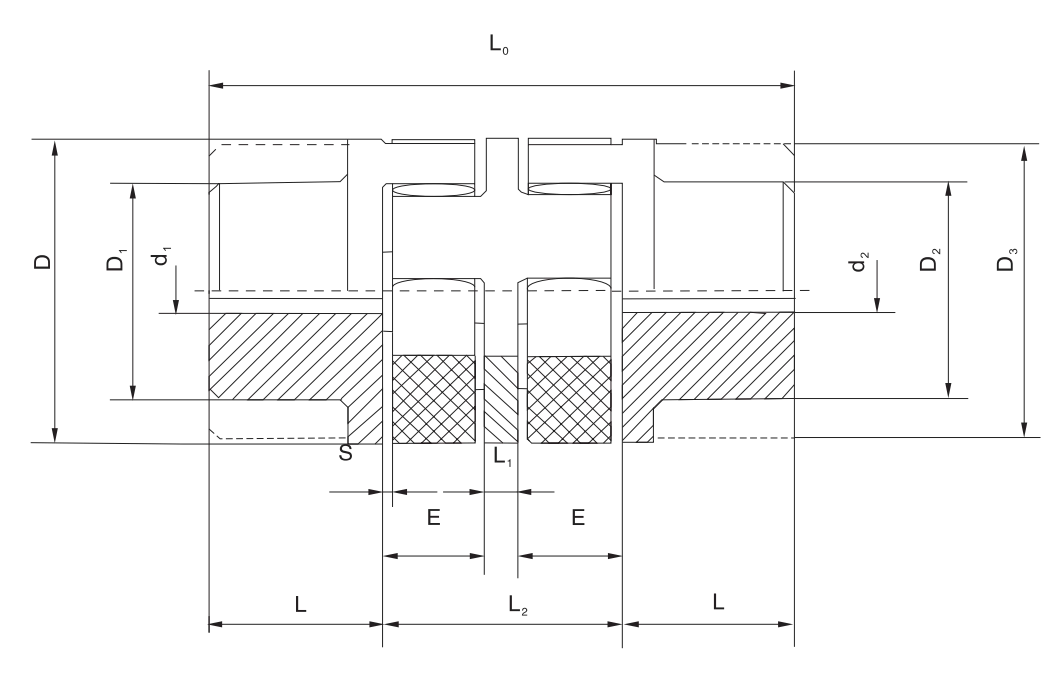
| Model | Nom. Torque (N·m) | Max Speed (rpm) | Bore (mm) | D (mm) | E (mm) | Radial Comp. (mm) | Angular Comp. | Axial Comp. (mm) |
|---|---|---|---|---|---|---|---|---|
| TS19S | 10 | 19000 | 6–25 | 40 | 16 | 0.65 | 1.5° | 1.2 |
| TS24S | 35 | 14000 | 8–35 | 55 | 18 | 0.89 | 1.5° | 1.4 |
| TS28S | 95 | 11800 | 10–40 | 65 | 20 | 1.00 | 1.5° | 1.5 |
| TS38S | 190 | 9500 | 12–48 | 80 | 24 | 1.15 | 1.5° | 1.8 |
| TS42S | 265 | 8000 | 14–55 | 95 | 26 | 1.26 | 1.5° | 2.0 |
| TS48S | 310 | 7100 | 15–60 | 105 | 28 | 1.36 | 1.5° | 2.1 |
| TS55S | 410 | 6300 | 20–70 | 120 | 30 | 1.52 | 1.5° | 2.1 |
| TS65S | 625 | 5600 | 22–75 | 135 | 35 | 1.75 | 1.5° | 2.6 |
| TS75S | 1280 | 4750 | 30–90 | 160 | 40 | 2.00 | 1.5° | 3.0 |
| TS90S | 2400 | 3750 | 40–100 | 200 | 45 | 2.50 | 1.5° | 3.4 |
Typical Applications
The S Type is specified wherever misalignment exceeds what a single-spider coupling can handle, or where vibration isolation is a primary engineering requirement. Visit our full couplings range for flanged and brake-integrated variants suitable for complementary applications.
Diesel Generator Sets
Generator sets mounted on flexible anti-vibration mounts experience continuous relative movement between engine and alternator. The S Type's dual damping stages isolate torsional pulses from the alternator windings and reduce structure-borne noise into the generator enclosure.
Pump Sets on Non-Rigid Bases
Portable pump sets, barge-mounted pumps, and skid-mounted process pumps are subject to base flexure and thermal misalignment. The S Type maintains reliable torque transmission without imposing damaging radial loads on pump shaft seals.
Mixer & Agitator Drives
Agitators in chemical and food processing vessels impose radial reaction loads on the drive shaft. The S Type absorbs these loads within the coupling, protecting the motor gearbox output shaft from fatigue and fretting at the keyway.
Marine & Offshore Auxiliaries
Vessel hull flexure and machinery mounting on resilient mounts creates continuous dynamic misalignment. The S Type's high compensation capacity and progressive damping make it suitable for marine auxiliary drives including bilge pumps, cooling water pumps, and cargo handling auxiliaries.
Customer Reviews & Case Studies
🇦🇺 Australia — Power Generation
A remote outback diesel power station in the Northern Territory replaced rigid couplings on four 500 kVA generator sets with TS65S units. Alternator bearing replacement intervals extended from 8 months to over 24 months, and generator enclosure noise levels dropped by a measured 4 dB(A), improving conditions for on-site maintenance personnel.
★★★★★
"Bearing life tripled and the genset room is noticeably quieter. Real difference."
🇳🇱 Netherlands — Marine & Offshore
A Rotterdam-based offshore vessel operator standardised TS48S couplings on bilge and ballast pump drives across a fleet of seven anchor handlers. The dual-spider design tolerated the continuous hull flexure and machinery movement that had previously caused rapid single-spider failure. Fleet-wide coupling MTBF improved from 11 months to beyond 36 months.
★★★★★
"Solved a persistent problem across our whole fleet in one product change."
🇫🇷 France — Food & Beverage Processing
A dairy processing plant near Lyon specified TS38S couplings on stainless-steel agitator drives in cheese vat rooms. The hygienic operating environment required zero-lubrication couplings; the polyurethane spider satisfied food-safe indirect contact requirements. Mechanical seal life on the agitator shafts improved by 60% after installation.
★★★★☆
"Seal replacement went from quarterly to annual. Worth every cent."
🇿🇦 South Africa — Mining Pumping
A gold mine dewatering station in Gauteng Province fitted TS90S couplings to four 630 kW vertical turbine pump drives. After fitting the S Type, bearing wear rates normalised and pump motor current draw reduced by 2–3%, indicating reduced misalignment loading on connected components.
★★★★★
"Current draw reduction was unexpected — clear sign the shafts are now properly decoupled."
Frequently Asked Questions
For applications requiring flange connection to heavy machinery, the F Type Flanged Flexible Jaw Coupling provides the same elastomeric performance with direct bolted flange interfaces suited to industrial gearboxes and motor bell housings.
Need an S Type Coupling for a Misalignment-Critical Application?
GBC supplies S Type dual-elastomer jaw couplings to engineering contractors, OEM builders, and industrial maintenance teams across Australia and internationally. Provide your shaft sizes, torque requirement, and misalignment data — our technical team responds within one business day.
The S Type Dual Elastomer Flexible Jaw Coupling uses a three-piece double-elastomer structure to compensate for large installation misalignment, damp vibration, and reduce noise. Torque range 10–2,400 N·m, bore up to Ø100 mm, angular compensation up to 1.5°. Ideal for drives where shaft alignment cannot be precisely maintained.
MOQ: 50 pcs. Minimum order value USD 1,500; mixed orders and trial quantities welcome.
Related products
-
LMZ-I Type Plum Blossom Coupling with Split Brake Wheel
-
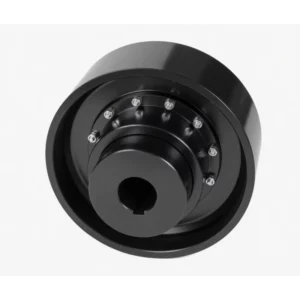
NGCLZ Drum Shape Gear Coupling with Brake Drum | Intermediate Shaft Type
-
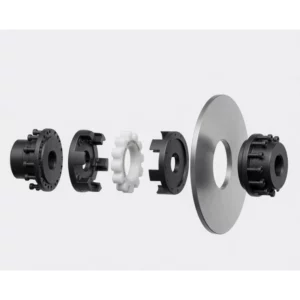
MLP Type Plum Blossom Coupling with Brake Disc
-
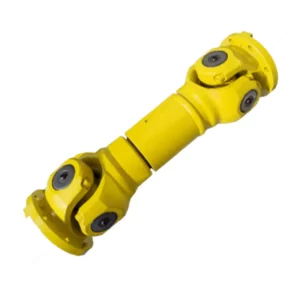
SWP-G Super Short Flexible Universal Joint Couplings
-
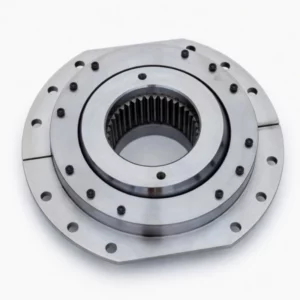
DC Drum Series Crowned Gear Coupling
-
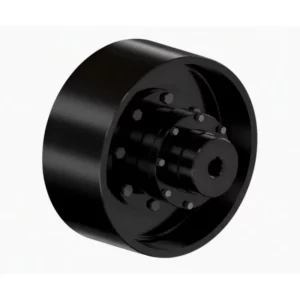
WGZ Drum Shape Gear Coupling with Brake Drum