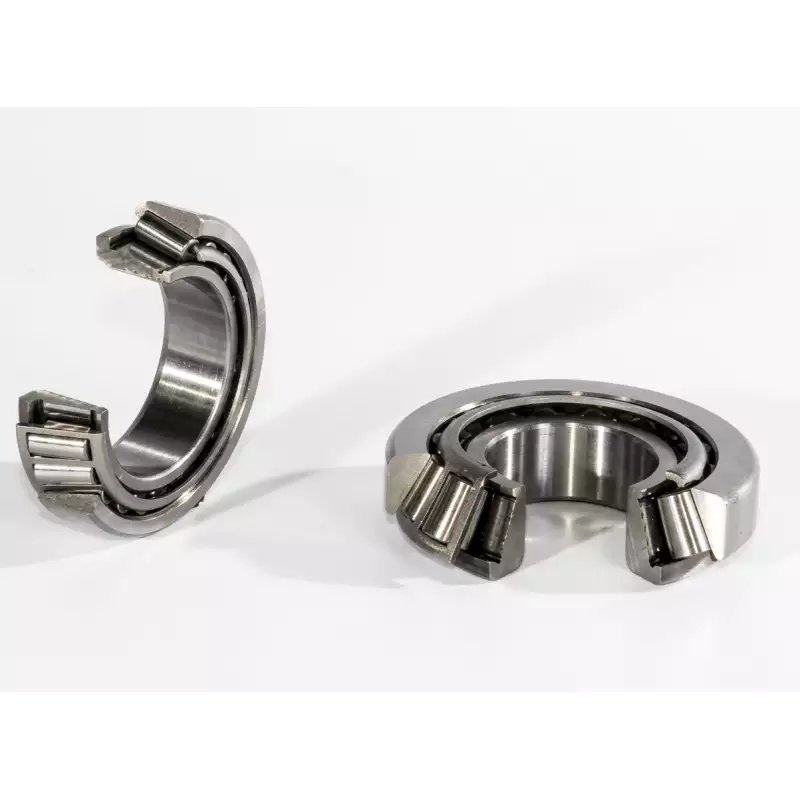
Tapered Roller Bearings

Inch series · Metric series · SET series · Single row & paired configurations · Combined radial and axial load capacity · Bore 10–220 mm

3
Series Groups
Inch & mm
Bore Standards
220 mm
Max. Bore
Combined
Radial & Axial Load
Bearings › Tapered Roller Bearings
Select by: 🌠 Inch Series ⚙ Metric Series 🔄 SET Series (Paired) ▲ Light Duty ★ Heavy Duty 🚗 Automotive

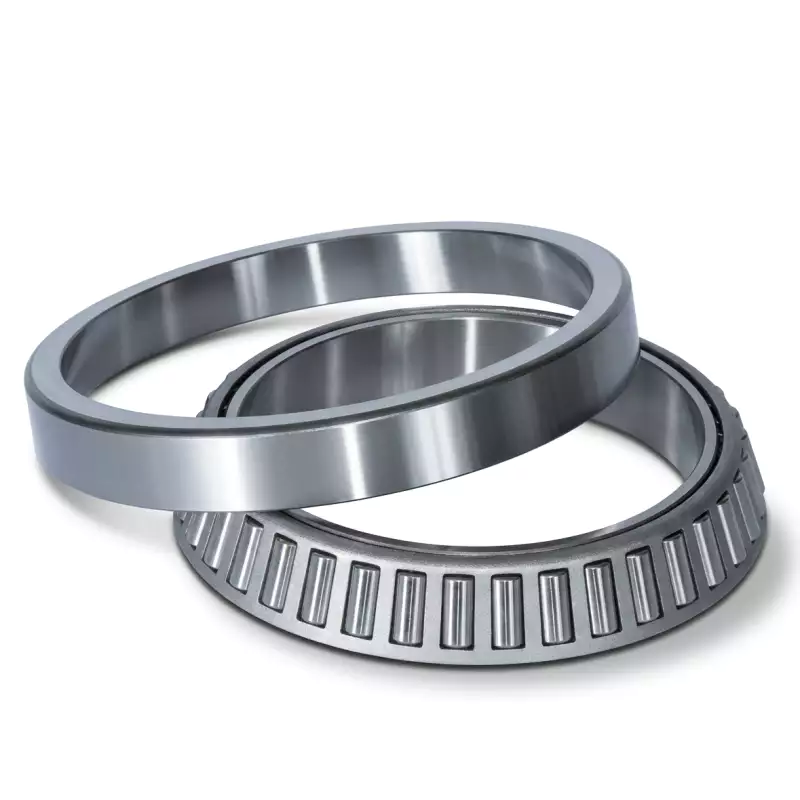
Tapered roller bearings consist of an inner ring (cone) with tapered raceways, tapered rollers, a cage, and an outer ring (cup). The tapered geometry means both radial and axial (thrust) loads are resolved along the bearing axis, allowing the bearing to carry combined radial and thrust loads simultaneously — a capability that deep groove ball bearings cannot match at equivalent bore sizes. Single-row tapered roller bearings are typically mounted in opposed pairs (face-to-face or back-to-back) to provide bidirectional axial load capacity. The cone and cup are supplied and catalogued separately in the inch series, and as a matched assembly in the metric series.

1. Inch Series Tapered Roller Bearings

The inch series follows ABMA/ANSI dimensional standards with bore sizes expressed in inch fractions. Cone and cup are catalogued separately — the cone (inner ring assembly) and cup (outer ring) are interchangeable between manufacturers to the same designation. LM, HM, L, JLM/JL, JM/M prefix series cover light automotive through heavy industrial bore ranges. BT, NP, TR, and U-SET series cover automotive, truck, and specialist applications. Inch tapered roller bearings are the standard in North American and British agricultural equipment, off-highway machinery, and heavy transport axle assemblies.
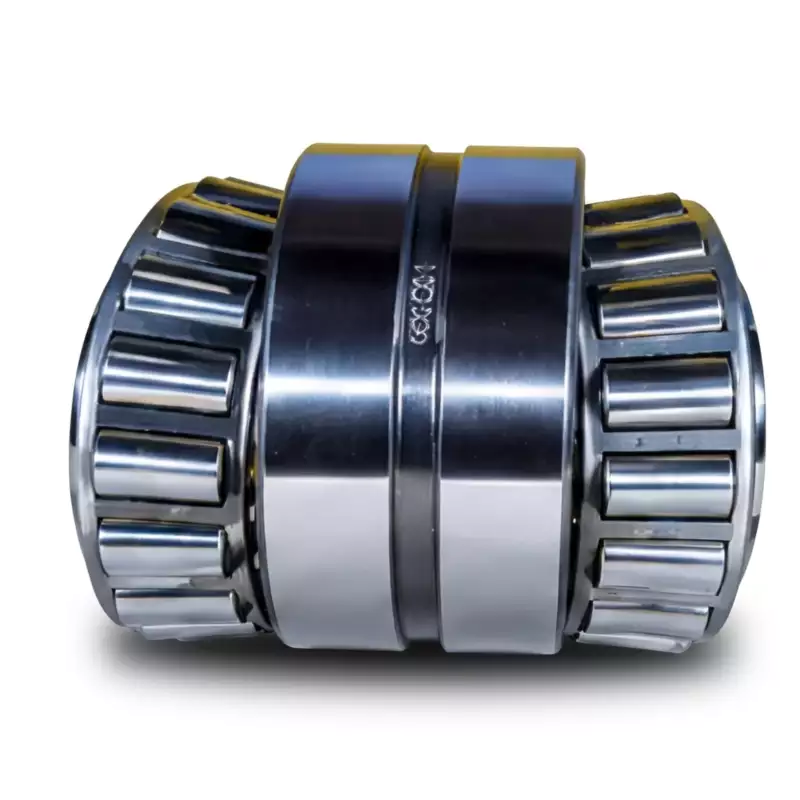
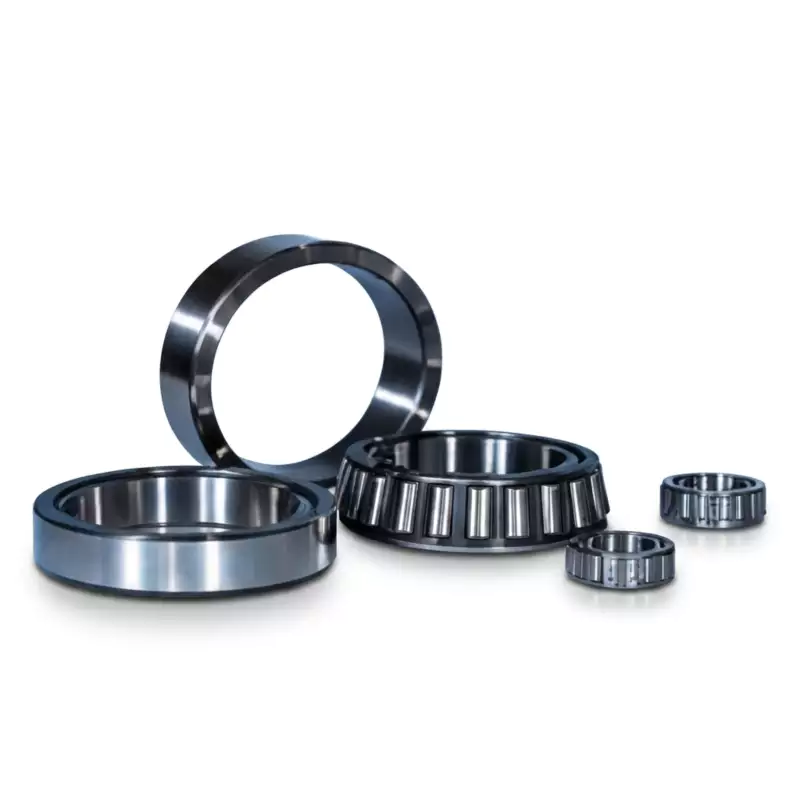
LM Series Tapered Roller Bearings
Inch — LM Series

LM Series Tapered Roller Bearings

LM Series · Single Row

LM11949~LM961548 · 17–280 mm bore

Light to medium duty inch range · Most widely used inch tapered roller series · Cone and cup supplied separately

Inch Series Tapered Roller Bearings — Single Row
Inch — Single Row

Inch Series Tapered Roller Bearings — Single Row

General Inch Series · Single Row

15–210 mm bore

Full inch single-row range · ABMA/ANSI dimensions · Cone and cup interchangeable between compliant manufacturers

HM Series — HM803 / HM804 / HM807 / HM813 / HM88 / HM89
Inch — HM Series

HM Series — HM803 / HM804 / HM807 / HM813 / HM88 / HM89

HM Series · Single Row

HM803 / HM804 / HM807 / HM813 / HM88 / HM89

Agricultural and off-highway vehicle hub and axle bearings · Heavy radial and thrust load capacity

HM212 / HM218 / HM220 / HM516 / HM518 Series
Inch — HM Series

HM212 / HM218 / HM220 / HM516 / HM518 Series

HM212 / HM218 / HM220 / HM516 / HM518

Bore 60–90 mm range

Medium to heavy duty inch tapered roller · Common in truck hub, trailer axle, and construction equipment positions

L Series — L44643 / L521949 / L540049 / LL225749
Inch — L Series

L Series — L44643 / L521949 / L540049 / LL225749

L / LL Series · Single Row

L44643 / L521949 / L540049 / LL225749

Automotive wheel hub and trailer axle applications · LL prefix = longer roller contact for higher load capacity

JLM / JL Series — JLM104948 / JL819349
Inch — JLM / JL Series

JLM / JL Series — JLM104948 / JL819349

JLM / JL Series · Single Row

JLM104948 / JL819349 and more

J-prefix = wider cone face for increased roller contact length · Higher radial load capacity than equivalent L series bore

JM / M Series — Inch, Heavy Duty
Inch — JM / M Series

JM / M Series — Inch, Heavy Duty

JM / M Series · Heavy Duty

M / JM designations · Large bore

Large bore heavy-duty inch series · Mining, construction, and heavy industrial gearbox shaft applications

BT / NP / TR / U-SET Series — Automotive and Specialist
Inch — Automotive / SET

BT / NP / TR / U-SET Series — Automotive and Specialist

BT / NP / TR / U-SET · Specialist

Automotive, truck, and SET paired configurations

BT = bearing technology series · NP = NTN-Precision · TR = Timken · U-SET = matched pre-adjusted cone+cup pairs for axle assembly

2. Metric Series Tapered Roller Bearings

The metric series follows ISO 355 and DIN 720 dimensional standards with bore sizes in millimetres. Cone and cup are supplied as a matched assembly under one part number. The 302xx, 303xx, 313xx, 320xx, 322xx, 323xx, and 330xx series cover progressively heavier duty ratings at the same bore size: the first two digits (30, 31, 32, 33) denote the series, and higher numbers indicate a wider cross-section and higher load capacity. Metric tapered roller bearings are the standard in European and Asian industrial gearboxes, agricultural machinery, and construction equipment.
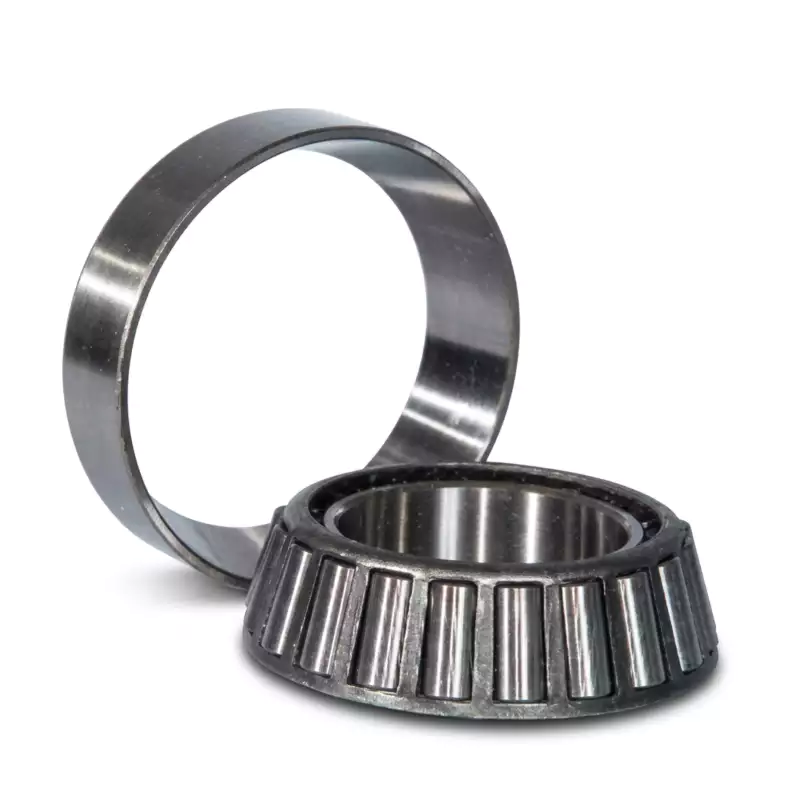
30200 Series — Metric, Light Duty
Metric — 30200

30200 Series — Metric, Light Duty

30200 Series · Light Duty

30202–30228 · 15–140 mm bore

Lightest duty metric tapered roller series · Compact cross-section · Gearbox input shafts, light agricultural drives

30300 Series — Metric, 15–100mm Bore
Metric — 30300

30300 Series — Metric, 15–100mm Bore

30300 Series · Standard Duty

30302–30320 · 15–100 mm bore

Wider cross-section than 30200 at same bore · Higher radial and axial load capacity · Standard industrial gearbox series

31300 Series — Metric, Higher Load at Same Envelope as 30300
Metric — 31300

31300 Series — Metric, Higher Load at Same Envelope as 30300

31300 Series · Enhanced Duty

31305–31320 · 25–100 mm bore

Same OD envelope as 30300 · Steeper contact angle delivers higher axial (thrust) load rating · Where thrust load exceeds 30300 capacity

32000X Series — Metric, 20–180mm Bore
Metric — 32000X

32000X Series — Metric, 20–180mm Bore

32000X Series · Standard Duty

32004X–32036X · 20–180 mm bore

X suffix = metric series with non-standard contact angle · Wide bore range for gearbox and general industrial applications

32200 Series — Metric, Wide Inner Ring, 20–220mm Bore
Metric — 32200

32200 Series — Metric, Wide Inner Ring, 20–220mm Bore

32200 Series · Wide Inner Ring

32204–32244 · 20–220 mm bore

Widest bore range in the metric series · Higher load capacity than 30200 at equivalent bore · Industrial gearboxes and rolling mill applications

32300 Series — Metric, Heavy Duty, 20–170mm Bore
Metric — Heavy Duty

32300 Series — Metric, Heavy Duty, 20–170mm Bore

32300 Series · Heavy Duty

32304–32334 · 20–170 mm bore

Heavy-duty metric series · Widest cross-section in 32xxx family · Mining, cement, and heavy industrial gearbox applications

33000 Series — Metric, High Combined Load Capacity
Metric — High Combined Load

33000 Series — Metric, High Combined Load Capacity

33000 Series · High Combined Load

33005–33022 · 25–110 mm bore

Steepest contact angle in standard metric series · Maximises axial load fraction of total load capacity · For high thrust + radial combined load positions

3. SET Series — Pre-Matched Paired Assemblies

SET series tapered roller bearings are factory-matched cone and cup pairs supplied as a single assembly with a pre-set internal clearance or preload. Where standard single-row tapered roller bearings require the installer to set axial play by adjusting the lock nut at assembly, a SET bearing is ready to install without adjustment — the correct internal clearance is guaranteed by the matched pair.

U-SET and similar pre-adjusted assemblies are common in automotive front wheel hub positions, truck steering knuckle bearings, and any application where consistent bearing preload is critical to service life and where assembly-line setting of axial play is not practical.

  • No axial clearance adjustment required at installation
  • Factory-guaranteed internal clearance or preload
  • Interchangeable within the same SET designation
  • Common in automotive wheel hub, steering, and transmission shaft applications
  • Available in face-to-face (DF) and back-to-back (DB) configurations
View BT / NP / TR / U-SET Series →
SET series paired tapered roller bearing assembly automotive wheel hub

Series Selection Matrix

Identify the correct series by standard, duty rating, and bore range. Higher series numbers within the same prefix indicate wider cross-section and higher load capacity at the same bore.

Series Standard Duty Bore Range Key Application / Feature
LM SeriesInch (ABMA)Light–Medium17–280 mmMost common inch series · Automotive to light industrial
Inch Single RowInch (ABMA)Light–Medium15–210 mmGeneral inch catalogue range · Cone and cup supplied separately
HM803/804/807/813Inch (ABMA)Medium40–65 mmAgricultural and off-highway vehicle hub and axle
HM212/218/220/516/518Inch (ABMA)Medium–Heavy60–90 mmTruck hub, trailer axle, construction equipment
L / LL SeriesInch (ABMA)Light25–150 mmAutomotive wheel hub · LL = longer contact, higher load
JLM / JL SeriesInch (ABMA)Medium50–130 mmJ prefix = wider cone face · Higher radial load than L series
JM / M SeriesInch (ABMA)Heavy60–300 mmMining, construction, industrial gearbox · Large bore heavy duty
BT / NP / TR / U-SETInch & SETAutomotiveVariousFactory-matched SET pairs · No axial adjustment at installation
30200 SeriesMetric (ISO)Light15–140 mmLightest metric series · Gearbox input shafts, light drives
30300 SeriesMetric (ISO)Standard15–100 mmWider than 30200 at same bore · General industrial gearboxes
31300 SeriesMetric (ISO)Standard–Enhanced25–100 mmSame OD as 30300 · Steeper contact angle · Higher axial capacity
32000X SeriesMetric (ISO)Standard20–180 mmWide bore range · Non-standard contact angle (X suffix)
32200 SeriesMetric (ISO)Medium–Heavy20–220 mmWidest metric bore range · Industrial gearboxes and rolling mills
32300 SeriesMetric (ISO)Heavy20–170 mmWidest cross-section in 32xxx · Mining, cement, heavy gearboxes
33000 SeriesMetric (ISO)High Combined Load25–110 mmSteepest contact angle · Maximum axial fraction of combined load

Frequently Asked Questions

▶ What loads can tapered roller bearings carry that deep groove ball bearings cannot?

Tapered roller bearings carry combined radial and axial (thrust) loads simultaneously, with the axial load fraction determined by the contact angle — a steeper contact angle (as in the 33000 series) carries a higher proportion of axial load. Deep groove ball bearings can carry moderate axial loads, but their capacity is a small fraction of their radial rating. For shaft positions where significant thrust loads exist alongside radial loads — helical gearbox shafts, wheel hubs, agricultural implement drives, and mining conveyor head pulleys — tapered roller bearings are the standard solution.

▶ What is the difference between inch series and metric series tapered roller bearings?

Inch series (LM, HM, L, JLM, JM, BT, TR, NP, U-SET) follow ABMA/ANSI standards with dimensions derived from inch fractions. The cone and cup are catalogued and supplied separately, and are interchangeable between manufacturers to the same designation. Metric series (30200, 30300, 31300, 32000X, 32200, 32300, 33000) follow ISO 355 and DIN 720 standards with bore sizes in millimetres. Cone and cup are supplied as a matched assembly. Inch series are the standard in North American and British agricultural, automotive, and off-highway equipment; metric series are the standard in European and Asian industrial machinery.

▶ How do I select between 30200, 30300, 32200, and 32300 metric series at the same bore size?

These series represent progressively heavier cross-sections at the same bore: 30200 is the lightest (narrowest width, lowest load rating); 30300 is wider and carries higher radial and axial loads; 32200 is wider again with the highest bore range in the 32xxx family; 32300 is the heaviest standard metric series at the same bore, suited to mining and cement applications. 31300 occupies the same outer diameter envelope as 30300 but uses a steeper contact angle to increase the axial load fraction. 33000 has the steepest contact angle in the standard metric range, maximising axial load capacity for high-thrust combined load positions. When in doubt, calculate L10 bearing life for the actual radial and axial load combination and select the lightest series that meets your service life target.

▶ What is a SET bearing and when should I use it instead of a standard single-row tapered roller bearing?

A SET bearing (such as U-SET, BT series, or similar) is a factory-matched cone and cup pair with a pre-set internal clearance or preload. Standard single-row tapered roller bearings require the installer to set axial play by adjusting a lock nut during assembly — incorrect setting causes premature failure from either excess preload (overheating, fatigue) or excess play (impact load on rollers). A SET bearing eliminates this adjustment: the internal clearance is guaranteed by the matched pair and the bearing is installed without further setting. Use SET bearings in automotive wheel hub and steering knuckle positions, high-speed shaft assemblies, and any application where consistent preload is critical and assembly-line setting of axial play is impractical.

▶ Can I mix cone and cup from different manufacturers in inch series bearings?

Yes, within the same designation. Inch series tapered roller bearing cones and cups are manufactured to ABMA/ANSI dimensional tolerances that allow interchange between compliant manufacturers for the same designation (e.g., LM11949 cone from any compliant manufacturer fits with an LM11910 cup from any compliant manufacturer). In practice, mixing manufacturers within the same assembly is acceptable for standard applications, but for precision or high-speed applications, matched sets from a single manufacturer are recommended to ensure that roller geometry and raceway profiles are optimised together.

▶ What is the difference between face-to-face (DF) and back-to-back (DB) paired mounting?

In face-to-face (DF) mounting, the two bearing cones point toward each other. The effective load centres are closer together than the bearing span, making the arrangement more tolerant of shaft deflection and misalignment. It provides bidirectional axial load capacity with the load being reacted at the inner rings. In back-to-back (DB) mounting, the two bearing cups point toward each other. The effective load centres are further apart than the bearing span, giving higher moment stiffness and resistance to shaft deflection. DB mounting is preferred for shafts with significant bending moments (cantilevered loads, overhanging gears) where shaft stiffness is the priority. DF mounting is preferred where shaft misalignment is expected or where the mounting system is less rigid.

Ready to Order?

Provide bore diameter, series designation or load requirements (radial and axial), shaft speed, and quantity. For inch series, specify cone and cup designations separately. New-client samples available at sample pricing. Multi-model orders from USD 1,500 accepted. Engineering drawings required before order confirmation — catalogue dimensions for reference only.