
Cylindrical Roller Bearings

Single row & double row · NU, NJ, NUP, N, NF cage types · E-design enhanced capacity · Light and heavy duty series · Bore 17–200 mm

5
Cage Types
High
Radial Load Capacity
200 mm
Max. Bore
Bearings › Cylindrical Roller Bearings
Select by: ◯ NU — Free Outer Ring ▶ NJ — One Flange Outer ▲ NUP — Two-Flange Outer ■ N & NF — Flanged Inner ▭ Double Row 2200 / 2300

Cylindrical roller bearings use line contact between rollers and raceways rather than the point contact of ball bearings, giving them significantly higher radial load capacity and rigidity at the same bore size. The rollers are guided by flanges on the inner or outer ring — the flange arrangement determines which cage type is appropriate and whether the bearing can accommodate axial displacement of the shaft relative to the housing. The E-design suffix indicates an optimised internal geometry with a larger roller complement and improved cage design, delivering higher dynamic load ratings than the equivalent standard design at the same envelope dimensions.

Double row cylindrical roller bearings (N2200EM, N2300EM) place two rows of rollers side by side in a single housing, providing radial load capacity roughly double that of a single row bearing at the same bore — without increasing the shaft span between bearing positions.

Cage Type Guide — NU, NJ, NUP, N, NF

Prefix Flange Location Axial Displacement Axial Load Typical Use
NU Two flanges on inner ring Outer ring free to move axially in both directions Radial only Most common · Floating bearing position · Accommodates thermal shaft expansion
NJ One flange on outer ring, two on inner One direction axial displacement only Limited one direction Gearbox shaft · Where one-directional axial location is required
NUP Two flanges on outer ring, two on inner No axial displacement Both directions (limited) Fixed bearing position · Locates shaft axially in both directions
N Two flanges on outer ring Inner ring free to move axially in both directions Radial only Floating · Outer ring fixed in housing · Inner ring free on shaft
NF One flange on outer, none on inner One direction only Limited one direction Where outer ring locates shaft axially in one direction

E suffix = enhanced internal geometry (larger roller complement, optimised cage) · Higher dynamic load rating at same envelope · M suffix = brass cage

Single Row Cylindrical Roller Bearings

Single row cylindrical roller bearings provide the highest radial load capacity of any single-row rolling element bearing at a given bore size. The 200E series covers the light-to-medium duty range; the 300E series covers the heavier duty range with a wider cross-section at the same bore. Both series carry the E-design suffix, indicating an enhanced internal geometry with a larger roller complement for higher dynamic load ratings compared to the standard design at the same envelope.
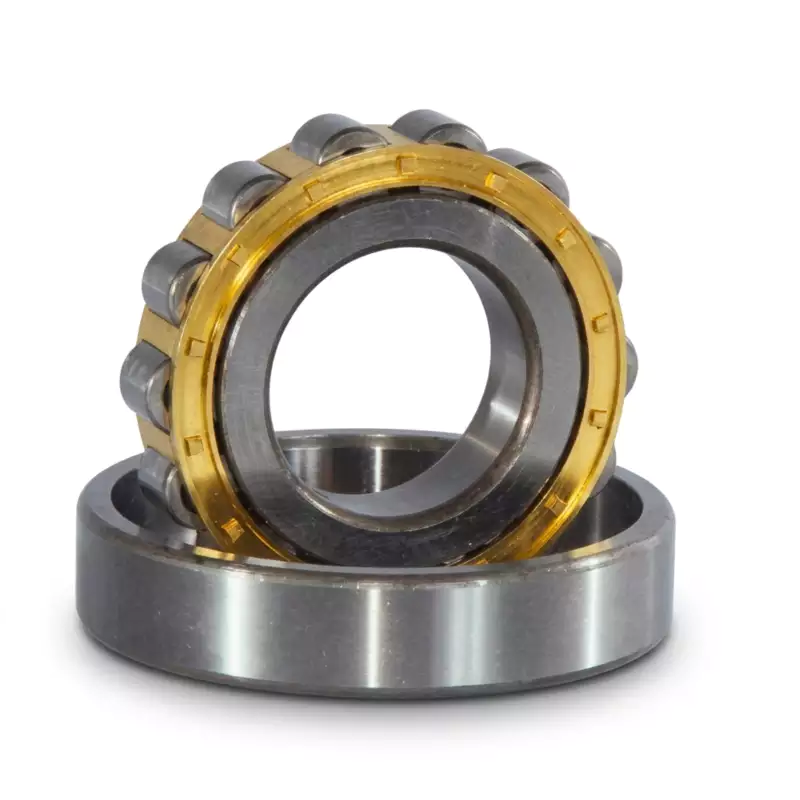
NU NJ NUP 200E series single row cylindrical roller bearings 17-140mm bore
Single Row — 200E Series

NU / NJ / NUP 200E Series

Light–Medium Duty · Single Row

NU2204E–NU2228E · 17–140 mm bore

E-design enhanced capacity · NU (free outer), NJ (one-flange outer), NUP (fixed position) types · Electric motor rotor shafts, gearbox shafts, machine tool spindle supports

N NF NU NJ NUP 300E series single row cylindrical roller bearings
Single Row — 300E Series

N / NF / NU / NJ / NUP 300E Series

Medium–Heavy Duty · Single Row

NU2304E–NU2330E · 20–150 mm bore

Wider cross-section than 200E at same bore · Higher radial load capacity · Full cage type range: N, NF, NU, NJ, NUP · Heavy gearboxes, industrial drives, rolling mill auxiliary shafts

Double Row Cylindrical Roller Bearings

Double row cylindrical roller bearings place two rows of rollers side by side in a single outer ring, delivering approximately double the radial load capacity of a single row bearing at the same bore without increasing the shaft span between bearing positions. The EM suffix combines the E-design enhanced roller complement with an M-series brass cage for high-speed and high-load combined service. 2200EM and 2300EM series parallel the 200E and 300E load tiers in the double-row format.
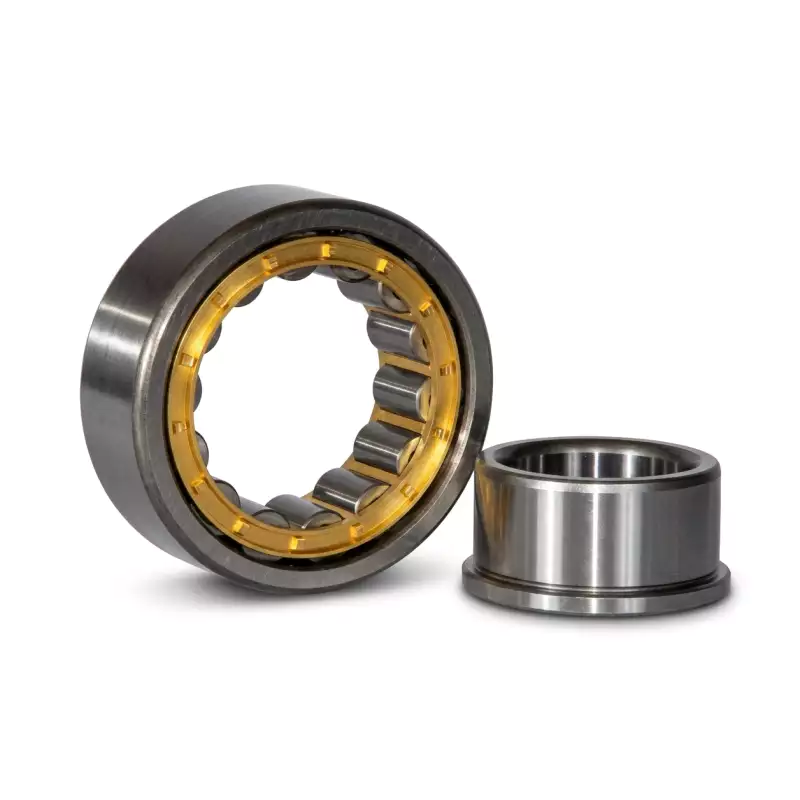
N2200EM series double row cylindrical roller bearings wide high radial load
Double Row — 2200EM

N2200EM Series

Double Row · Light–Medium Duty

N2204EM–N2228EM · 20–140 mm bore

Two rows of rollers · EM = E-design + brass cage · Approximately 2× single row radial load capacity · Compact axial footprint · Gearbox output shafts, heavy conveyor drives, rolling mill work roll necks

N2300EM series wide double row cylindrical roller bearings high radial load
Double Row — 2300EM

N2300EM Series

Double Row · Heavy Duty

N2304EM–N2330EM · 20–150 mm bore

Wide series double row · Highest radial capacity in the standard CRB range · Mining conveyor drives, cement mill pinion shafts, heavy press and rolling mill applications

Series Comparison

At the same bore, 300E series provides higher radial load than 200E due to wider cross-section. Double row EM series provides approximately twice the radial load of the equivalent single row at the same bore.

Series Rows Cross-Section Bore Range Cage Types Key Application
200E (NU/NJ/NUP) Single Light–Medium 17–140 mm NU, NJ, NUP Electric motors, light gearboxes, machine tools
300E (N/NF/NU/NJ/NUP) Single Medium–Heavy 20–150 mm N, NF, NU, NJ, NUP Heavy gearboxes, industrial drives, rolling mills
N2200EM Double Light–Medium 20–140 mm N (double row) ~2× single row radial load · Compact span · Gearbox output shafts
N2300EM Double Heavy 20–150 mm N (double row) Highest CRB radial capacity · Mining, cement, rolling mills

Frequently Asked Questions

▶ What is the difference between NU, NJ, NUP, N, and NF type cylindrical roller bearings?

The prefix describes where the guiding flanges are located, which determines axial displacement behaviour. NU has two flanges on the inner ring and none on the outer: the outer ring can move freely in both axial directions, making NU the standard floating bearing type for accommodating thermal shaft expansion. NJ has one flange on the outer ring and two on the inner: the shaft can move axially in one direction only. NUP has two flanges on both inner and outer rings, locating the shaft axially in both directions — it is used as a fixed bearing position. N has two flanges on the outer ring and none on the inner: the inner ring (and shaft) can move freely in both axial directions. NF has one flange on the outer ring and none on the inner, providing one-directional axial location from the outer ring side.

▶ What does the E suffix mean in cylindrical roller bearings?

E denotes the enhanced internal design (also called E-design or optimised design). Compared to the standard design at the same bore and OD, the E-design bearing has a larger roller complement (more rollers and/or longer rollers), an optimised cage design that allows larger rollers, and improved contact geometry between rollers and raceways. The result is a significantly higher dynamic load rating (C) and static load rating (C0) within the same dimensional envelope as the standard design. E-design bearings are directly interchangeable with standard design bearings of the same designation in terms of fit dimensions; the internal geometry improvement is invisible from the outside.

▶ Can cylindrical roller bearings carry axial loads?

Standard cylindrical roller bearings (NU, N type) are designed for radial loads only and cannot carry axial loads — the rollers and raceways have no axial guidance geometry. NJ and NUP types can carry limited axial loads in one direction (NJ) or both directions (NUP) through roller contact with the guide flanges, but the axial load capacity is typically less than 10–15% of the radial load capacity. For applications requiring significant combined radial and axial load capacity, tapered roller bearings or angular contact ball bearings are the correct choice.

▶ What does the M suffix mean in N2200EM and N2300EM?

M denotes a brass (machined) cage. Standard cylindrical roller bearings often use pressed steel or polyamide cages. A brass cage provides better performance at high speeds and high temperatures than pressed steel, and better resistance to lubricant degradation and centrifugal loading than polyamide. The EM suffix therefore combines the E-design enhanced roller complement with a brass cage, making the N2200EM and N2300EM double row bearings suitable for demanding service conditions including high speeds, elevated temperatures, and heavy continuous loads.

▶ When should I choose a double row cylindrical roller bearing instead of two single row bearings?

A double row cylindrical roller bearing (N2200EM, N2300EM) provides approximately twice the radial load capacity of a single row bearing at the same bore, in a single housing that occupies a shorter axial shaft span than two separate single row bearings. Choose double row when radial loads are too high for a single row bearing but the axial space between bearing positions is constrained and the shaft span cannot be increased. Choose two separate single row bearings when more flexibility in bearing spacing is available, when differential thermal expansion between inner and outer rings must be accommodated by a floating arrangement, or when different cage types are required at the two positions.

▶ What is the difference between 200E and 300E series at the same bore size?

The 200E and 300E series share the same bore diameter at the same designator (e.g., NU2208E and NU2308E both have 40 mm bore) but the 300E has a larger OD and wider width, providing a heavier cross-section with more and/or larger rollers. The 300E dynamic load rating (C) is significantly higher than the 200E at the same bore. Select 200E when the housing envelope limits the OD or when the 200E load rating is adequate for the L10 life target. Select 300E when radial loads are higher and the larger OD can be accommodated in the housing design.

Ready to Order?

Provide bearing designation (e.g., NU2208E), bore diameter, cage type (NU / NJ / NUP / N / NF), single or double row, and quantity. Radial load and speed data welcome for L10 life calculation. New-client samples available. Multi-model orders from USD 1,500 accepted. Engineering drawings required before order confirmation.