
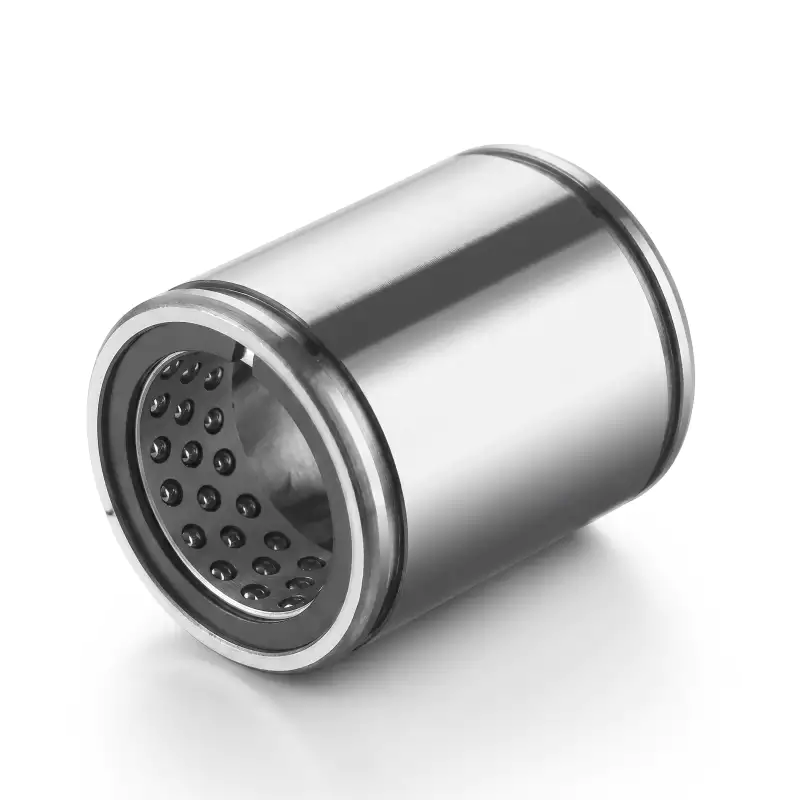
ST B Series — Stroke Bearing Heavy Duty Type Linear and Rotary Motion
ST…B — 13 bore sizes · 6-row ball circuit · Higher load ratings for demanding combined-motion applications.
MOQ: 50 pcs. Minimum order value USD 1,500; mixed orders and trial quantities welcome.
Linear Bearings › Special Series
ST B Series — Stroke Bearing Heavy Duty Type Linear and Rotary Motion
13 bore sizes · 6-row ball circuit · Higher load ratings for demanding combined-motion applications
🆕 Series Overview
The ST...B heavy duty stroke bearing series doubles the ball row count from three (standard ST) to six, approximately doubling both dynamic and static load ratings for the same bore size. The B designation indicates the heavy-duty configuration — all other characteristics, including combined linear and rotary motion capability, shaft specification, and operating temperature range, are identical to the standard ST series.
The ST...B series is specified when load calculations using the standard ST dynamic load rating C produce a service life below the target maintenance interval. The increased ball row count also improves stiffness against moment loads generated by offset loading points — relevant in pick-and-place heads and cam mechanisms where the load application point is displaced from the bearing centreline.
⚙ Key Design Features
6-Row Ball Circuit
Six ball rows versus three in the standard series — approximately doubles dynamic and static load ratings without increasing bore size or shaft diameter.
Combined Motion
Enables simultaneous linear travel along the shaft axis and rotation around the shaft axis — identical capability to the standard ST series but at twice the load capacity.
Nickle-Plated Option
All ST...B models can be supplied with nickel plating for corrosion resistance in humid or mildly aggressive environments.
Defined Maximum Stroke
Each model has a rated maximum stroke listed in the specification table. Motion must be controlled to remain within this limit to prevent ball circuit overrun.
GCr15 Chrome Steel
Through-hardened to HRC 58–64. Both linear and rotary bearing surfaces precision-ground. Phosphate coating standard; nickel plating on request.
13 Bore Sizes
Available from 6 mm to 100 mm bore for heavy-duty combined-motion applications across the full industrial shaft diameter range.
📋 Complete Specification Table
ⓘ Maximum stroke in mm. Dynamic and static load ratings in N (approximately double the standard ST for the same bore). Weight in g. Shaft h6/h7 HRC 60+.
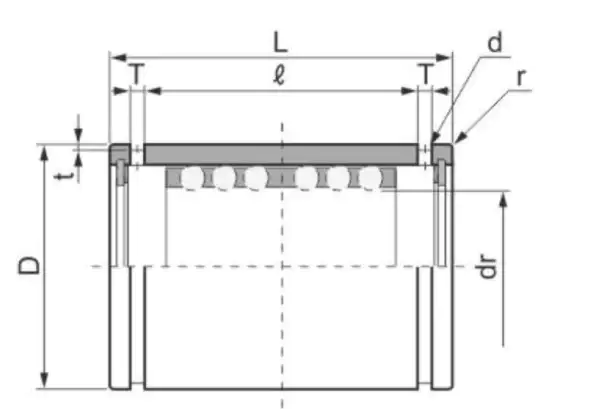
| Model | Max Stroke (mm) | Ball Rows | Shaft dr (mm) | OD D (mm) | Length L (mm) | Dynamic C (N) | Static Co (N) | Weight (g) |
|---|---|---|---|---|---|---|---|---|
| ST 6B | 8 | 6 | 6 | 15 | 24 | 490 | 549 | 16.8 |
| ST 10B | 8 | 6 | 10 | 19 | 30 | 931 | 1030 | 31.2 |
| ST 12B | 8 | 6 | 12 | 24 | 32 | 1630 | 1720 | 46 |
| ST 16B | 16 | 6 | 16 | 26 | 37 | 1910 | 1980 | 75 |
| ST 20B | 20 | 6 | 20 | 32 | 45 | 2060 | 2350 | 106 |
| ST 25B | 20 | 6 | 25 | 37 | 45 | 2170 | 2670 | 125 |
| ST 30B | 44 | 6 | 30 | 45 | 65 | 4800 | 6270 | 220 |
| ST 35B | 54 | 6 | 35 | 52 | 70 | 5050 | 7060 | 346 |
| ST 40B | 66 | 6 | 40 | 60 | 80 | 6710 | 9560 | 540 |
| ST 50B | 66 | 6 | 50 | 72 | 100 | 8970 | 13800 | 862 |
| ST 60B | 88 | 6 | 60 | 85 | 100 | 9700 | 16500 | 1290 |
| ST 80B | 76 | 6 | 80 | 110 | 100 | 12700 | 24300 | 2110 |
| ST 100B | 76 | 6 | 100 | 130 | 100 | 13700 | 29400 | 2520 |
🔭 Materials & Construction
ST...B bearings use the same GCr15 chrome steel (AISI 52100) construction as the standard ST series, through-hardened to HRC 58–64. The six-row ball circuit requires a longer outer race, increasing the bearing weight versus the standard ST for the same bore. The PA66-GF30 retainer maintains ball spacing in all six circuits. Factory NLGI-2 grease fill. Phosphate coating standard; nickel plating available on request for corrosion-resistant applications.
🏭 Typical Applications
Heavy-Duty Cam Mechanisms
High-force cam followers and eccentric drives requiring combined linear and rotary motion use the ST...B series when the standard ST load rating is insufficient for the target life at the application load level.
Industrial Pick-and-Place
Heavy-payload robotic pick-and-place heads requiring simultaneous vertical linear travel and part rotation use the ST...B series for its increased moment-load resistance.
Hydraulic Rotary-Linear Actuators
Hydraulic actuators that combine linear extension with rotary output require high load capacity in the linear bearing element — the ST...B 6-row configuration meets this requirement.
Precision Machine Tools
Combined linear-rotary axes in grinding machine dressing heads and honing tools use ST...B bearings for the load capacity needed to maintain geometric accuracy under cutting forces.
🔧 Installation & Maintenance
🔎 Shaft Specification
Ground to h6/h7 tolerance, HRC 60+ hardness, Ra 0.4 µm. The six ball rows increase the total shaft contact load — shaft hardness is even more critical than in the standard ST series.
🔧 Stroke Limit Compliance
The ST...B maximum stroke is shorter than the standard ST for the same bore due to the longer ball circuit. Check the specification table for the correct stroke limit before programming motion limits.
📈 Re-Lubrication
NLGI-2 grease. Re-lubricate every 300 km of combined linear travel. The higher load capacity of the ST...B series does not extend re-lubrication intervals — the additional ball rows increase grease consumption proportionally.
⚙ Housing Fit
Housing bore H7 tolerance. The larger outer diameter D of the ST...B (compared with standard ST for the same bore) must be reflected in the housing design. Verify against the specification table before machining.
🔎 Selection Guide
Select ST...B when load calculations using the standard ST series result in insufficient service life, or when moment loads from offset loading points require greater stiffness than the 3-row circuit provides. The bore selection process and shaft specification are identical to the standard ST series.
①
Identify Application Type
Confirm combined linear and rotary motion is required. Verify that the standard ST load rating is insufficient before upgrading to ST...B.
②
Select Bore & Model
Match bore to shaft nominal diameter. Note that ST...B maximum stroke is shorter than standard ST — verify against specification table.
③
Verify Load & Life
Calculate L10 using ST...B load rating C and equivalent load P. The ST...B should comfortably exceed the target life with a safety margin of at least 2×.
④
Contact Us
MOQ 100 units. Contact our team with engineering drawings specifying bore, housing, load case, stroke, and target life.
❓ Frequently Asked Questions
📞 Ready to Order?
MOQ is 100 units per model. Provide engineering drawings with bore, housing bore tolerance, load case, stroke, speed, and target service life. All catalogue data is for reference only.
ST…B — 13 bore sizes · 6-row ball circuit · Higher load ratings for demanding combined-motion applications.
MOQ: 50 pcs. Minimum order value USD 1,500; mixed orders and trial quantities welcome.
Related products
-
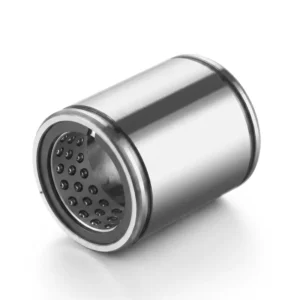
ST Series — Stroke Bearing Standard Type Linear and Rotary Motion
-
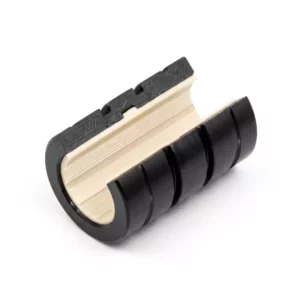
LIN-01RSK Series — Cylindrical Plastic Linear Bearing with Keyway Aluminum Housing
-
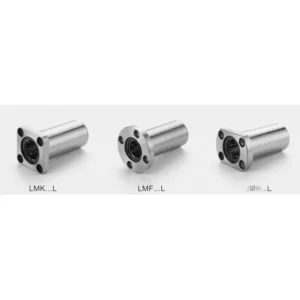
LMF LMK LMH Linear Bearing LUU Series — Standard Flanged Extended Length Ball Bushing
-
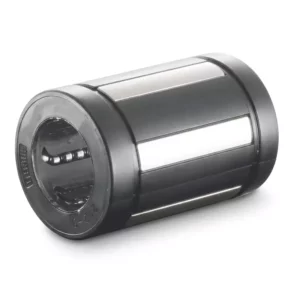
LMES Series — Small Metric Linear Bearing Sealed and Open Type
-
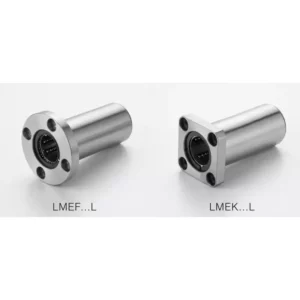
LMEF LMEK Linear Bearing LUU Series — Euro Standard Flanged Extended Length Ball Bushing
-
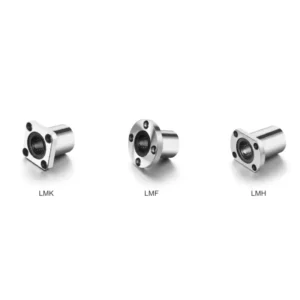
LMF LMK LMH Linear Bearing UU Series — Standard Flanged Sealed Ball Bushing