LMZ-II Type Plum Blossom Coupling with Integral Brake Wheel
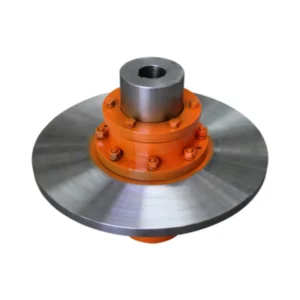
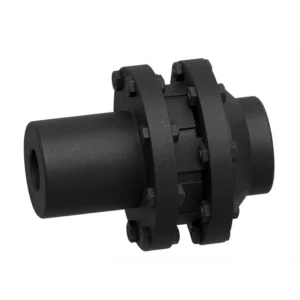
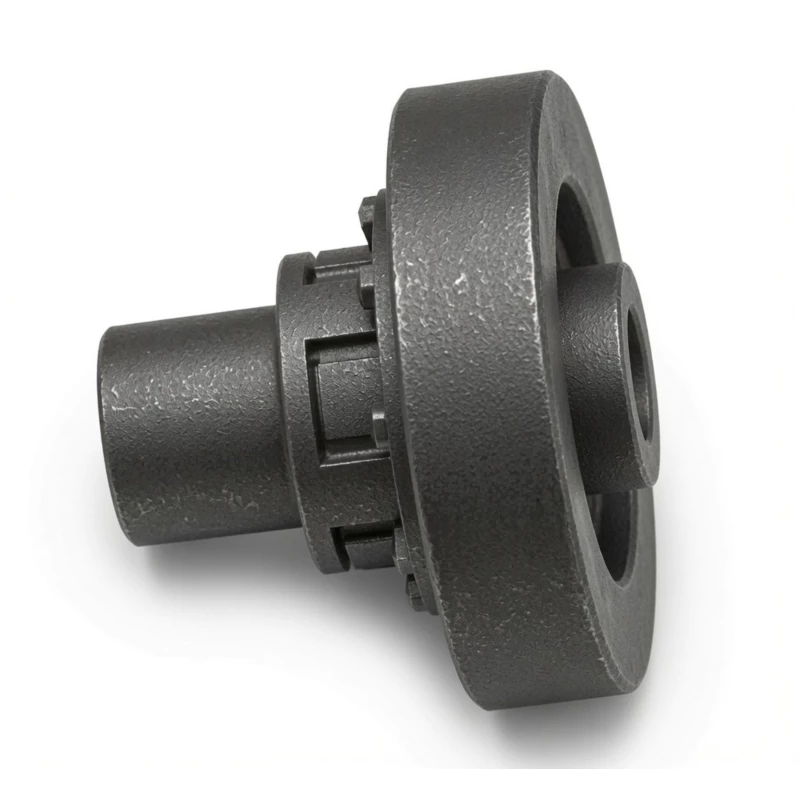
The LMZ-II Type Plum Blossom Coupling with Integral Brake Wheel (GB/T5272-2002) casts the brake drum directly into the coupling hub body, creating the most axially compact brake-coupling unit in the GB/T5272 range. Available in 15 configurations from LMZ5-II-160 to LMZ14-II-800 covering torque up to 12,500 N·m — the preferred choice for space-constrained hoist, crane, and winch drives where the brake drum is replaced infrequently.
MOQ: 50 pcs. Minimum order value USD 1,500; mixed orders and trial quantities welcome.
What Is an LMZ-II Integral Brake Wheel Coupling?
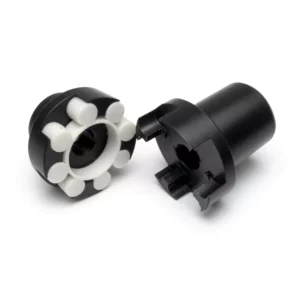
The LMZ-II plum blossom coupling with integral brake wheel represents the most space-efficient solution in the GB/T5272-2002 brake-coupling family. Unlike the LMZ-I's two-piece split drum or the traditional approach of fitting a separate brake wheel alongside a coupling, the LMZ-II integrates the brake drum surface directly into the casting of the coupling hub — eliminating the drum-hub interface, the joining bolts, and the concentric runout risk that a bolted assembly introduces.
Integral Construction Advantages
- Minimum axial length: No drum joining face or bolt circle; L0 (total length = L + C + B + E) is shorter at every size than the LMZ-I equivalent.
- Perfect concentricity: Drum surface and bore are machined from a single casting — inherent true-running without bolt-joint runout.
- Fewer parts: Three components total (two hubs + spider) versus four for LMZ-I.
- Lower unit cost: Simpler hub casting reduces machining time versus the split-drum design.
When to Choose LMZ-II vs LMZ-I
| Factor | Choose LMZ-I | Choose LMZ-II |
|---|---|---|
| Brake drum replacement frequency | High (frequent wear) | Low (long service intervals) |
| Axial space available | Sufficient for split ring | Tight — minimum axial length required |
| Drum replacement without shaft movement | Yes (radial removal) | No (hub removal needed) |
| Max torque (standard) | 25,000 N·m | 12,500 N·m |
| Unit cost | Higher (split drum) | Lower |
LMZ-II Coupling Specifications & Dimensions
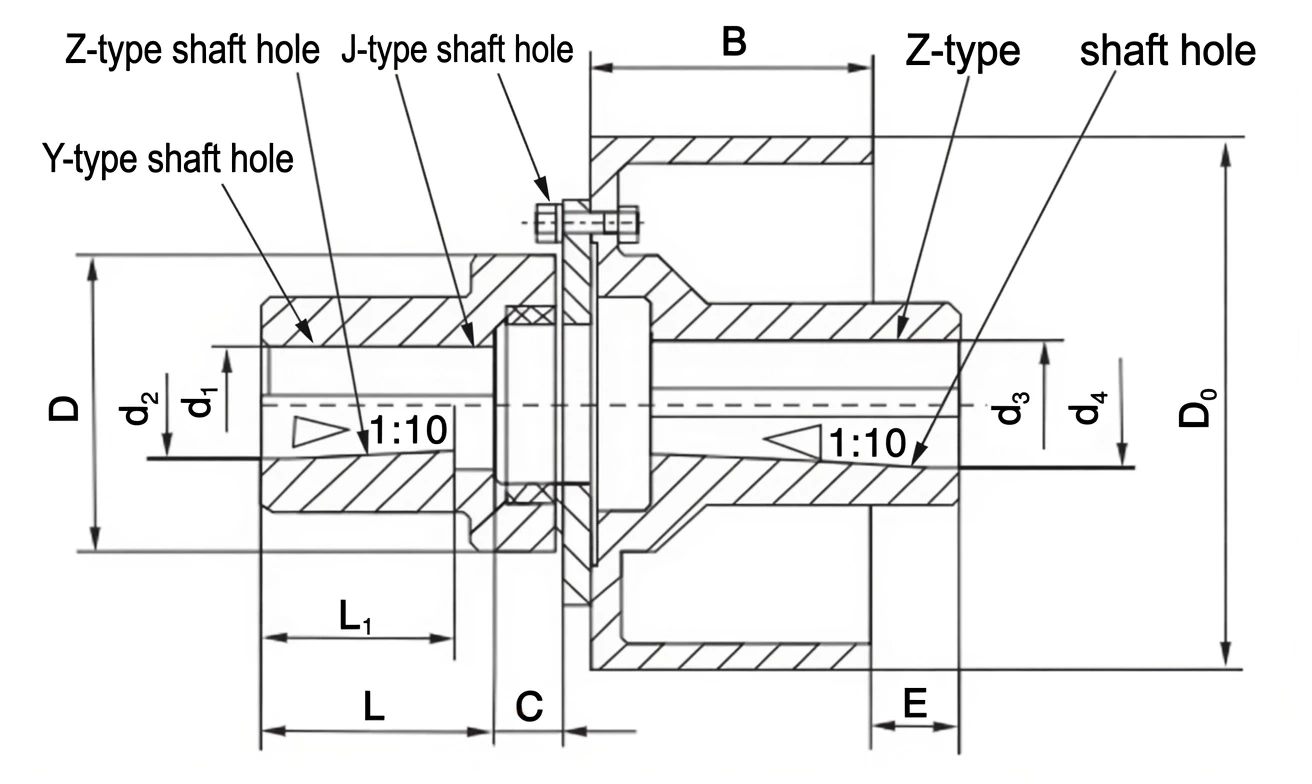
Total length L0 = L + C + B + E · Hub: cast iron (LMZ5–LMZ8) / ductile iron (LMZ9–LMZ14) · Drum rim: 35–45 HRC, 2–3 mm depth · * bore for Z/J types · — = size/diameter combination not offered
| Type | Old Type | Nom. Torque N·m | Max Speed rpm | Shaft Bore mm | Bore Length L mm | C mm | E mm | D0 Drum mm | B mm | D mm | |
|---|---|---|---|---|---|---|---|---|---|---|---|
| Y-type | J / Z-type | ||||||||||
| LMZ5-II-160 | MLL4-II-160 | 250 | 4750 | 25,28 | 30–45 | 62 | 38.5 | 20 | 160 | 70 | 105 |
| LMZ5-II-200 | MLL4-II-200 | 250 | 4750 | 25,28 | 30–45 | 62 | 38.5 | 30 | — | 105 | — |
| LMZ6-II-200 | MLL5-II-200 | 400 | 3800 | 30–48 | Same as Y | 82 | 45 | 30 | 200 | 85 | 125 |
| LMZ7-II-200 | MLL6-II-200 | 630 | 3050 | 35*,38* | 40*–56 | 82 | 52 | 30 | — | 145 | — |
| LMZ7-II-250 | MLL6-II-250 | 630 | 3050 | 35*,38* | 40*–56 | 82 | 52 | 40 | 250 | 105 | 145 |
| LMZ8-II-250 | MLL7-II-250 | 1,120 | 2400 | 45*–56 | 60–65 | 112 | 55 | 40 | 250 | 105 | 170 |
| LMZ8-II-315 | MLL7-II-315 | 1,120 | 2400 | 45*–56 | 60–65 | 112 | 55 | 40 | 315 | 135 | 170 |
| LMZ9-II-315 | MLL8-II-315 | 1,800 | 1800 | 50*–56* | 60–80 | 112 | 64 | 40 | 315 | 135 | 200 |
| LMZ9-II-400 | MLL8-II-400 | 1,800 | 1900 | 50*–56 | 60–80 | 142 | 64 | 40 | 400 | 170 | 200 |
| LMZ10-II-400 | MLL9-II-400 | 2,800 | — | 60–75 | 80–100 | 142 | 70 | 39 | 400 | 170 | 230 |
| LMZ10-II-500 | MLL9-II-500 | 2,800 | 1500 | 60–75 | 80–100 | 142 | 70 | 53 | 500 | 210 | 230 |
| LMZ11-II-500 | MLL10-II-500 | 4,500 | 1500 | 70–75 | 80–120 | 142 | 84 | 54 | 500 | 210 | 260 |
| LMZ12-II-630 | MLL11-II-630 | 6,300 | 1200 | 80–95 | 100–130 | 172 | 84 | 59 | 630 | 265 | 300 |
| LMZ13-II-710 | MLL12-II-710 | 11,200 | 1050 | 90,95 | 100–150 | 172 | 98 | 60 | 710 | 300 | 360 |
| LMZ14-II-800 | MLL13-II-800 | 12,500 | 950 | 100–125 | 130–160 | 212 | 98 | 60 | 800 | 340 | 400 |
Complete Plum Blossom Coupling Range
Torque: 16–8,000 N·m · No brake · General industrial drives
Torque: 25–25,000 N·m · No brake · Spider: radial replacement
Torque: 250–25,000 N·m · Split drum, radial replacement · High brake-wear duty
Torque: 250–12,500 N·m · One-piece drum · Compact, low-wear duty
Torque: 630–1,800 N·m · Disc brake · Spider replaceable in situ
Download dimensional drawings for all multiple types from our coupling catalogue.
How to Select an LMZ-II Coupling
Step 1 — Design Torque
Step 2 — Brake Wheel Diameter
Select the D0 suffix matching your brake gear. For each LMZ-II size, available drum diameters are listed in the table. Verify clearance between the drum OD and surrounding structure before ordering.
Step 3 — Total Length Check
Calculate total installed length: L0 = L + C + B + E. All four dimensions are tabulated per size. For space-constrained drives this formula is the key advantage of LMZ-II over LMZ-I — the integral drum eliminates the drum flange extension found in the split-type design.
Ordering Mark Format
→ LMZ-II type · size 9 · 400 mm drum · Y-bore A-keyway 65×142 mm / Y-bore A-keyway 75×142 mm
Industry Applications
Workshop and warehouse bridge cranes with low-frequency braking use LMZ-II-200 to LMZ-II-400. The compact L0 suits the narrow end-truck frames where axial space for a split drum ring would be marginal.
Traction drive machines in elevator machine rooms benefit from LMZ-II's shorter overall length. Brake drum replacement coincides with major overhaul cycles where hub removal is part of the scheduled scope.
Head-drum drive gearboxes on steep-incline conveyors use LMZ-II for holdback braking. The integral casting delivers the true-running drum surface needed for consistent shoe contact across the full brake width.
Deck winches and mooring capstans (LMZ-II-160 to LMZ-II-315) use the compact integral coupling where machine envelope is the binding constraint and brake drum replacement happens at drydock intervals.
Warp beam drives and let-off units need smooth, vibration-free braking. LMZ-II's integral casting eliminates bolt-joint runout harmonics that can cause tension variation in fine yarn winding.
Electric chain hoists and jib crane drives where the entire drive head is replaced as a unit at end of life — making the integral drum's lower replacement cost (versus LMZ-I split drum) the economically rational choice.
For applications with high brake-wear frequency, see our LMZ-I split brake wheel coupling page for easier in-situ drum replacement.
Installation & Maintenance
Installation Steps
- Press or heat-shrink both hubs; torque all setscrews. Use induction heater ≤120 °C for interference fits.
- Align shafts (laser recommended for LMZ-II-400 and above) to within coupling angular/radial tolerances.
- Insert the polyurethane spider between the claw faces with the shafts at the correct gap (per L0 table).
- Fit brake shoes with correct clearance (typically 0.5–1.0 mm from drum surface) and verify even contact.
-
Check drum runout with dial gauge (≤0.3 mm recommended); adjust shoe backing plates if required.
Spider Replacement
Because the drum is integral to the hub, spider replacement follows the standard LM procedure: slide one hub axially to open the claw gap, extract the worn spider, insert the replacement, and return the hub. The brake shoe mechanism must be retracted before hub movement. Typical elapsed time: under 20 minutes.
Fault Diagnosis
| Symptom | Likely Cause | Action |
|---|---|---|
| Vibration during running | Worn spider; misalignment | Replace spider; realign shafts |
| Uneven brake grip | Drum runout; worn/glazed shoes | Check runout; reline shoes |
| Spider failure under moderate load | Wrong hardness; service factor too low | Recalculate TC; specify shB if available |
| Drum surface scoring | Lining worn to metal; foreign object | Replace coupling; inspect brake gear |
LMZ-II vs Comparable Brake-Drive Solutions
| Criterion | LMZ-II Integral | LMZ-I Split | LTZ Elastic Pin + Brake |
|---|---|---|---|
| Axial compactness | ★★★★★ Best | ★★★★☆ | ★★★☆☆ |
| Drum replacement | Hub removal needed | In-situ radial | Hub removal needed |
| Drum runout | Lowest (single casting) | Low (half-joint face) | Depends on fit |
| Unit cost | Lowest | Higher | Medium |
| Vibration damping | ★★★★☆ | ★★★★☆ | ★★★☆☆ |
Customer Case Studies
Australia — Freight Elevator OEM
Standardised on LMZ-II-200 and LMZ-II-315 across our freight elevator drive range. The integral drum's shorter L0 let us reduce the machine frame length by 60 mm — a material saving in the fabrication cost of our standard machines. Zero warranty claims related to the coupling in two years of production.
Engineering Director, Melbourne AU
★★★★★
South Korea — Textile Machinery
LMZ7-II-200 on let-off beam drives. The true-running integral drum eliminated the tension variation we experienced with a bolted drum assembly — our fabric defect rate from warp tension irregularity dropped to zero after the switch.
Process Engineer, Daegu KR
★★★★★
Netherlands — Port Equipment
LMZ10-II-400 on deck crane slewing drives. Compact enough to fit our crane slewing ring geometry. Eighteen months of continuous port operation with only one scheduled spider replacement — both machines stayed in place for the entire procedure.
Fleet Maintenance Manager, Rotterdam NL
★★★★☆
Australia — Workshop Crane Supplier
Supply LMZ-II-160 and LMZ-II-200 as standard fitment across our 2–5 tonne workshop bridge crane range. Customers appreciate the compact OD clearance above the end truck. Replacement couplings are stocked at all our service centres for same-day despatch.
Product Manager, Brisbane QLD AU
★★★★★
Frequently Asked Questions
▶ How does LMZ-II differ from LMZ-I?
LMZ-II has a one-piece brake drum cast integrally with the hub body — no joining bolts, no split faces, minimum axial length. Replacing a worn drum requires hub removal from the shaft. LMZ-I has a two-piece split drum that unbolts and withdraws radially, so the drum is replaceable without any shaft movement. Choose LMZ-II when space is the primary constraint and brake-drum replacement is infrequent.
▶ What is the total length formula for LMZ-II?
Total coupling length L0 = L + C + B + E, where L = bore length, C = flange-to-claw spacing, B = drum width, E = hub tail extension. All four values are listed in the parameter table for each size. This is the key dimension to verify against your drive housing drawing.
▶ Can I replace the spider without removing the hub from the shaft?
Spider replacement still requires one hub to slide axially to open the claw gap — the same procedure as for a standard LM coupling. The brake shoe mechanism must be retracted before moving the hub. Under 20 minutes total elapsed time. The integral drum does not prevent spider access; it simply means the drum itself cannot be changed without hub removal.
▶ What is the maximum operating speed for LMZ-II couplings?
Maximum speed ranges from 950 rpm (LMZ14-II-800) to 4,750 rpm (LMZ5-II-160). Larger sizes with heavier brake drums have lower speed limits due to drum balance and centrifugal stress constraints. Always verify that the operating speed is below the rated maximum for the selected size.
▶ Is LMZ-II available with brake disc rather than drum?
No — the MLP type provides disc-brake integration for the plum blossom coupling family. LMZ-I and LMZ-II both use drum (shoe-type) brake interfaces. If your brake system uses a caliper acting on a disc, specify the MLP type instead.
Source LMZ-II Integral Brake Couplings — Fast Delivery, Full Documentation
GBC supplies all 15 LMZ-II configurations with dimensional drawings, material certificates, and bore customisation. Send us your motor rating, speed, brake gear D0, and shaft diameters and we will confirm the correct mark and availability within 24 hours.
The LMZ-II Type Plum Blossom Coupling with Integral Brake Wheel (GB/T5272-2002) casts the brake drum directly into the coupling hub body, creating the most axially compact brake-coupling unit in the GB/T5272 range. Available in 15 configurations from LMZ5-II-160 to LMZ14-II-800 covering torque up to 12,500 N·m — the preferred choice for space-constrained hoist, crane, and winch drives where the brake drum is replaced infrequently.
MOQ: 50 pcs. Minimum order value USD 1,500; mixed orders and trial quantities welcome.