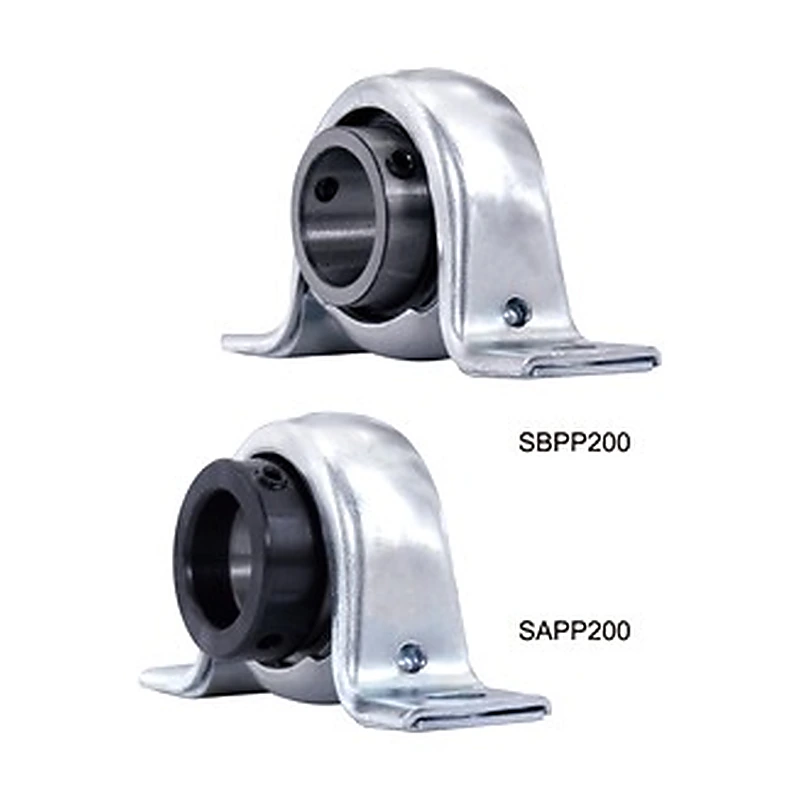
SBPP200 & SAPP200 Stamped Steel Pillow Block Bearing Units
SBPP200 and SAPP200 are compact pillow block units made with pressed steel housings rather than a heavy cast pedestal. The two series share the same light-duty housing concept but offer different shaft retention: SBPP uses setscrews, while SAPP uses eccentric locking.
This family is useful when low mass, simple mounting and moderate-duty service are more important than a large cast housing. The catalogue covers 12-45 mm shafts and publishes very low unit weights compared with the plummer-block and cast-iron cartridge families.
For a wider housing comparison, browse the bearings range before finalising the mounting style.
A lightweight pedestal for straightforward shaft support
Two-bolt pillow block shape
The housing mounts on a flat base with a simple two-bolt footprint.
Two locking choices
SBPP uses setscrews; SAPP uses an eccentric locking arrangement.
12-45 mm published range
The family covers small and medium light-duty shaft sizes.
Very low housing mass
Published weights start around 0.15 kg for SBPP, supporting compact machine designs.
SBPP200/SAPP200 published technical range
The table below keeps the catalogue values used for this series. Use the model-specific drawing for the final interchange decision; dimensions and suffixes can vary inside a family.
| Specification point | SBPP200/SAPP200 catalogue data |
|---|---|
| Series / model family | SBPP201-209 and SAPP201-209 |
| Duty class | Light duty |
| Locking / bearing mounting | SBPP: setscrew locking; SAPP: eccentric locking |
| Published shaft range | 12-45 mm |
| Published metric / inch options | 12, 15, 17, 20, 25, 30, 35, 40, 45 mm |
| Housing / mounting style | 2-bolt stamped steel pillow block |
| Housing construction | Pressed / stamped steel |
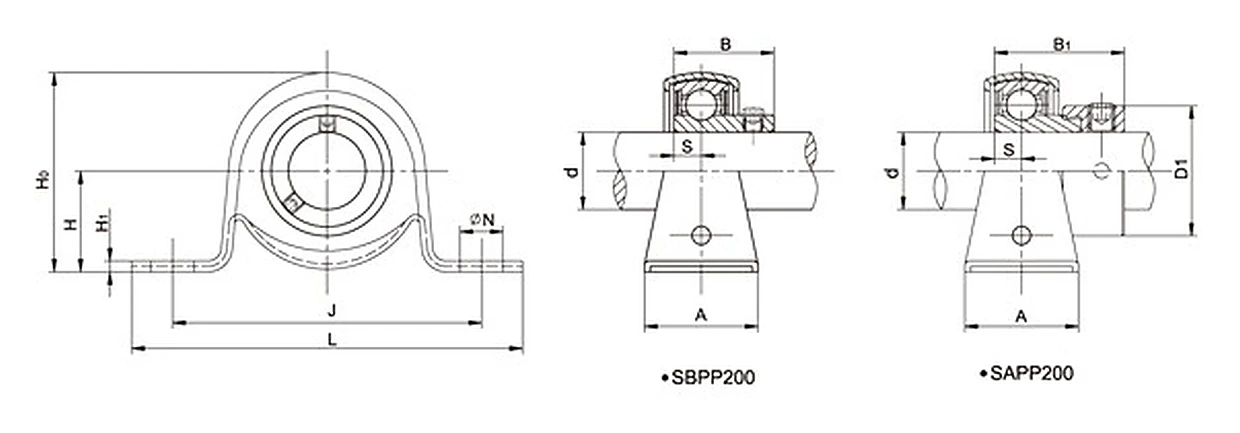
| Catalog dimensional fields | L, J, H, H1, H0, N, A, B/B1, S, bolt size and weight |
| Published unit weight | SBPP approx. 0.15-1.20 kg; SAPP approx. 0.26-1.24 kg |
Choose SBPP or SAPP by locking method
Use the product drawing as the final dimensional authority. The points below are practical filters that help narrow the correct model before a full drawing comparison.
Do not treat SBPP and SAPP as one interchangeable code; the insert retention method differs.
L, J, H and H0 control whether the unit aligns with the existing frame.
Stamped steel is intended for lighter service; do not choose it only because the bore and bolt spacing fit.
The compact housing is often used in tight assemblies where a small dimensional change can contact covers.
Applications where pressed steel makes sense
These are application patterns where the housing concept is commonly considered. Final suitability still depends on load, speed, alignment, environment and the machine designer’s requirements.
Light conveyors
The pillow-block footprint works well on compact frames supporting rollers and small drive shafts.
Agricultural accessories
Low mass and simple mounting suit guards, feeders and auxiliary mechanisms with moderate bearing loads.
Fans and HVAC equipment
Stamped housings can support light rotating shafts without the bulk of a cast pedestal.
General small machinery
A two-bolt pressed-steel unit is practical where low cost, easy replacement and compact packaging are priorities.
Installation details that matter on thin formed housings
Thin formed housings should not be twisted down onto distorted sheet metal.
Setscrew and eccentric-lock inserts are installed differently.
Cracked or elongated sheet-metal mounting holes can cause more trouble than the bearing itself.
A visibly bent pressed housing should not be treated like a reusable heavy cast pedestal.
When to stay with stamped steel and when to move up
Choose SBPP/SAPP when a light two-bolt pillow block is appropriate for the machine. If the support must mount to a vertical face, SBPFL/SAPFL provides a two-bolt oval flange. SAPF/SAPFT and SBPF/SBPFT use three-bolt flange geometry, with different locking methods.
Send the machine details for a model check
For SBPP200/SAPP200, send the existing model marking, shaft diameter, mounting dimensions and a photo of the bearing position. GBC can review the information against the published series before quotation. Email: sales@australia-drive.com.