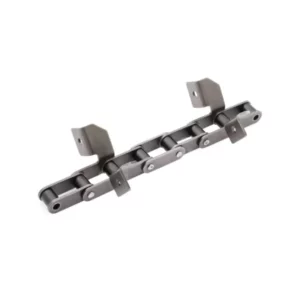
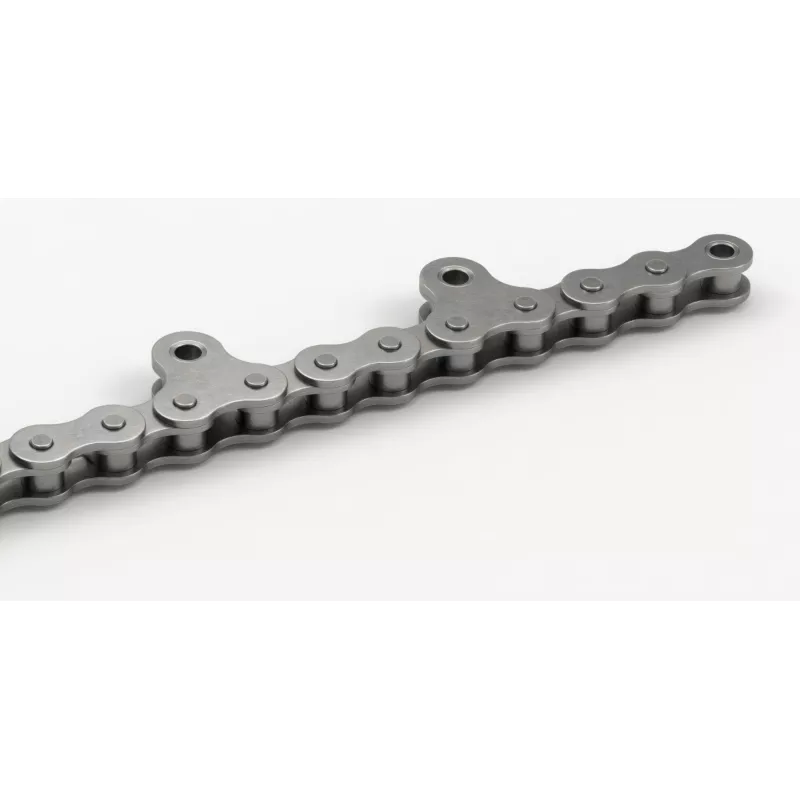
Agricultural Hoist Chains
Precision-manufactured 415 and 420 series agricultural hoist chains engineered for Australian farm machinery including rice harvesters, vegetable transplanters, hay balers, and potato harvesters. Available in 12 variants from 415Y1 to 420Y1, conforming to ISO 487:2013. SGS certified, OEM/ODM customisation supported, with AEST business-hours technical assistance.
MOQ: 10 pcs. Minimum order value USD 1,500; mixed orders and trial quantities welcome.
Agricultural Hoist Chain — Precision Attachment Chains for Australian Farm Machinery
In the specialised world of agricultural machinery drive systems, not all chains are created equal. The agricultural hoist chain — also commonly referred to as an agricultural attachment chain or agricultural conveying chain — occupies a uniquely demanding position in the drivetrain hierarchy. Unlike standard power-transmission roller chains that simply transfer torque between sprockets, agricultural hoist chains must simultaneously transmit drive force and carry, elevate, or position physical material — whether that material is harvested grain stalks, transplanted seedlings, metered fertiliser, or cut forage.
The 415 and 420 series attachment chains offered by Australia Drive are purpose-engineered for the dual-function demands of Australian agricultural operations — from the wet-season rice harvests of the Murrumbidgee Irrigation Area to the year-round vegetable production operations of Queensland's Lockyer Valley and Western Australia's Swan Coastal Plain. Every chain in this range carries measurable, documented specifications and is manufactured under ISO 9001:2015 quality management protocols, with SGS third-party verification available for export documentation.
This technical reference page is designed to give Australian farm operators, OEM procurement engineers, and agri-machinery service technicians everything they need to correctly identify, specify, and source the right agricultural hoist chain — eliminating the guesswork that leads to mismatched components, accelerated wear, and avoidable field stoppages.
Technical Specifications — 415 & 420 Series Agricultural Hoist Chains
The following dimensional and mechanical data is extracted from production inspection records and conforms to ISO 487 (agricultural chains with attachments) and ISO 606 standards. All attachment dimensions listed under d₃ and C refer to the extended pin or K-type attachment bolt-hole geometry used for material-handling fixture mounting. All values are measured at 20°C; tolerances comply with ISO 487:2013.
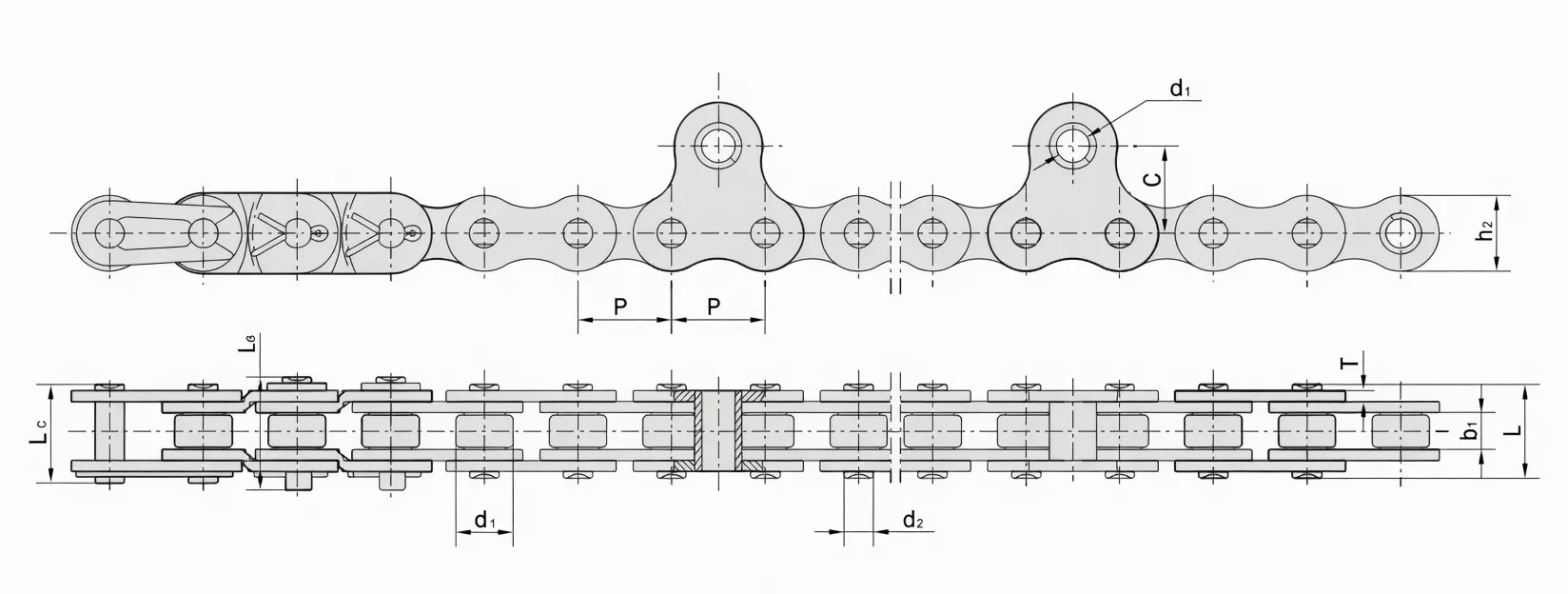
| Chain No. | Pitch P (mm) | Roller Dia. d₁ max (mm) | Inner Width b₁ min (mm) | Pin Dia. d₂ max (mm) | Pin Length L max (mm) | Pin Length Lc max (mm) | Pin Length L₄ max (mm) | Inner Plate Depth h₂ max (mm) | Plate Thickness T (mm) | Attachment d₃ max (mm) | Attachment C (mm) | Ultimate Tensile Q min (kN) | Avg. Tensile Qo (kN) |
|---|---|---|---|---|---|---|---|---|---|---|---|---|---|
| 415Y1 | 12.7 | 7.77 | 4.90 | 3.64 | 11.0 | 12.1 | 12.95 | 9.5 | 1.1 | 4.02 | 12.0 | 6.86 | 8.1 |
| 415Y2 | 12.7 | 7.77 | 4.90 | 3.64 | 11.0 | 12.1 | 12.95 | 9.5 | 1.1 | 4.02 | 12.0 | 6.86 | 8.1 |
| 415Y3 | 12.7 | 7.77 | 4.90 | 3.64 | 11.0 | 12.1 | 12.95 | 9.5 | 1.1 | 4.02 | 12.0 | 6.86 | 8.1 |
| 415Y4 | 12.7 | 7.77 | 4.68 | 3.64 | 11.8 | — | — | 9.6 | 1.3 | 4.00 | 12.0 | 10.30 | 12.1 |
| 415Y5 | 12.7 | 7.77 | 4.68 | 3.64 | 11.8 | 13.0 | 14.0 | 9.6 | 1.3 | 4.00 | 12.0 | 10.30 | 12.1 |
| 415S | 12.7 | 7.77 | 4.90 | 3.96 | 12.8 | 14.3 | 15.70 | 12.0 | 1.5 | 4.02 | 12.0 | 15.69 | 16.3 |
| 415FA | 12.7 | 7.77 | 4.80 | 3.96 | 12.8 | 14.3 | 15.70 | 12.0 | 1.5 | 4.02 | 12.0 | 13.80 | 16.3 |
| 415SY1 | 12.7 | 7.77 | 4.80 | 3.96 | 13.0 | 14.5 | — | 10.4 | 1.5 | 4.50 | 12.0 | 13.93 | 16.3 |
| 415SY2 | 12.7 | 7.77 | 4.80 | 3.96 | 13.0 | 14.5 | — | 10.4 | 1.5 | 4.50 | 12.0 | 13.93 | 16.3 |
| 415SY3 | 12.7 | 7.77 | 4.80 | 3.96 | 12.8 | 14.3 | 15.70 | 12.0 | 1.5 | 4.02 | 12.0 | 15.69 | 16.3 |
| 415SY4 | 12.7 | 7.77 | 4.80 | 3.96 | 13.0 | 14.5 | 15.70 | 12.0 | 1.5 | 4.00 | 12.0 | 13.80 | 16.3 |
| 420Y1 | 12.7 | 7.77 | 6.25 | 3.96 | 14.7 | 16.1 | 18.50 | 12.0 | 1.5 | 4.00 | 12.0 | 16.00 | 18.8 |
Notes: (—) indicates dimension not applicable for that variant's attachment configuration. All tensile values are measured under static pull test per ISO 487. Attachment dimensions d₃ and C refer to the extended pin outer diameter and the centre-to-attachment-hole dimension respectively, as used for mounting agricultural paddles, fingers, and transplanting fixtures.
Series differences: 415Y1/Y2/Y3 share identical dimensions with light-duty 1.1 mm plates and lower tensile strength — suited to seedling metering and light conveying. 415Y4/Y5 use 1.3 mm plates for a notable increase in tensile capacity. 415S, 415SY, and 415FA variants all step up to 1.5 mm plates and 3.96 mm pins for heavy-duty harvester and baler applications. The 420Y1 stands apart with a wider inner width of 6.25 mm, making it the preferred choice where wider sprocket engagement is required.
Application Guide — Where Agricultural Hoist Chains Operate and What They Do
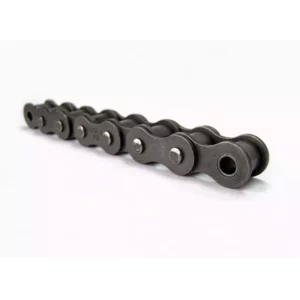
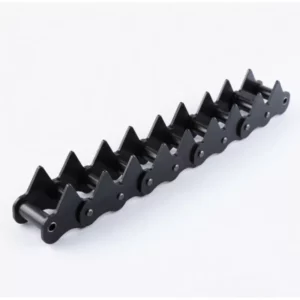
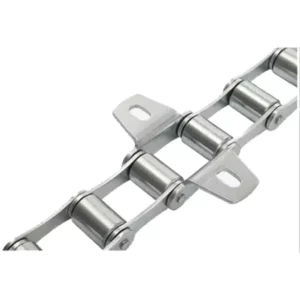
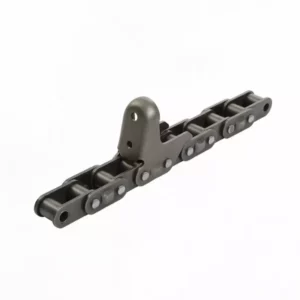
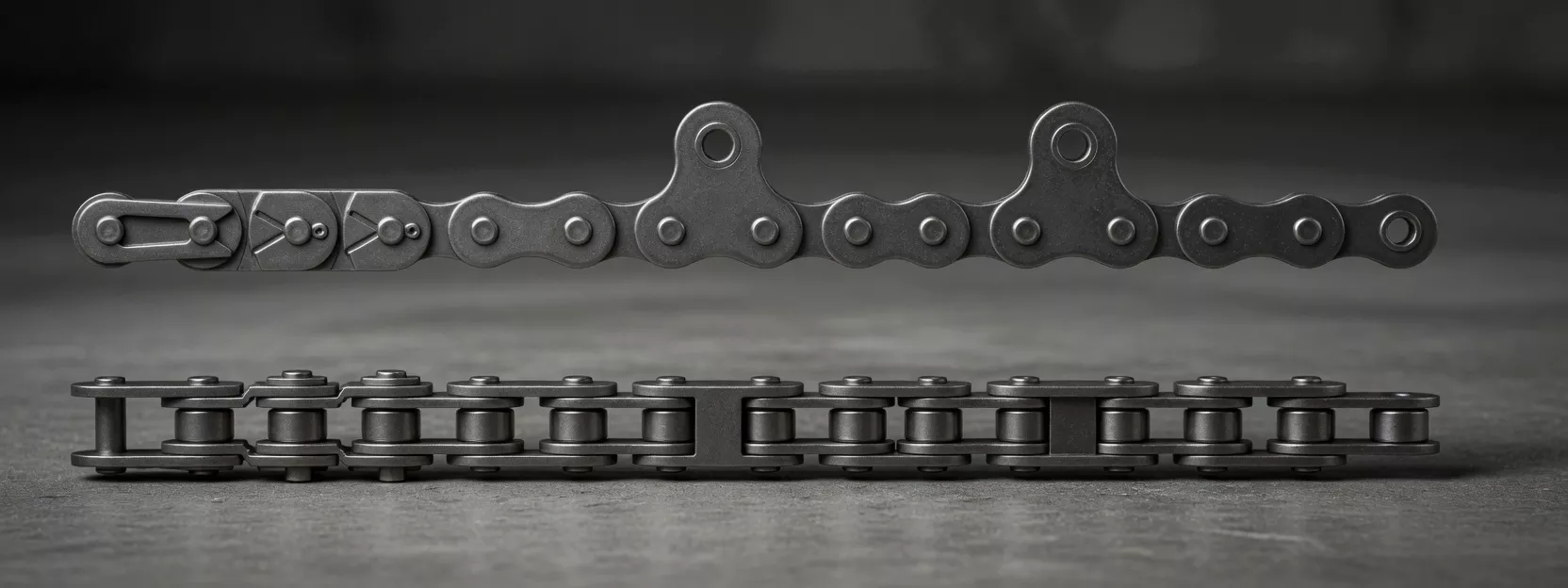
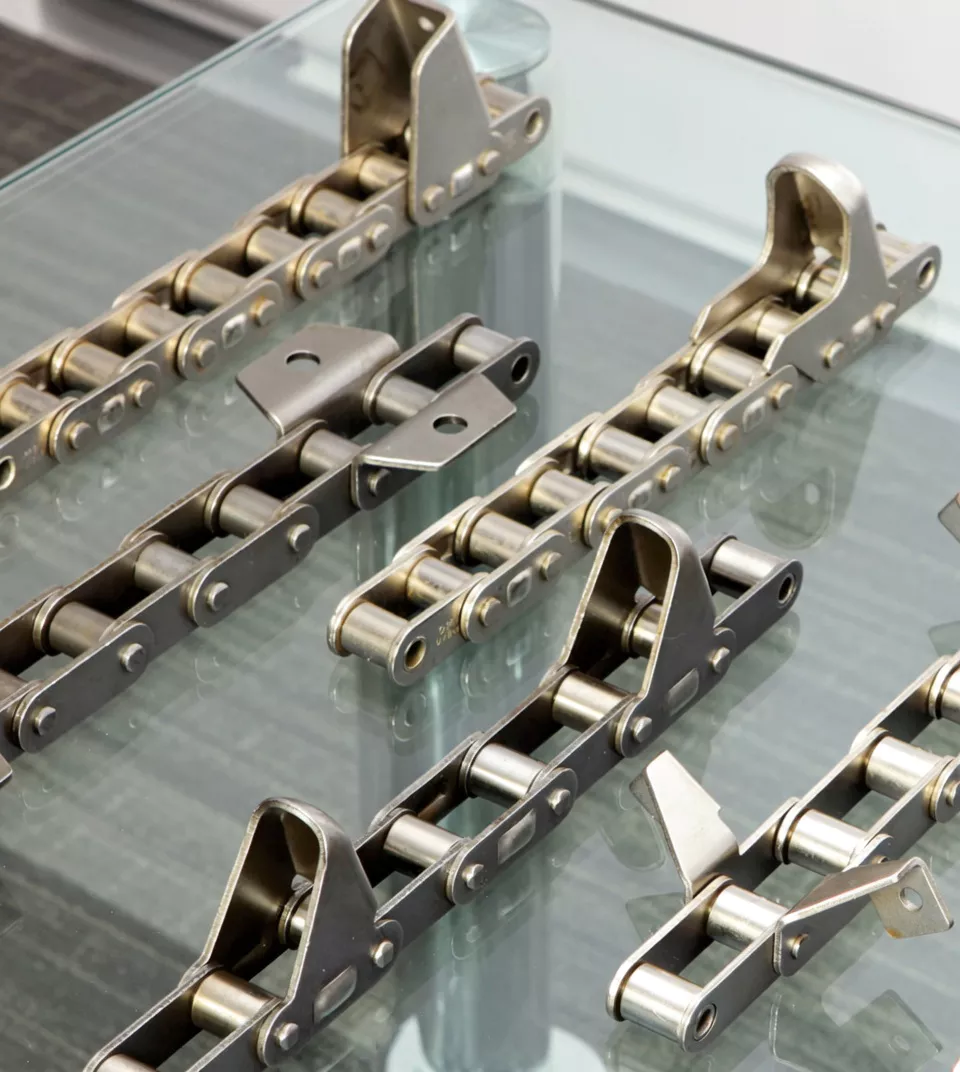
The defining characteristic of agricultural hoist chains — compared to standard transmission roller chains — is the presence of special attachments on selected links. These attachments may take the form of extended pins (K-type), bent lugs, flat-plate tabs, or U-shaped brackets, and they serve as anchor points for paddles, fingers, clamps, or guides that physically contact, carry, or position the crop material passing through the machine. Understanding which attachment type and which chain variant suits each application is critical to achieving correct machine function and acceptable service life.
🌾 Rice Harvesters & Paddy Grain Elevators
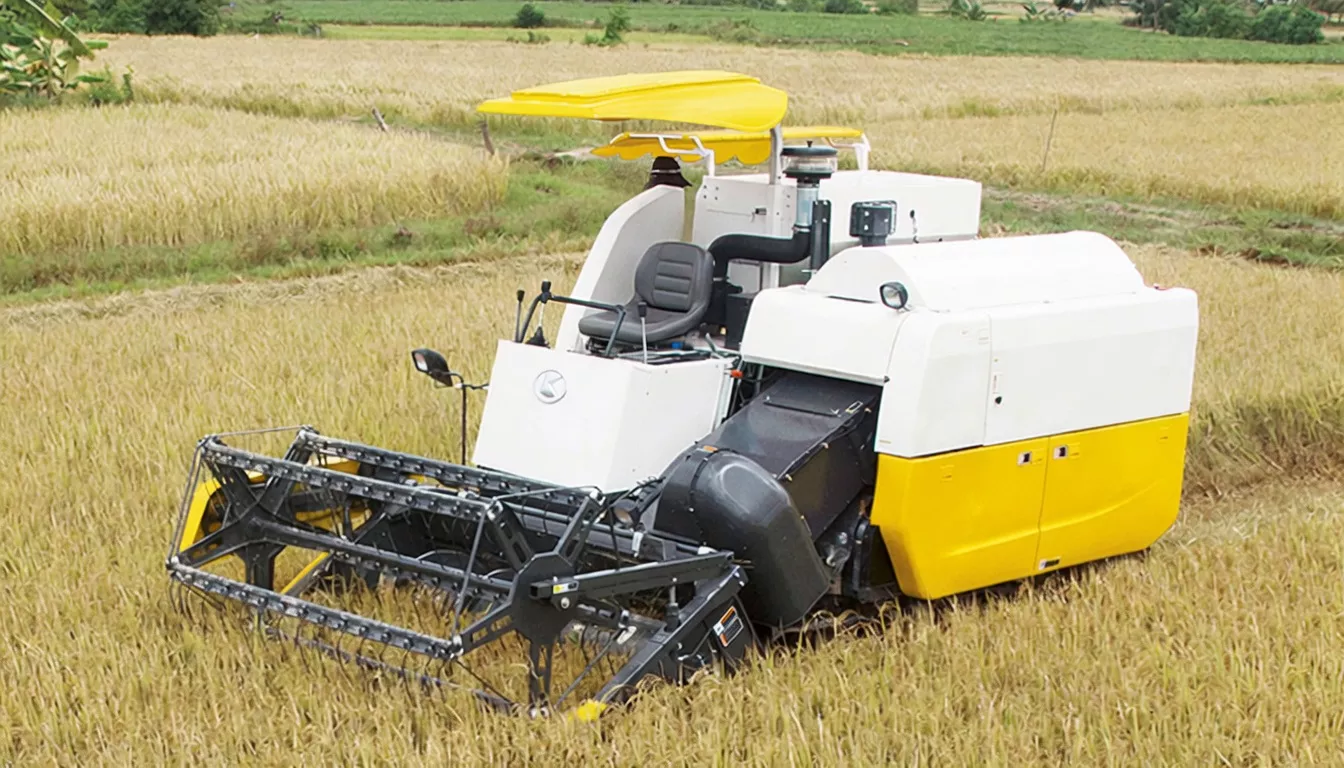
Rice harvesters are the primary application driver for the 415 series agricultural hoist chain across the Asia-Pacific region, and increasingly in Australia's expanding irrigated rice production zones in the Murrumbidgee Irrigation Area (MIA) and Murray Valley. Within a combine rice harvester, the 415 series chains fulfil multiple distinct functions simultaneously.
The crop-divider guide chains (typically 415Y1/Y2/Y3 with light-duty 1.1 mm plates) run along the outside of the crop dividers to guide standing rice stems into the cutterbar without tangling. These chains are exposed to the full abrasive and corrosive environment of wet paddy fields — mud, water, silica-laden soil particles, and fertiliser residues. Their attachment pins must maintain precise dimensional tolerances to keep the guide fingers correctly positioned across the full cutting width, which in modern Australian-market machines ranges from 1.8 to 2.5 metres.
The grain elevator chains (typically 415S or 415SY3 with 1.5 mm plates and 15.69 kN minimum tensile strength) run vertically inside the elevator housing to carry the threshed grain from the concave area up to the grain tank. The paddles attached to the extended pins must be precisely dimensioned — too small and grain spills back; too large and the paddle scrapes the elevator housing, creating wear on both chain and housing. Our 415S variant with C = 12.0 mm attachment centre dimension is the standard specification for this application in most Japanese-designed and Chinese-manufactured rice harvesters operating in Australian paddocks.
The straw-walker discharge chains (typically 415Y4/Y5 with intermediate 1.3 mm plates) manage the ejection of separated straw from the rear of the machine. In wet harvest conditions — which are common in the MIA when growers harvest at sub-optimal moisture levels to meet processing schedules — straw weight increases dramatically, significantly elevating the load on these chains. The 10.30 kN minimum tensile strength of the 415Y4/Y5 variants provides a meaningful safety margin over the lighter 415Y1/Y2/Y3 range for this duty.
🥦 Vegetable Transplanting Machines & Precision Seeders
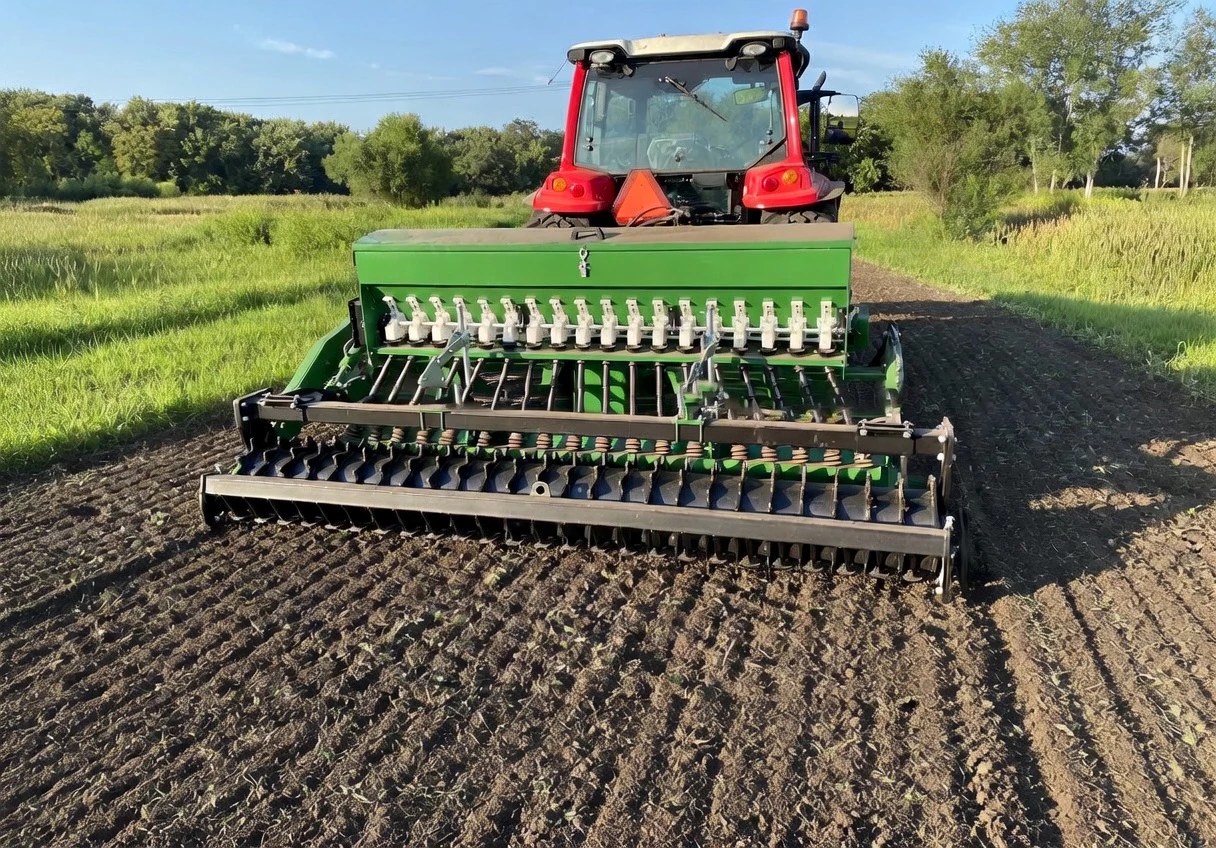
Vegetable transplanting machines used across Australia's intensive horticultural production zones — the Lockyer Valley, the Murray-Darling basin irrigated regions, and the Perth metropolitan market-garden belt — depend critically on 415 series hoist chains for their seedling-cup carousel drives. In these machines, a continuous loop of attachment chain carries equally spaced seedling cups or finger-clamp assemblies around an oval track. Each cup descends into a furrow opened by a preceding coulter, deposits a seedling at a precise depth and spacing, and then rises clear as the machine moves forward.
The chain's pitch accuracy directly controls plant spacing. The 415Y1/Y2/Y3 range — with their tighter-than-standard pitch tolerance from our manufacturing process — is specified for transplanting applications where row spacing accuracy of ±5 mm over 50 links is required. Any accumulated pitch error beyond this threshold will cause inconsistent plant spacing, uneven canopy development, and reduced marketable yield — a commercially significant outcome in high-value crops like iceberg lettuce, broccoli, and Asian brassicas.
The 420Y1 variant with wider 6.25 mm inner width is specified for larger-format transplanting machines that use wider sprockets to accommodate beefier cup-mounting hardware. The wider inner width of 420Y1 (6.25 mm vs. 4.80–4.90 mm for the 415 variants) prevents the side plates from contacting the sprocket tooth flanks on these wider-hub designs — an issue that causes side-plate edge wear and premature chain elongation if a standard-width chain is incorrectly fitted.
🌾 Hay Balers — Crop Feed & Density Control Chains
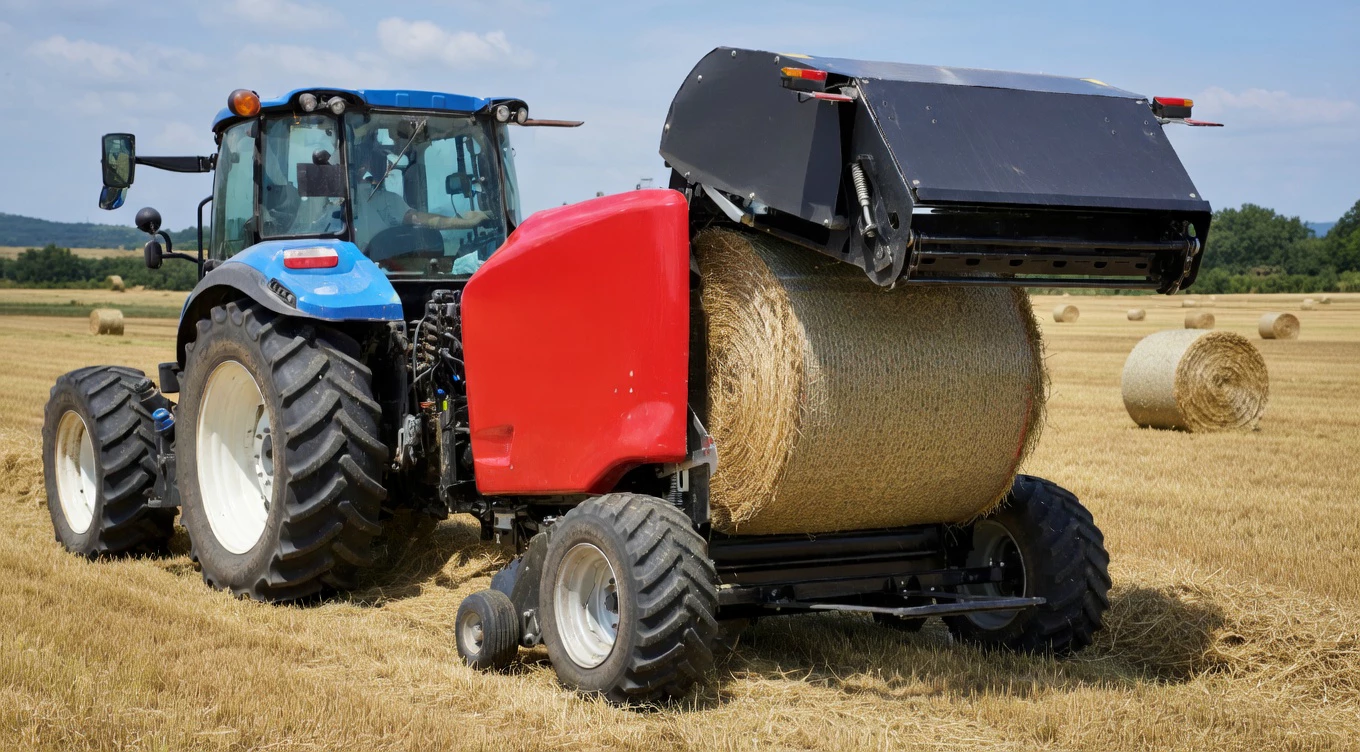
Square balers and large-format round balers used extensively across Australian hay-producing regions — the Riverina, the Darling Downs, and the Eyre Peninsula — incorporate attachment chains in their crop-compression monitoring systems and feed-rotor assemblies. In these applications, the attachment links provide anchor points for sensor flags that pass through magnetic or optical proximity sensors, generating the pulse signals used by the baler's electronic density-control system to maintain consistent bale weight and tying cycle timing.
The 415FA variant — notable for its slightly reduced minimum tensile strength of 13.80 kN compared to the 415S at 15.69 kN — is commonly specified for these lighter-duty sensing-flag applications where the load requirement is modest but dimensional precision of the attachment bolt-hole (d₃ = 4.02 mm, C = 12.0 mm) is critical for correct flag-to-sensor clearance.
🌿 Hay Rakes — Finger Carrier Chains
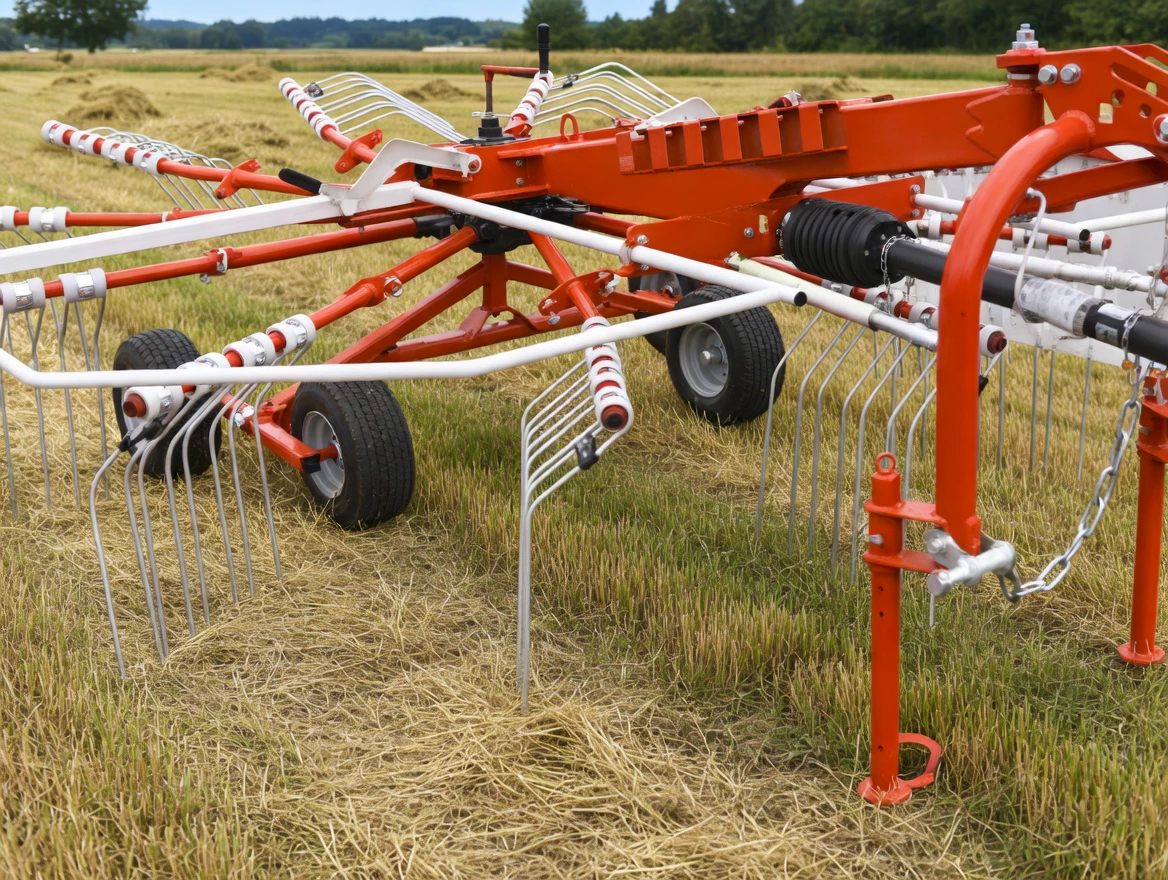
Bar-type hay rakes — widely used on mixed farms across southern Australia — use 415 series attachment chains to carry the rotating tine fingers around the oval path that sweeps cut forage into windrows. Each finger is bolted through the attachment holes in the chain's extended pins. The chain runs continuously around the circumference of the rake head, and each finger must maintain a precise radial position relative to the ground to achieve consistent windrow formation without soil contamination.
The 415SY1 and 415SY2 variants — with their slightly larger attachment pin diameter of d₃ = 4.50 mm (versus 4.02 mm on other variants) — are specified for rake-finger carriers where the tine bolt uses a larger shank diameter for improved resistance to the bending loads imposed when tines encounter windrow buildup or embedded stones. This larger attachment bore also accommodates the wider finger-root flanges used on premium stainless-steel hay rake tines sold into the Australian market by European suppliers.
🚜 Wheeled Tractor-Mounted Implements — PTO-Driven Conveying Systems
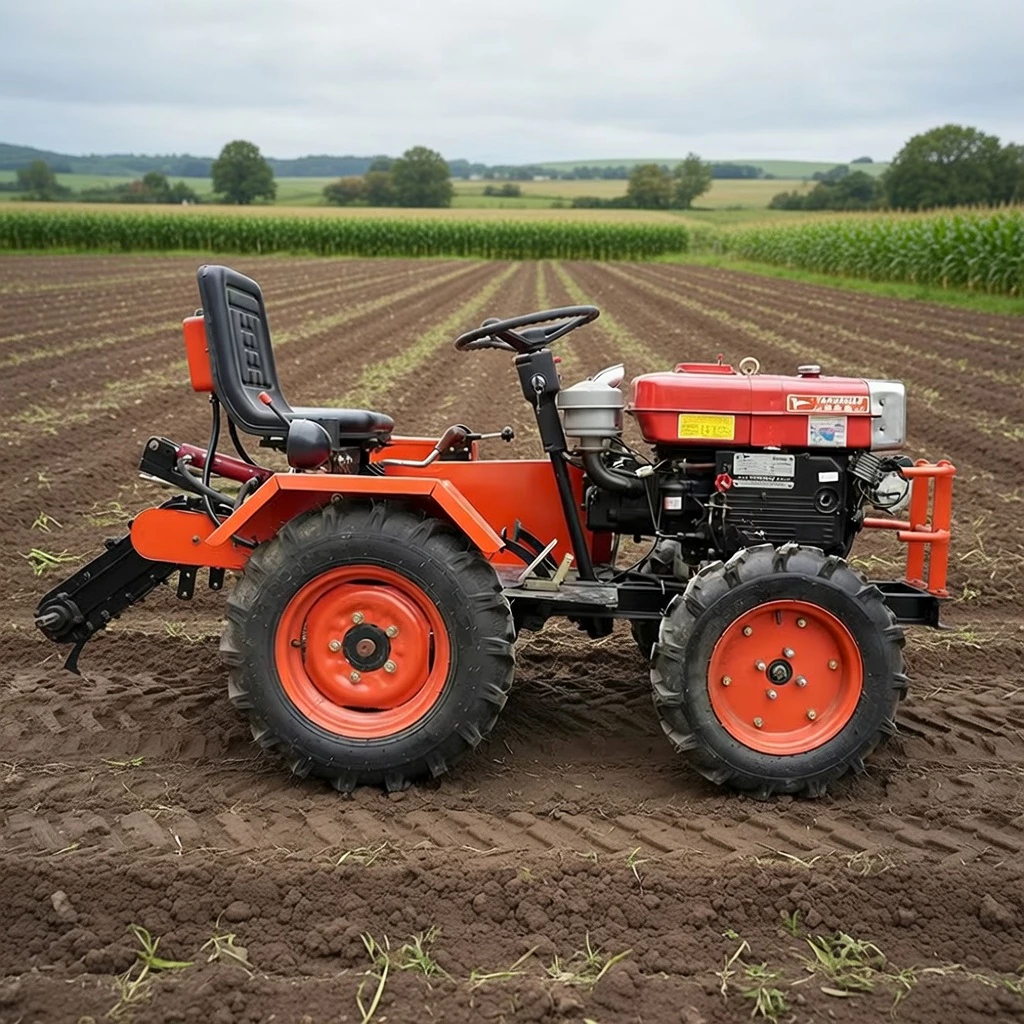
A wide range of PTO-driven tractor attachments — including trailed potato harvesters, onion windrowers, and bulk-bag filling systems — incorporate 415 series hoist chains in their lateral conveying systems. In potato harvesters, for example, the dug potatoes are elevated from the share blade to the rear cleaning and sorting table by a series of parallel 415S or 415SY3 chains carrying cross-bar slats at regular intervals. The combined weight of the potato load, soil, and stones imposes a complex combined tension and bending load on the attachment links — a duty cycle that the heavy-series 415S variant with 1.5 mm plates and 15.69 kN minimum tensile strength handles reliably across a full harvest season.
🌿 Rotary Mowers & Mulchers — Safety Chain Applications
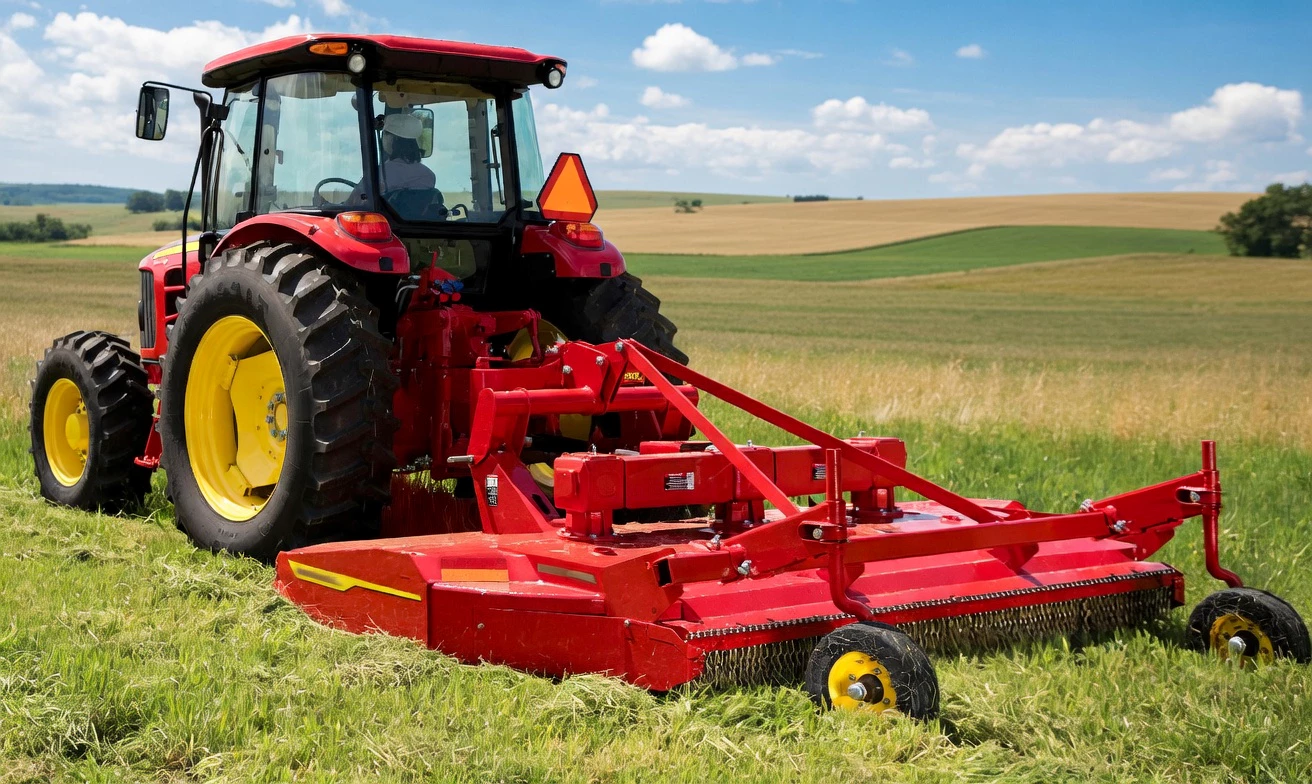
Some rotary flail mower designs use 415 series attachment chain sections as debris-deflection curtains at the rear and sides of the mower deck. The extended attachment pins act as hinge points for overlapping rubber or steel deflector flaps. In this application, the chain does not transmit power — its role is entirely structural, providing a flexible, self-cleaning curtain that prevents ejected debris from reaching the operator or bystanders while flexing freely around obstructions. The 415S variant's combination of 1.5 mm plate thickness and 15.69 kN minimum tensile strength makes it appropriate for these safety-critical curtain applications.
Australian Market Suitability — Environment, Compliance & OEM Compatibility
The 415 and 420 series agricultural hoist chains face a distinct set of environmental and operational demands in the Australian market that set them apart from the conditions these chains were originally designed for in their primary Asian markets. Understanding these differences — and how our manufacturing process addresses them — is essential for Australian procurement and maintenance decisions.
🌡️ Australian Environmental Challenges for Hoist Chains
- Paddy Field Corrosion: Australian rice paddies are managed with a more aggressive water-chemistry regime than many Asian paddocks, with higher soil pH in the MIA's alkaline soils and significant iron and manganese concentrations in irrigation water. These conditions accelerate the surface corrosion of carbon-steel chain plates. Our 415 series chains receive a black-oxide post-treatment that provides short-term corrosion protection during transit and the pre-season storage period, with zinc-plated variants available for operators who store machines through the wet fallow season without disassembly.
- High-UV Pre-Season Storage: Australian farm machinery typically sits outdoors through the off-season, exposing chains stored on machines to intense UV radiation and temperature cycling. Our packaging uses UV-stabilised polyethylene film for chains supplied for pre-season stocking, protecting both the chain and any pre-applied lubricant from degradation during extended outdoor storage.
- Dry Harvest Conditions: Unlike the wet-paddy environment for rice, Australian grain and pulse harvesting typically occurs at very low ambient humidity — sometimes below 20% relative humidity in the WA wheatbelt during summer. In these conditions, standard chain lubricant evaporates rapidly from pin-bushing interfaces. Our attachment chains are pre-loaded with a high-viscosity synthetic EP lubricant between pins and bushings at assembly to extend the initial lubrication interval under these conditions.
- Abrasive Attachment Interface Wear: In transplanting and seeding applications, the bolt holes in attachment links (d₃) are a wear point that is specific to hoist chains and not present in standard transmission chains. In Australian sandy soils — especially the siliceous white sand soils of the Swan Coastal Plain — fine abrasive particles migrate into the attachment bolt clearance and act as a lapping compound. We specify a through-hardened pin with surface hardness of HRC 48–54 at the attachment interface to resist this abrasive wear mode.
📋 Standards Compliance for Australian Market
| Standard | Scope | Status |
|---|---|---|
| ISO 487:2013 | Short-pitch transmission precision roller chains with attachments — dimensions and tensile strengths | ✅ Full compliance — all 415/420 variants |
| ISO 606:2015 | Short-pitch precision roller chains — base chain geometry (pitch, roller diameter, inner width) | ✅ Verified by SGS third-party inspection |
| ISO 9001:2015 | Quality management system covering all production, inspection, and despatch operations | ✅ Current certification — audit records available |
| RoHS / REACH | Material compliance — no restricted substances in chain or packaging materials | ✅ Compliant — declaration of conformity available on request |
🔧 OEM Brand Compatibility Reference
The following OEM brand compatibility data is provided as a selection reference to assist Australian operators in identifying replacement chain specifications for their existing machinery. All brand names listed remain the exclusive property of their respective trademark owners. This reference implies no commercial relationship or trademark association with any brand named.
| OEM Brand / Machine | Typical Application in Australia | Likely Chain Variant | Compatibility Verification Method |
|---|---|---|---|
| John Deere — W/T Series Combines, 600 Series Draper Headers | Grain elevator chains, straw-discharge attachment chains in header feeder house | 415S, 415SY3 | Verify pitch (12.7 mm), inner width (4.90 mm for 415S) and attachment pin diameter (d₃ = 4.02 mm). Cross-check John Deere Parts ADVISOR — chain suffix "AG415" in parts catalogue. |
| Case IH — Axial-Flow 150–250 Series Combines, Early Riser 2150 Planter | Elevator paddle chains, seed-metering ground-drive attachment chains | 415SY1/SY2, 415Y1/Y2/Y3 | Case IH planter seed-metering chains use Y-series attachment type. Identify by the extended K1 pin configuration in the Case IH parts manual. Confirm d₃ = 4.50 mm for SY1/SY2 variants. |
| New Holland — CR/CX Combine Range, BigBaler 1270 Series | Cross-conveyor attachment chains, density-sensor flag chains in balers | 415FA, 415S | New Holland service manuals designate these as "415 pitch attachment chain." Verify attachment hole centre C = 12.0 mm against flag mounting plate slot. Measure with a go/no-go gauge if the original chain is available for reference. |
| Kubota / Iseki — DC Series Rice Harvesters (widely imported into northern QLD and NSW MIA) | All crop-guide, elevator, and straw-discharge chains — the primary chain type in these machines | 415Y1/Y2/Y3 (light guides), 415S/415SY3 (elevator), 415Y4/Y5 (straw walkers) | Kubota DC-105 and DC-70 service manuals list chain numbers with "415" prefix. Verify the chain type suffix (Y1/Y2 vs. S) from the parts list by position in the machine — guide chains are almost always Y1/Y2/Y3; elevator chains are S or SY series. |
| Horwood Bagshaw — HB Precision Seeder range (SA/WA dryland cropping) | Seed-metering finger wheel drives, fan-speed monitoring chains | 415Y1/Y2/Y3 | HB seeder parts use a proprietary part number prefix "HB-CH" followed by chain type code. Cross-reference to 415 series by pitch (12.7 mm) and inner width (4.90 mm). Contact our technical team for specific HB model cross-referencing. |
| MacDon — D/FD Series Draper Headers (used on WA and Qld broadacre farms) | Header reel drive attachment chains, slow-speed platform conveying chains | 415SY4, 415FA | MacDon uses Imperial pitch designation in service documentation (½" = 12.7 mm pitch). Verify attachment style from MacDon Section 6 (Drive Components) in the header service manual — FA-type (flat attachment) links are distinguishable from Y-type (extended pin) links by the absence of a protruding pin tail. |
Pitch Verification for 415 vs. 420 Series: All chains in this range share the same 12.7 mm pitch — so pitch measurement alone will not distinguish between 415 and 420 series chains. The critical differentiator is the inner width (b₁): 415 series variants range from 4.68 to 4.90 mm, while the 420Y1 uses a wider 6.25 mm inner width. Measure the inner width with a digital calliper across the gap between opposing inner plates at mid-link. If the measured value is approximately 6.25 mm, your machine uses 420Y1. If it is approximately 4.68–4.90 mm, it uses a 415 series variant — then match the attachment configuration (pin diameter, plate thickness, and attachment hole geometry) to identify the specific sub-variant.
Technical Advantages — Quantified, Documented, Verifiable
📐 Attachment-Hole Dimensional Accuracy
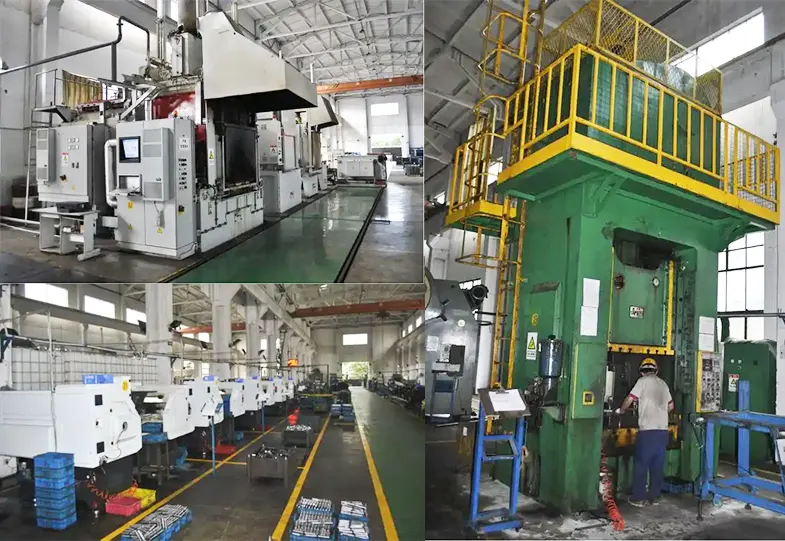
The attachment bolt holes (d₃) in our hoist chains are punched and reamed to a tolerance of +0.05 / -0.00 mm relative to the nominal d₃ value. This is tighter than the ISO 487 standard tolerance band, which permits up to +0.10 mm over-size. In transplanting applications where the cup-mounting bolts must slide through the attachment holes cleanly without wobble — wobble causes cup angular misalignment and inconsistent planting depth — this tighter tolerance directly improves machine performance. Verified by 100% go/no-go gauge inspection on all attachment links at the manufacturing stage.
🔬 Shot-Peened Side Plates for Extended Fatigue Life
All side plates — including the special-profile plates used on attachment links — undergo shot peening before assembly. The resulting compressive residual stress layer (0.15–0.25 mm depth, verified by X-ray diffraction on batch samples) raises the plate's fatigue limit by 20–30% over un-peened plates of the same steel grade. This is particularly significant for hoist chains in rice harvester applications where the attachment links experience a complex combination of tension, bending, and torsion loads with each crop-guide cycle — a multi-axis fatigue loading scenario that accelerates failure in conventionally manufactured plates.
🏭 50,000 Links Per Day — Pre-Season Availability Guaranteed
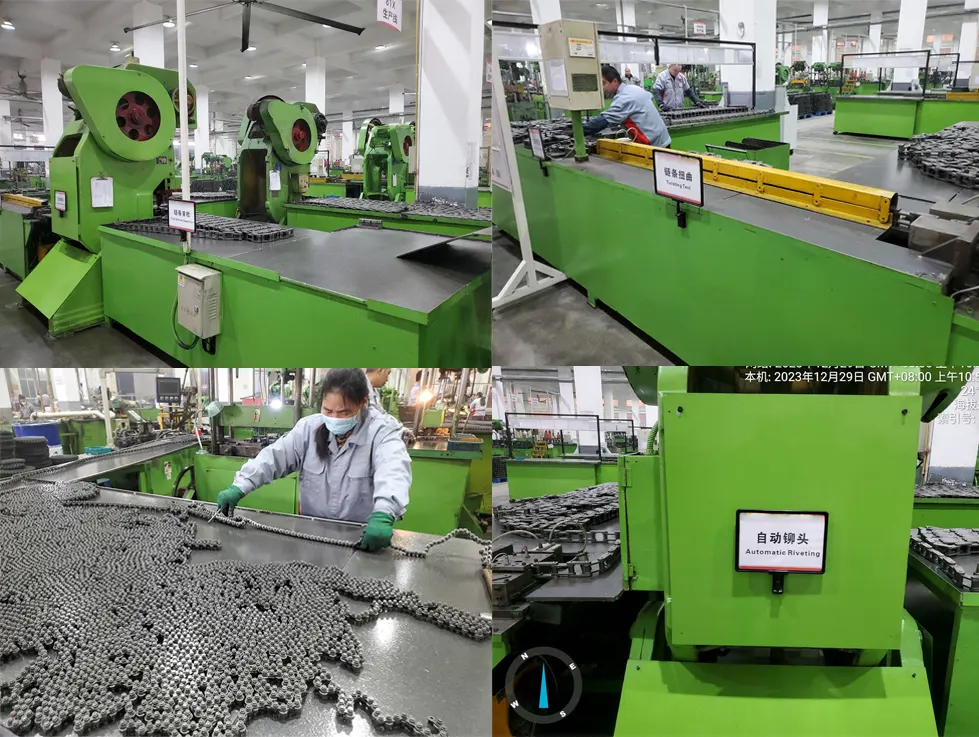
Our dedicated agricultural hoist chain production lines operate at a verified capacity of 50,000 links per day across the 415/420 range. For Australian distributors and dealerships placing pre-season orders ahead of the October–January harvest window, this capacity ensures we can fulfil stocking orders without compromising on fill rates during the August–September pre-season demand peak. We maintain a 90-day raw material buffer — including pre-cut attachment plate blanks for all 12 chain variants — to insulate our production schedule from global steel supply disruptions.
🛡️ ISO 9001:2015 Certified & SGS Third-Party Inspected
Our quality management system is independently certified to ISO 9001:2015. Beyond this system-level certification, we engage SGS — the world's leading inspection and verification organisation — to conduct random-lot dimensional and tensile strength inspections on chains destined for Australian and export markets. The SGS report (covering pitch accuracy, attachment-hole dimensions, tensile strength at guaranteed minimum load, and plate hardness) is available to accompany any commercial shipment, supporting our Australian customers' incoming goods quality records and tender documentation requirements.
⚙️ Full OEM/ODM Customisation Program
Beyond the 12 standard variants listed above, we offer a full OEM and ODM customisation program for the 415/420 series: non-standard attachment spacing (e.g. every 3rd link, every 5th link, or alternating-side attachments); custom attachment plate profiles (bent tab, U-bracket, drilled boss); extended pin lengths beyond the standard L₄ max; zinc plating, nickel plating, or black-oxide surface treatment; and private-label packaging for dealer or OEM branded distribution. Enquire through our contact page with your attachment drawing or sample chain for a project-specific assessment.
🕘 AEST Business-Hours Technical Support
We maintain dedicated technical support availability at AEST 09:00–17:00, Monday–Friday — meaning farmers in the Murrumbidgee Irrigation Area, technicians in the Lockyer Valley, and machinery dealers across the WA wheatbelt all reach a knowledgeable chain specialist during normal working hours. Support services include variant cross-referencing from OEM part numbers, attachment geometry interpretation, tensile strength clarification, installation procedure guidance, and field failure root-cause analysis. We do not outsource this function to a general customer service team.
Customer Case Studies — Documented Field Performance
The following case studies represent real application outcomes and customer feedback drawn from our technical records across Australia and international markets. Each reflects a specific application challenge and a documented outcome from use of our 415/420 series agricultural hoist chains.
🌍 Australia — Murrumbidgee Irrigation Area, NSW | Rice Farm Owner-Operator
Application: Full replacement of all 415 series chains across a Kubota DC-105X rice harvester prior to the 2024–25 paddy harvest season. The operator had experienced repeated elevator-chain failures mid-harvest with a generic aftermarket chain source — failures that required field repairs under difficult wet-paddy access conditions.
Chains Specified: 415Y1 (crop-guide channels), 415S (grain elevator paddles), 415Y4 (straw discharge). Full machine chain set supplied pre-cut to correct loop lengths with connecting links included.
"Went through the whole season — 280 hectares of Reiziq and Sherpa — without a single chain issue. The elevator chains in particular were noticeably better — the paddles stayed square and didn't wobble on the pins the way the old ones used to. That gives you cleaner grain and less tailings recirculation."
⭐⭐⭐⭐⭐ — Owner-operator, 280 ha irrigated rice, Murrumbidgee Irrigation Area NSW
🌍 Australia — Lockyer Valley, Queensland | Vegetable Transplanting Contractor
Application: Replacement of transplanting cup-carrier chains on a fleet of four Italian-made vegetable transplanters operating in high-value lettuce and broccoli production. The previous chain source had unacceptable plant-spacing variance — measured at 8–12% — due to accumulated pitch error over 50 links, causing uneven rows and reduced canopy uniformity at harvest.
Chains Specified: 415Y2 (12.7 mm pitch, 4.90 mm inner width) to match the transplanter's existing sprocket specification. Custom 60-link loops pre-assembled for drop-in replacement.
"Plant spacing variance dropped from around 10% to under 3% immediately after the chain swap. That translates directly to better row structure, more even irrigation coverage, and better picking efficiency. We've now put these chains on all four machines and will not go back to the previous supplier."
⭐⭐⭐⭐⭐ — Operations Manager, specialist vegetable transplanting contractor, Lockyer Valley QLD
🌍 Australia — Western Australia (Great Southern Region) | Agricultural Machinery Dealer
Application: Annual pre-season chain stocking program for a dealership servicing both grain farms (John Deere and Case IH combines) and horticultural operations (potato and carrot harvesters) across the Great Southern and Wheatbelt regions. The dealer needed a supplier who could provide SGS-certified 415 series chains with documented batch traceability to satisfy the insurance and quality-assurance requirements of their corporate farming clients.
Chains Stocked: Mixed pallet of 415S, 415SY1, 415SY3, and 415FA in standard roll lengths plus custom pre-cut machine-specific sets for their top 12 most-serviced machine models.
"The batch-level SGS documentation is something none of our previous chain suppliers could offer. Our corporate farming clients have incoming quality requirements that we simply couldn't meet before. Now we can hand over a certificate with every chain order — and our technicians have found the fit-up on the attachment links is consistently on spec, which speeds up our installation time considerably."
⭐⭐⭐⭐⭐ — Parts & Service Manager, multi-brand agricultural machinery dealer, Albany WA
🌍 Japan — Niigata Prefecture | Rice Harvester OEM Manufacturer
Application: A mid-tier Japanese rice harvester manufacturer sought to qualify a second-source 415 series chain supplier to reduce supply-chain concentration risk following disruptions to their primary domestic chain supplier. The qualification program included dimensional conformance testing to JIS B 1803 (the Japanese equivalent of ISO 487), tensile strength verification at 100 consecutive link samples, and a 500-hour field trial on two production prototype machines.
Outcome: All 415Y1, 415S, and 415SY2 variants passed JIS B 1803 dimensional conformance. Tensile test sample mean values exceeded JIS minimums by 9–14%. After 500-hour field trial across two machines harvesting Koshihikari paddy in waterlogged conditions, chain elongation measured at 1.3% — within the 2% replacement threshold — confirming the full-season service life.
"Second-source qualification was completed in one production season. Dimensional results and field-trial elongation data both exceeded our internal acceptance criteria. We have formally approved three chain variants for use in our OEM assembly from this supplier."
⭐⭐⭐⭐⭐ — Chief Procurement Engineer, rice harvester OEM, Niigata Japan
🌍 Thailand — Chiang Rai Province | Sugarcane Harvesting Cooperative
Application: A cooperative operating eight Austoft-design sugarcane harvesters in northern Thailand sourced 415SY3 chains for the machines' crop-elevator paddle chains. The existing generic chains were failing at around 180 operating hours — well short of the 350-hour target for a full crushing season without chain replacement.
Outcome: After switching to the 415SY3 variant with heavier 1.5 mm plates and 15.69 kN minimum tensile strength, average chain service life reached 340 operating hours — a 89% improvement season-on-season — with chains still within acceptable elongation limits at end-of-season inspection. This eliminated two full chain replacements per machine per season, reducing the cooperative's chain expenditure and maintenance downtime by approximately 55% on a per-hectare basis.
"We went from changing chains twice a season per machine to once — and at the end of the season the chains were still usable with small elongation. The improvement in the machine availability rate through peak crushing was significant and the whole cooperative committee noticed the difference in maintenance cost."
⭐⭐⭐⭐⭐ — Fleet Maintenance Coordinator, sugarcane harvesting cooperative, Chiang Rai Thailand
🔗 Related Products — Completing Your Drive & Conveying System
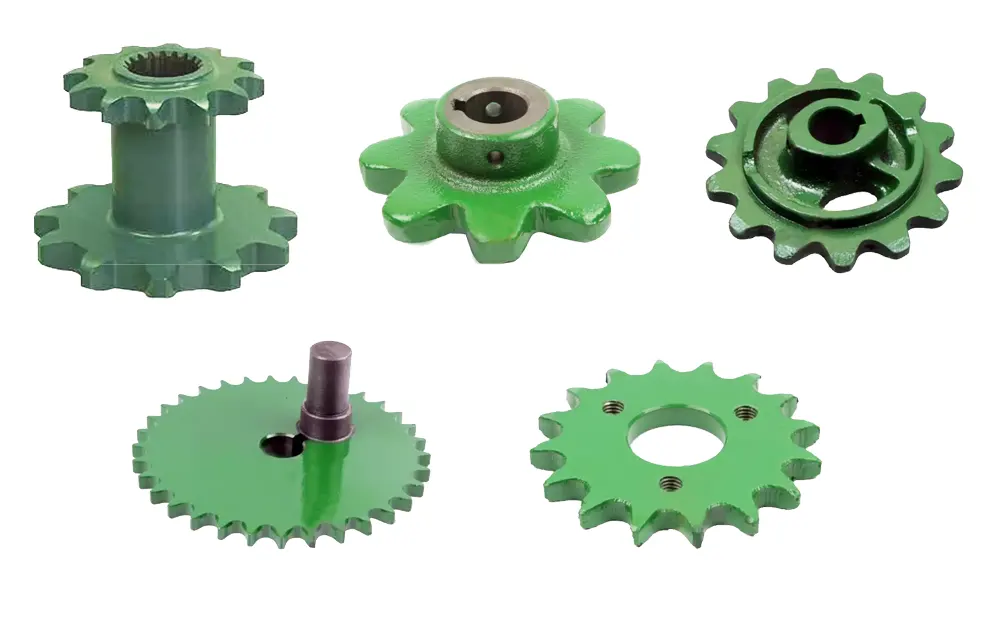
🔩 Agricultural Sprockets — Engineered to Match Your Hoist Chain
An agricultural hoist chain is only as dependable as the sprockets it wraps around. In hoist-chain applications — where the chain loop is often very short (as few as 20–30 links in a transplanting machine cup carousel) — the chain-to-sprocket engagement ratio is far higher than in a typical long-run power transmission circuit. This means that sprocket tooth geometry has a disproportionately large influence on chain wear rate, noise level, and attachment link fatigue.
Worn sprockets with "hooked" tooth profiles — where the load-bearing flank has deformed into a concave shape due to wear from a previous chain — impose a dramatically higher bending load on individual chain plates each time a link engages. This bending load acts at the worst possible location: the pin-hole stress concentration at the inner plate. Even a brand-new attachment chain will wear prematurely and fatigue early if run on a worn sprocket.
Our agricultural sprockets are machined with tooth profiles optimised for 12.7 mm pitch chains including the full 415/420 series range. Induction-hardened tooth flanks (HRC 45–55 surface hardness) are matched to the roller hardness of our hoist chains to provide an optimised wear pairing. We recommend simultaneous replacement of chain and sprockets when chain elongation reaches the 2% replacement threshold — this single practice is the most effective step Australian operators can take to extend service intervals and reduce unplanned downtime.
Frequently Asked Questions — Agricultural Hoist Chains (415 & 420 Series)
Get the Right Agricultural Hoist Chain for Your Machine — First Time, Every Time
Whether you need a single pre-cut replacement set for your Kubota rice harvester, a pre-season dealer stocking order for your workshop, or an OEM customisation program for your machinery brand — our Australia-market technical team is ready to help you specify with complete confidence.
📞 Technical support available AEST 09:00–17:00, Monday–Friday. | ✉️ We respond within 24 business hours.
Precision-manufactured 415 and 420 series agricultural hoist chains engineered for Australian farm machinery including rice harvesters, vegetable transplanters, hay balers, and potato harvesters. Available in 12 variants from 415Y1 to 420Y1, conforming to ISO 487:2013. SGS certified, OEM/ODM customisation supported, with AEST business-hours technical assistance.
MOQ: 10 pcs. Minimum order value USD 1,500; mixed orders and trial quantities welcome.