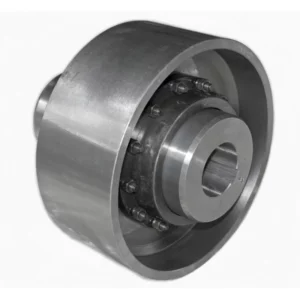
LMZ-I Type Plum Blossom Coupling with Split Brake Wheel
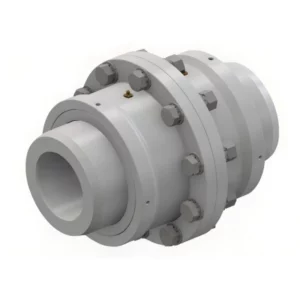
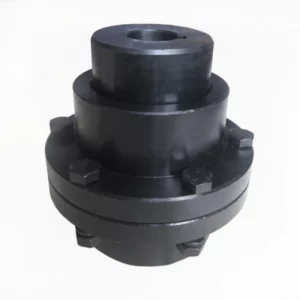
The LMZ-I Type Plum Blossom Coupling with Split Brake Wheel (GB/T5272-2002) integrates a removable split brake drum directly onto the jaw coupling hub, eliminating the separate brake-wheel component. Available in 15 sizes from LMZ5-1-160 to LMZ14-1-800 covering torque up to 25,000 N·m with brake wheel diameters 160–800 mm — the standard solution for hoist, crane, and elevator drives requiring drum-brake deceleration.
MOQ: 50 pcs. Minimum order value USD 1,500; mixed orders and trial quantities welcome.
What Is an LMZ-I Split Brake Wheel Coupling?
The LMZ-I plum blossom coupling with split brake wheel solves a long-standing design challenge in hoist and crane engineering: how to mount a brake drum on a drive shaft without sacrificing the vibration damping and misalignment tolerance of a jaw coupling. By casting the brake drum in two bolt-together halves and integrating them directly onto one coupling hub, the LMZ-I eliminates the separate brake wheel, its keyway, its retaining hardware, and the axial space it would otherwise consume.
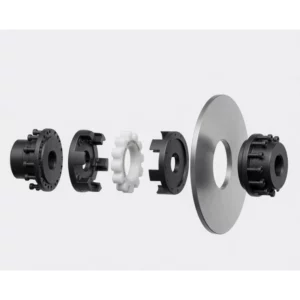
Four-Component Assembly
- Drive hub (inner body) — keyed to the drive shaft; carries the claw profile for spider engagement. Cast iron for sizes LMZ5–LMZ8; ductile iron for LMZ9–LMZ14.
- Split brake wheel (2 halves) — bolted together around the hub OD. Removed radially for replacement or brake lining access without any shaft movement. Rim surface hardness 35–45 HRC to depth 2–3 mm.
- Driven hub — standard LM-type hub on the opposing shaft.
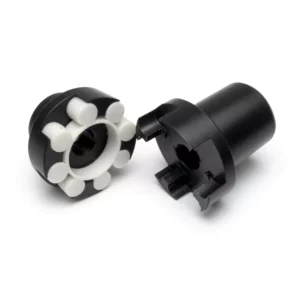
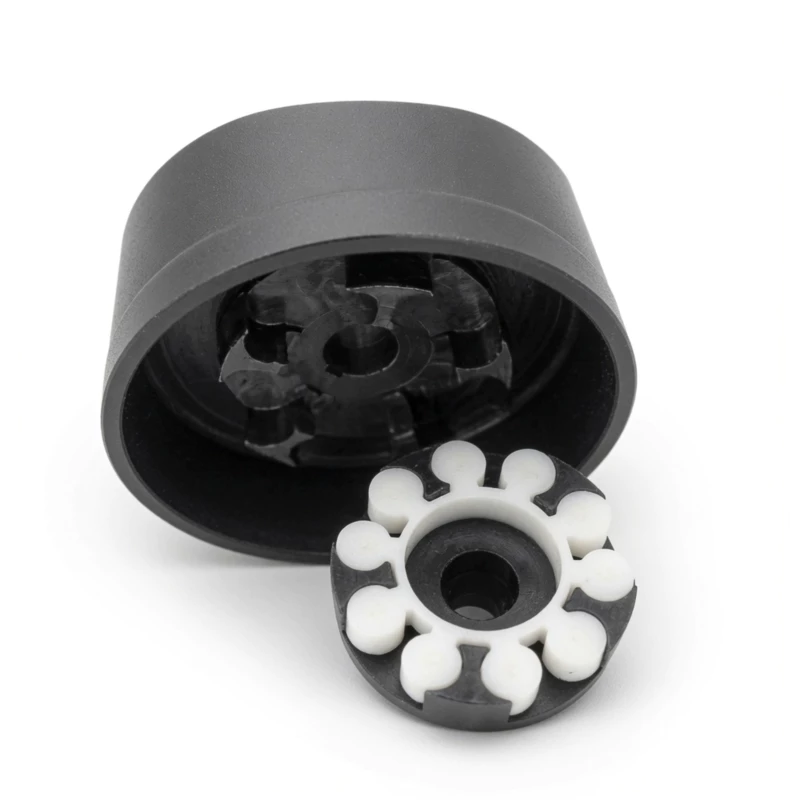
- Polyurethane spider — standard shA (a) or shD (b) grade; same replacement procedure as the base LM coupling.
LMZ-I vs LMZ-II — Key Differences
| Feature | LMZ-I (Split Wheel) | LMZ-II (Integral Wheel) |
|---|---|---|
| Brake wheel construction | Two removable halves | Cast integrally with hub |
| Brake wheel replacement | Radial — no shaft movement | Requires hub removal |
| Axial length | Slightly longer (split ring) | Compact |
| Torque range | 250–25,000 N·m | 250–12,500 N·m |
| Brake wheel diameters | 160–800 mm | 160–800 mm |
| Best for | High brake-wear applications; tight axial access | Compact drives; lower brake wear frequency |
LMZ-I Coupling Specifications & Dimensions
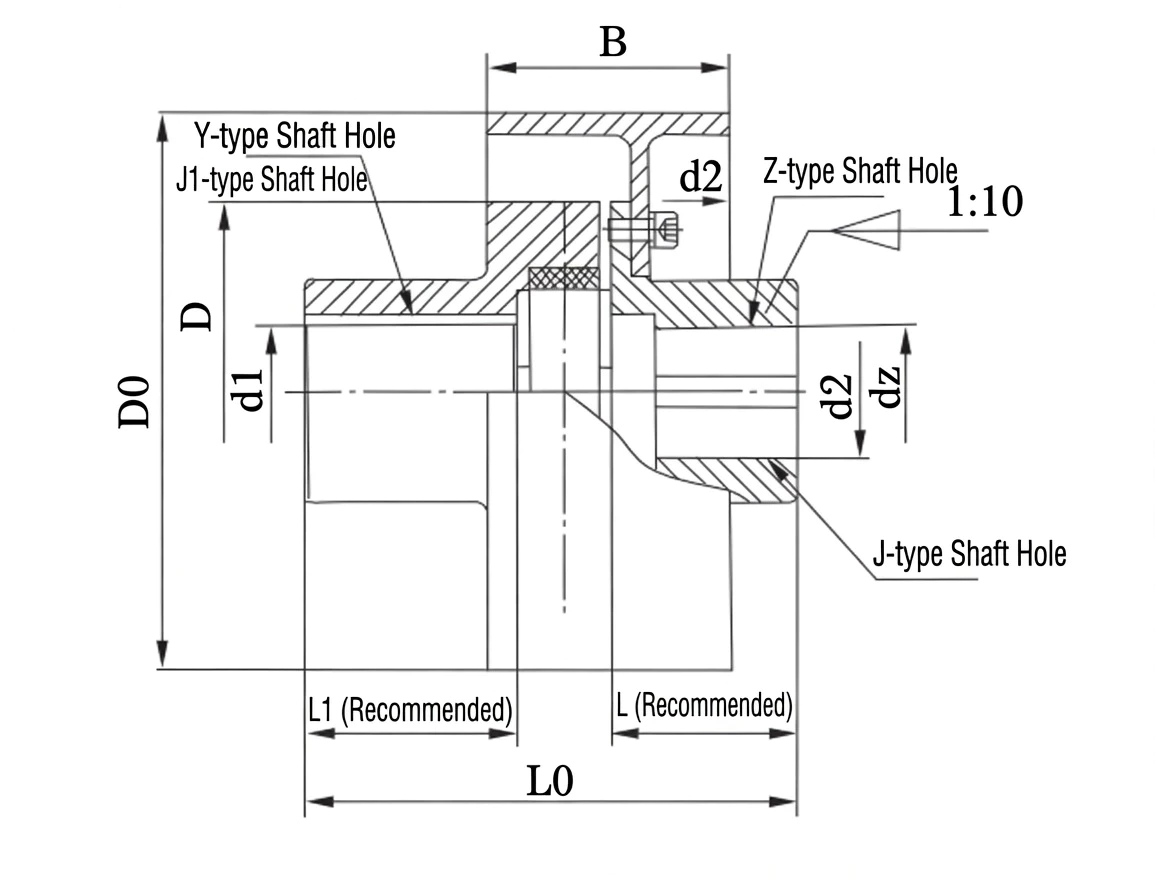
Hub: cast iron (LMZ5–LMZ8) / ductile iron (LMZ9–LMZ14) · Brake wheel rim hardness: 35–45 HRC, depth 2–3 mm · Spider: polyurethane −35 °C to +80 °C · * bore compatible with Z/J types
| Type | Nom. Torque N·m | Max Speed rpm | Shaft Bore d1,d2,dz mm | L mm | L0 mm | D0 Brake Wheel mm | B mm | D mm | Spider | |
|---|---|---|---|---|---|---|---|---|---|---|
| shA (a) | shD (b) | |||||||||
| LMZ5-1-160 | 250 | 400 | 4,750 | 25–45 | 50 | 127 | 160 | 70 | 105 | MT5 a/b |
| LMZ5-1-200 | 250 | 400 | 4,750 | 25–45 | 50 | 127 | 160 | 70 | 105 | MT5 a/b |
| LMZ6-1-200 | 400 | 710 | 3,800 | 30–48 | 55 | 143 | 200 | 85 | 125 | MT6 a/b |
| LMZ7-1-200 | 630 | 1,120 | 3,050 | 35–56 | 60 | 159 | — | — | 145 | MT7 a/b |
| LMZ7-1-250 | 630 | 1,120 | 3,050 | 35–56 | 60 | 159 | 250 | 105 | 145 | MT7 a/b |
| LMZ8-1-250 | 1,120 | 2,240 | 2,400 | 45–65 | 70 | 181 | 250 | 105 | 170 | MT8 a/b |
| LMZ8-1-315 | 1,120 | 2,240 | 2,400 | 45–65 | 70 | 181 | 315 | 135 | 170 | MT8 a/b |
| LMZ9-1-315 | 1,800 | 3,550 | 1,900 | 50–80 | 80 | 208 | 315 | 135 | 200 | MT9 a/b |
| LMZ9-1-400 | 1,800 | 3,550 | 1,900 | 50–80 | 80 | 208 | 400 | 170 | 200 | MT9 a/b |
| LMZ10-1-400 | 2,800 | 5,600 | 1,500 | 60–100 | 90 | 230 | 400 | 170 | 230 | MT10 a/b |
| LMZ10-1-500 | 2,800 | 5,600 | 1,500 | 60–100 | 90 | 230 | 500 | 210 | 230 | MT10 a/b |
| LMZ11-1-500 | 4,500 | 9,000 | — | 70–120 | 100 | 260 | 500 | 210 | 260 | MT11 a/b |
| LMZ12-1-630 | 6,300 | 12,500 | 1,200 | 80–130 | 115 | 297 | 630 | 265 | 300 | MT12 a/b |
| LMZ13-1-710 | 11,200 | 20,000 | 1,050 | 90–150 | 125 | 323 | 710 | 300 | 360 | MT13 a/b |
| LMZ14-1-800 | 12,500 | 25,000 | 950 | 100–160 | 135 | 343 | 800 | 340 | 400 | MT14 a/b |
Related Plum Blossom Coupling Types
Torque: 16–8,000 N·m · No brake · General industrial drives
Torque: 25–25,000 N·m · No brake · Radial spider replacement
Torque: 250–25,000 N·m · Split drum D0 160–800 mm · Shoe-brake drives
Torque: 250–12,500 N·m · One-piece integral drum · Compact drum-brake drives
Torque: 630–1,800 N·m · Disc brake systems · Spider replaceable in situ
Full dimensional cross-reference drawings are available on our coupling catalogue page.
How to Select an LMZ-I Coupling
Step 1 — Coupling Torque
Apply service factor K (1.25–3.0), motor power P in kW, and speed N in rpm. Select the LMZ-I size whose nominal torque Tn ≥ TC.
Step 2 — Brake Wheel Diameter
The required brake wheel diameter D0 is determined by the braking torque demand and the brake shoe geometry. For a given coupling size, multiple D0 options are available — select the suffix that matches your brake gear. Example: for LMZ9 with 315 mm shoes, order LMZ9-1-315; with 400 mm shoes, order LMZ9-1-400.
Step 3 — Shaft Bore & Spider Hardness
Verify both shaft diameters fall within the bore range for the selected size. For hoist and crane drives with frequent starts and dynamic braking, the shA (a) spider is the standard choice. For drives with severe shock or resonance, specify shD (b). Shaft hole types Y, J, J1, and Z are all available — confirm shaft-end geometry before ordering.
LMZ-I Ordering Mark Format
Example: LMZI 2-I-630 YAI 10×115 / Zc95×115
- Size number 2 → LMZ6 series coupling
- I → split brake wheel type
- 630 → brake wheel diameter D0 = 630 mm
- YA, Zc → bore type and keyway style
- 10×115, 95×115 → bore diameter × bore length
Industry Applications
The primary application for LMZ-I. Bridge and gantry crane cross-travel drives use LMZ8–LMZ12 with D0 315–630 mm. The split brake wheel allows drum replacement during scheduled crane maintenance without disturbing gearbox-motor alignment.
Ship-to-shore crane drives, rubber-tyred gantries, and bulk-handling grabs (LMZ10–LMZ14). High cycle rates and dynamic braking demand frequent brake lining replacement; the split drum makes this a one-technician task.
Shaft sinking hoists and friction-winders with LMZ12–LMZ14 (up to 800 mm drum, 25,000 N·m). The spider's vibration damping reduces dynamic loads transmitted to the winder gearbox during rapid stops.
Blast furnace and EAF charging cranes need reliable braking in high-temperature, dusty environments. LMZ-I's split drum simplifies lining inspection and replacement without rigging the crane hook.
Offshore crane winch drives exposed to corrosive marine atmospheres use LMZ-I with stainless steel bolt hardware. The radial drum removal is critical when working over water where axial disassembly is impractical.
Machine-room-less elevator main drives use LMZ7–LMZ9 for their compact footprint and the ability to service the brake drum without disturbing the traction sheave alignment.
Installation & Maintenance
Initial Installation
- Press or heat-shrink both hubs onto their shafts; torque setscrews to spec.
- Align shafts with laser or dial gauge to within coupling angular/radial tolerances.
- Insert the polyurethane spider between the claw faces.
- Assemble the two brake wheel halves around the hub OD and torque the joining bolts evenly.
- Connect brake shoes to the drum; verify shoe-to-drum clearance (typically 0.5–1.0 mm).
- Rotate by hand and confirm concentric running of brake drum (runout <0.3 mm recommended).
Brake Wheel Replacement
- De-energise and lock out the drive; release brake shoes away from the drum.
- Remove the half-wheel joining bolts; withdraw each half radially.
- Inspect hub OD for wear; clean and de-burr.
- Fit new drum halves; torque joining bolts in three cross-pattern passes.
- Check drum runout (<0.3 mm) before returning to service.
Fault Diagnosis
| Symptom | Likely Cause | Action |
|---|---|---|
| Vibration after braking | Drum runout; uneven shoe wear; spider degradation | Check drum runout; replace spider; equalise shoes |
| Drum overheating | Excessive braking frequency; incorrect shoe clearance | Check duty cycle; reset shoe clearance |
| Coupling vibration (no braking) | Worn spider; shaft misalignment | Replace spider; realign shafts |
| Drum half-joint noise | Loose joining bolts; fretting at split faces | Re-torque bolts; inspect split faces |
LMZ-I vs Alternative Brake-Coupling Approaches
| Criterion | LMZ-I (Split Wheel) | LMZ-II (Integral Wheel) | Separate Brake Wheel + LM Coupling |
|---|---|---|---|
| Drum replacement | Radial, in-situ | Hub removal required | Shaft removal required |
| Axial space required | L0 only | L0 (shorter) | L0 + brake wheel + spacers |
| Component count | 4 (2 hubs + drum halves + spider) | 3 (2 hubs + spider) | 5+ (coupling + wheel + key + spacers) |
| Vibration damping | ★★★★☆ | ★★★★☆ | ★★★★☆ |
| Max torque (standard) | 25,000 N·m | 12,500 N·m | Coupling-dependent |
Customer Case Studies
Australia — Container Port
Installed LMZ11-1-500 on four ship-to-shore crane travel drives. The split drum meant our maintenance crew could change brake linings without rigging the crane for coupling disassembly — a full drum swap now takes two people and 40 minutes versus half a day previously.
Port Equipment Manager, Port of Melbourne AU
★★★★★
Germany — Steel Mill
LMZ12-1-630 units on charging crane drives in our EAF shop. Dusty, high-temperature environment. We strip and inspect the brake drums every 1,000 hours — the split design makes this a routine task even with limited overhead clearance.
Maintenance Manager, Duisburg DE
★★★★★
Brazil — Mining Hoist
LMZ14-1-800 couplings on the main skip hoist drive at an iron ore mine. 25,000 N·m torque rating comfortably handles our duty cycle. The coupling's vibration damping has noticeably reduced dynamic loads on the head-gear bearings compared to the rigid flanged couplings we used before.
Chief Engineer, Minas Gerais BR
★★★★☆
Australia — Industrial Elevator
LMZ8-1-315 fitted to machine-room-less elevator main drives in a 28-storey commercial building. Compact footprint fits the machine room constraint; split drum allows annual brake inspection without disturbing the traction sheave alignment. Twelve months operational — zero service calls.
Lift Maintenance Contractor, Sydney NSW AU
★★★★★
Frequently Asked Questions
▶ What is the difference between LMZ-I and LMZ-II?
LMZ-I has a split brake wheel in two removable halves — each half unbolts and withdraws radially, so the drum can be replaced without any shaft or hub movement. LMZ-II has a one-piece integral brake wheel cast directly into the hub, giving a more compact design but requiring hub removal (and realignment) to replace a worn drum. Choose LMZ-I when brake wear is frequent or when axial hub movement is impractical.
▶ What brake wheel diameters are available?
Diameters range from 160 mm (LMZ5-1-160) to 800 mm (LMZ14-1-800). Each size family (LMZ5 through LMZ14) offers two or more D0 options — select the suffix matching your brake gear. For example, LMZ9 is available as LMZ9-1-315 (315 mm drum) or LMZ9-1-400 (400 mm drum).
▶ Can the brake wheel halves be replaced without disassembling the coupling?
Yes. Remove the half-wheel joining bolts and withdraw each half radially away from the hub. Neither shaft nor coupling hub needs to move at any point. The spider can remain in place during drum replacement unless it is also due for inspection.
▶ What is the rim hardness of the brake drum?
The brake drum rim is surface-hardened to 35–45 HRC to a depth of 2–3 mm, providing good wear resistance against brake shoe friction material. The hub body beneath the rim remains at cast or ductile iron hardness for impact toughness.
▶ How do I specify an LMZ-I coupling for ordering?
Use the format: LMZI [Size]-I-[D0] [BoreType][d1]×[L1] / [BoreType][d2]×[L2]. Example: LMZI 2-I-630 YAI 10×115/Zc95×115 — size 2 (LMZ6), split wheel, 630 mm drum, Y-type bore A keyway 10 mm dia × 115 mm long, Z-type bore c keyway 95 mm dia × 115 mm long. Contact our team if you need assistance generating the correct mark.
Specify LMZ-I Brake-Wheel Couplings for Your Crane or Hoist Project
GBC supplies all 15 LMZ-I configurations — full range of brake wheel diameters, both spider grades, all shaft hole types — with dimensional drawings and material certificates. Share your motor power, speed, and brake gear specification and we'll confirm the correct mark within 24 hours.
The LMZ-I Type Plum Blossom Coupling with Split Brake Wheel (GB/T5272-2002) integrates a removable split brake drum directly onto the jaw coupling hub, eliminating the separate brake-wheel component. Available in 15 sizes from LMZ5-1-160 to LMZ14-1-800 covering torque up to 25,000 N·m with brake wheel diameters 160–800 mm — the standard solution for hoist, crane, and elevator drives requiring drum-brake deceleration.
MOQ: 50 pcs. Minimum order value USD 1,500; mixed orders and trial quantities welcome.