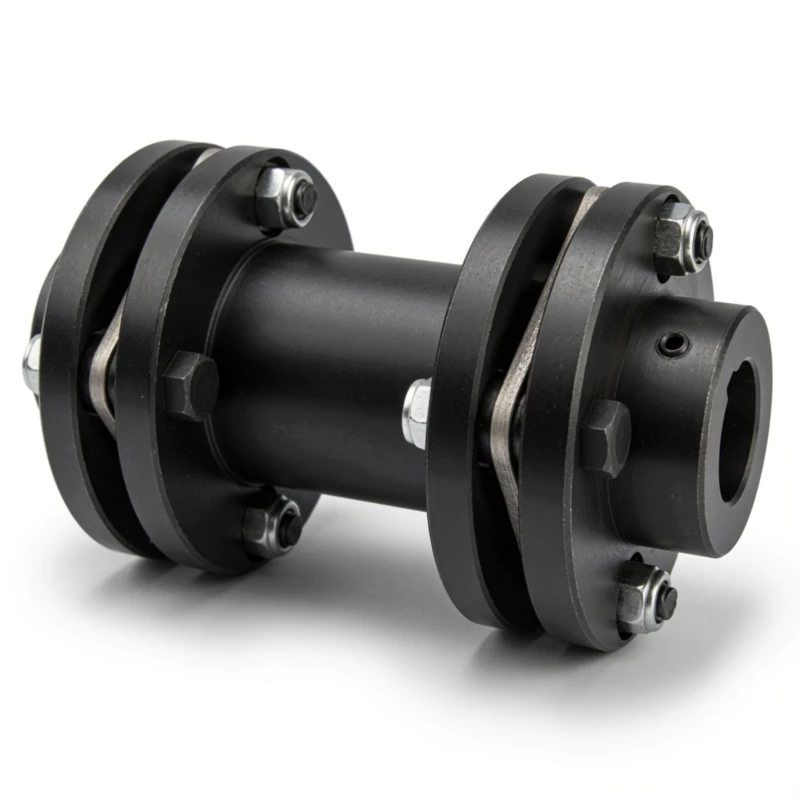
SJM Type Double Flexible Diaphragm Coupling
The SJM Type Double Flexible Diaphragm Coupling uses two stainless steel diaphragm packs separated by a centre spacer to deliver twice the misalignment compensation of the single-pack DJM — including direct radial offset up to 3.0 mm. Spanning 41 sizes from 9.8 N·m to 8,100,000 N·m at up to 20,000 rpm, it is the preferred zero-lubrication solution for long shaft spans, turbomachinery, and drives where multi-directional misalignment cannot be avoided.
MOQ: 50 pcs. Minimum order value USD 1,500; mixed orders and trial quantities welcome.
What Is an SJM Double Flexible Diaphragm Coupling?
The SJM type double flexible diaphragm coupling builds on the proven single-pack DJM architecture by adding a second stainless steel diaphragm pack on the opposite shaft end, separated from the first by a rigid cylindrical spacer. This dual-pack arrangement provides a step-change in misalignment capacity: axial compensation doubles, angular tolerance increases to 2°, and — critically — direct radial offset becomes possible because the two packs can flex in complementary directions to accommodate shaft centreline offset without bending moments on the bearings.
Like the single-pack DJM, the SJM transmits torque entirely through the elastic deformation of its stainless steel diaphragm packs, without any sliding contact, grease, or wear-limited elastomeric element. The coupling is torsionally stiff, backlash-free, and serviceable at temperatures from -40°C to +280°C — making it the preferred choice for turbomachinery, long-span pump installations, power generation couplings, and any drive where shafts cannot be held within the tighter tolerance required by a single-pack unit.
Dual-Pack Geometry and Why It Matters
In a single-pack coupling, radial shaft offset produces a bending moment at the single diaphragm location. Two packs separated by the spacer C create a mechanical linkage: radial offset is absorbed by equal and opposite angular deflection at each pack, so the bending moments cancel. The result is true radial compensation without transmitting offset-induced forces to the shaft bearings. This property is essential on long shaft spans where thermal growth, soft-foot settlement, or foundation movement routinely produces radial offsets beyond the single-pack's capacity.
Key Differences from the DJM Single-Pack
| Criterion | SJM Double | DJM Single |
|---|---|---|
| Diaphragm packs | 2 (with spacer) | 1 |
| Axial compensation | ±1.6–±16.4 mm | ±0.8–±8.2 mm |
| Angular compensation | Up to 2° | Up to 1° |
| Direct radial compensation | 0.5–3.0 mm | Indirect only |
| Overall length | Longer (spacer C) | Shorter |
| Long shaft spans | Preferred choice | Limited |
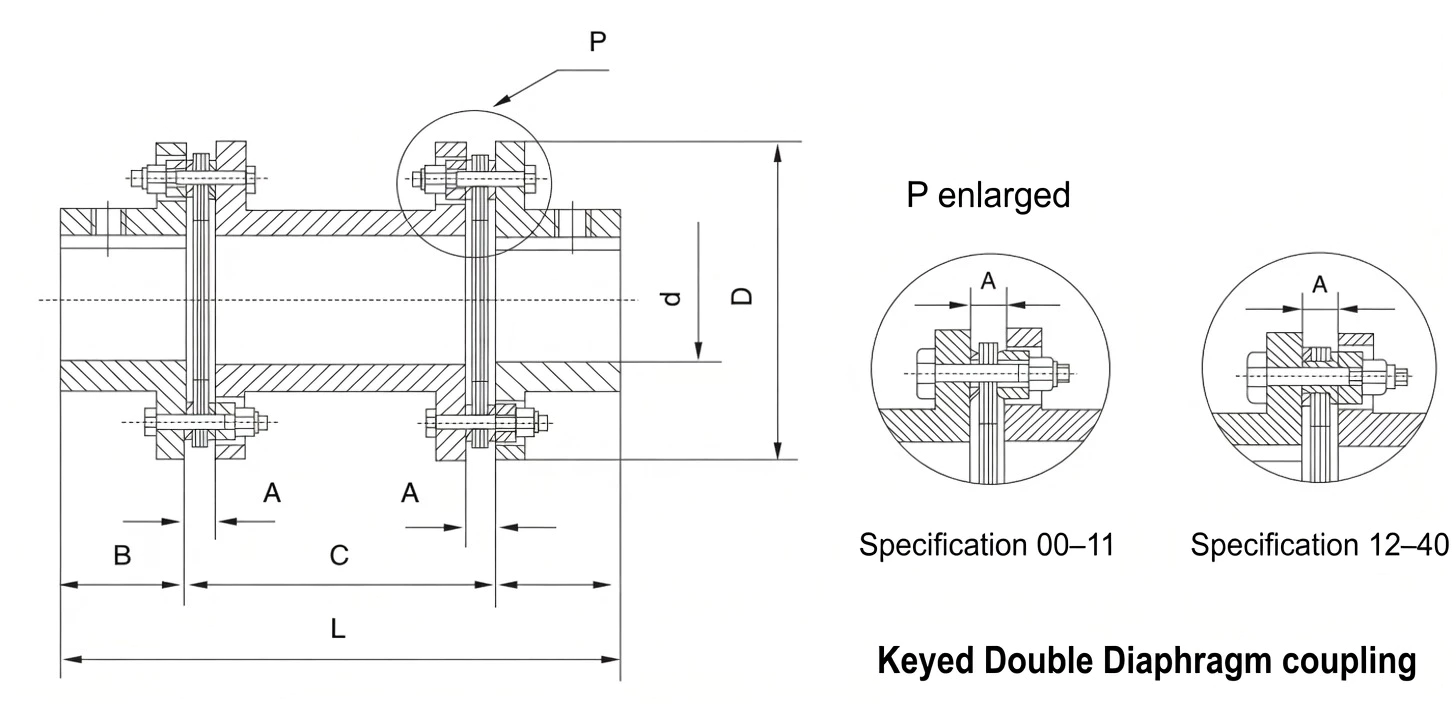
SJM Coupling Specifications and Dimensions
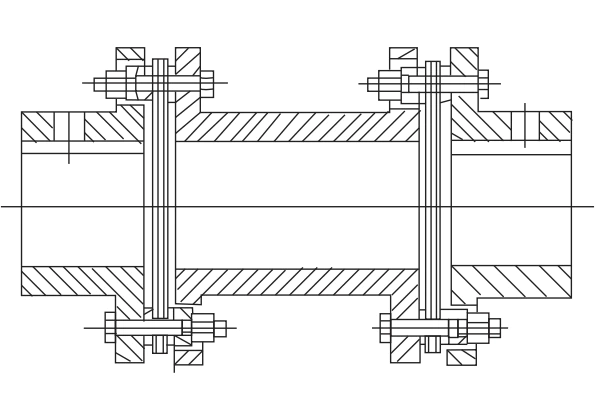
Materials
Diaphragm packs: stainless steel sheet (two packs per coupling). Spacer and hubs: carbon steel or alloy steel. Bolts: high-tensile alloy steel. Imperial bore machining and corrosion-resistant surface treatments available on request.
Ordering Mark Example
→ Type SJM double, size 07 | Drive: Y-bore A-keyway d=55 mm L=112 mm | Driven: Y-bore A-keyway d=50 mm L=112 mm
Complete Parameter Table — SJM00 to SJM40
Sizes 00–11: bore length L per Y-type recommendation. Sizes 12–40: hub flange type, J dimension not applicable (–). Spacer C is standard value; custom spacer lengths available. Radial compensation: 0.5 mm (00–04), 0.7–0.8 mm (05–11), 1.2 mm (12–14), 1.3–3.0 mm (15–40).
| Size | Nom. Torque N·m | Max Speed rpm | Bore d mm | D mm | A mm | B mm | L mm | C (spacer) mm | Axial mm | Angle | Radial mm | Weight kg |
|---|---|---|---|---|---|---|---|---|---|---|---|---|
| 00 | 9,800 | 20,000 | 3–20 | 57 | 4.9 | 20 | 100 | 60 | ±1.6 | 2° | 0.5 | 0.7 |
| 01 | 33,000 | 20,000 | 5–22 | 68 | 6.1 | 26 | 141 | 89 | ±1.6 | 2° | 0.5 | 1.2 |
| 02 | 90,000 | 20,000 | 6–32 | 81 | 6.6 | 26 | 141 | 89 | ±1.6 | 2° | 0.5 | 1.9 |
| 03 | 173,000 | 18,000 | 8–35 | 93 | 8.4 | 29 | 160 | 102 | ±2.4 | 2° | 0.6 | 2.9 |
| 04 | 245,000 | 15,000 | 10–42 | 104 | 11.2 | 34 | 195 | 127 | ±2.8 | 2° | 0.7 | 4.7 |
| 05 | 420,000 | 13,000 | 15–50 | 126 | 11.7 | 42 | 211 | 127 | ±3.2 | 1°30' | 0.7 | 7.1 |
| 06 | 772,000 | 12,000 | 20–60 | 143 | 11.7 | 48 | 223 | 127 | ±3.6 | 1°30' | 0.8 | 10.8 |
| 07 | 1,270,000 | 10,000 | 25–75 | 168 | 16.8 | 58 | 243 | 127 | ±4.0 | 1°30' | 0.8 | 16.3 |
| 08 | 2,080,000 | 10,000 | 30–82 | 194 | 17.0 | 64 | 268 | 140 | ±4.4 | 1°30' | 0.9 | 24.7 |
| 09 | 3,328,000 | 9,000 | 30–95 | 214 | 21.6 | 77 | 306 | 152 | ±4.8 | 1°30' | 0.9 | 32.5 |
| 10 | 4,900,000 | 8,000 | 40–108 | 250 | 23.9 | 89 | 356 | 178 | ±5.2 | 1°30' | 1.0 | 50.0 |
| 11 | 6,368,000 | 6,300 | 52–118 | 276 | 27.2 | 102 | 382 | 178 | ±5.6 | 1°30' | 1.2 | 75.0 |
| 12 | 8,900,000 | 6,300 | 60–110 | 276 | 17.5 | 128 | 409 | 153 | ±3.6 | 1° | 1.2 | 72.2 |
| 13 | 15,280,000 | 5,000 | 60–135 | 308 | 19.0 | 160 | 492 | 172 | ±4.0 | 1° | 1.2 | 120.0 |
| 14 | 25,410,000 | 4,700 | 60–155 | 350 | 21.5 | 182 | 554 | 190 | ±4.0 | 1° | 1.2 | 175 |
| 15 | 37,130,000 | 4,300 | 60–160 | 375 | 24.0 | 198 | 620 | 224 | ±4.0 | 1° | 1.3 | 234 |
| 16 | 47,120,000 | 3,900 | 70–180 | 410 | 29.5 | 214 | 682 | 254 | ±4.4 | 1° | 1.3 | 306 |
| 17 | 57,000,000 | 3,500 | 70–190 | 445 | 29.5 | 225 | 720 | 270 | ±4.4 | 1° | 1.4 | 369 |
| 18 | 63,186,000 | 3,500 | 80–205 | 470 | 31.0 | 248 | 770 | 274 | ±4.8 | 1° | 1.5 | 448 |
| 19 | 82,590,000 | 3,200 | 90–230 | 512 | 32.0 | 278 | 843 | 287 | ±4.8 | 1° | 1.6 | 596 |
| 20 | 102,100,000 | 2,800 | 90–255 | 556 | 32.5 | 305 | 902 | 292 | ±5.2 | 1° | 1.8 | 763 |
| 21 | 126,070,000 | 2,450 | 100–265 | 588 | 34.0 | 318 | 948 | 312 | ±5.4 | 1° | 1.8 | 919 |
| 22 | 146,350,000 | 2,150 | 100–275 | 630 | 34.5 | 332 | 1008 | 344 | ±5.6 | 1° | 2.0 | 1068 |
| 23 | 173,830,000 | 2,000 | 100–290 | 655 | 35.5 | 348 | 1052 | 356 | ±6.0 | 1° | 2.0 | 1235 |
| 24 | 200,000,000 | 1,400 | 210–305 | 680 | 44 | 350 | 1080 | 380 | ±7.0 | 30' | 2.0 | 1350 |
| 25 | 250,000,000 | 1,250 | 225–340 | 745 | 44 | 350 | 1100 | 400 | ±8.0 | 30' | 2.0 | 1580 |
| 26 | 315,000,000 | 1,200 | 250–365 | 785 | 50 | 350 | 1120 | 420 | ±8.4 | 30' | 2.0 | 1650 |
| 27 | 400,000,000 | 1,150 | 270–380 | 830 | 50 | 380 | 1200 | 440 | ±9.0 | 30' | 2.0 | 1950 |
| 28 | 500,000,000 | 1,100 | 290–400 | 875 | 50 | 400 | 1250 | 450 | ±9.6 | 20' | 2.5 | 2200 |
| 29 | 630,000,000 | 1,000 | 320–425 | 935 | 60 | 400 | 1280 | 480 | ±10.0 | 20' | 2.5 | 2300 |
| 30 | 800,000,000 | 930 | 340–440 | 1030 | 60 | 440 | 1380 | 500 | ±10.4 | 20' | 2.5 | 2600 |
| 31 | 1,000,000,000 | 880 | 380–460 | 1080 | 66 | 460 | 1440 | 520 | ±11.0 | 20' | 2.5 | 3500 |
| 32 | 1,250,000,000 | 820 | 400–500 | 1160 | 70 | 520 | 1620 | 580 | ±11.6 | 20' | 2.5 | 4800 |
| 33 | 1,600,000,000 | 740 | 420–560 | 1290 | 82 | 570 | 1740 | 600 | ±12.4 | 20' | 3.0 | 6100 |
| 34 | 2,000,000,000 | 680 | 460–600 | 1410 | 92 | 570 | 1740 | 600 | ±13.0 | 20' | 3.0 | 7600 |
| 35 | 2,500,000,000 | 620 | 480–650 | 1530 | 105 | 610 | 1900 | 700 | ±13.6 | 20' | 3.0 | 8600 |
| 36 | 3,020,000,000 | 570 | 500–710 | 1670 | 115 | 730 | 2210 | 750 | ±14.4 | 20' | 3.0 | 11000 |
| 37 | 4,050,000,000 | 520 | 600–780 | 1830 | 125 | 800 | 2450 | 850 | ±15.0 | 20' | 3.0 | 14700 |
| 38 | 5,300,000,000 | 480 | 650–860 | 2000 | 130 | 800 | 2500 | 900 | ±15.6 | 20' | 3.0 | 21000 |
| 39 | 6,600,000,000 | 430 | 700–945 | 2200 | 140 | 960 | 2920 | 1000 | ±16.0 | 20' | 3.0 | 26700 |
| 40 | 8,100,000,000 | 400 | 800–1030 | 2400 | 140 | 960 | 2920 | 1000 | ±16.4 | 20' | 3.0 | 32000 |
How to Select an SJM Diaphragm Coupling
Design Torque Calculation
K = service factor | P = rated power (kW) | N = speed (rpm) | Tn = nominal torque of selected size
When to Choose SJM over DJM
- Shaft radial (parallel) offset exceeds the DJM single-pack's indirect compensation capacity
- Long shaft spans where thermal growth or foundation settlement routinely produces radial drift
- Both angular and radial misalignment are present simultaneously
- Applications where re-alignment after each maintenance shutdown is impractical
- Turbomachinery trains where bearing-to-bearing distances exceed 600 mm
Spacer Length C
The spacer length C determines the total coupling length L and the effective radial compensation. Standard C values are listed in the parameter table. Custom spacer lengths are available to suit specific shaft-end gaps — specify the required C dimension when ordering. Increasing C beyond the standard value increases radial compensation proportionally.
Metal Diaphragm Coupling Series Overview
All diaphragm coupling types in the GBC range share the same stainless steel diaphragm pack technology and steel hub materials. Browse the full diaphragm coupling range for selection guidance.
9.8–8,100,000 N·m · 41 sizes · Single pack · Shorter length · Axial and angular compensation
9.8–8,100,000 N·m · 41 sizes · Dual pack · Radial offset to 3.0 mm · Long shaft spans
33–1,270 N·m · 7 sizes · Interference-fit Z1 locking device · Zero backlash · CNC drives
Cone-hub connection · CNC machine tool feed shafts · Replaces Z1 locking device
33–8,100,000 N·m · Z7B locking disc · Single and double pack
420–25,410 N·m · Integrated disc brake D0 315–1,000 mm
Rod-type · 40–180,000 N·m · Large compensation
Rod-type · Maximum misalignment · Long shaft spans
SJM Coupling Industry Applications
Large turbine-driven pump and compressor trains involve shaft spans of 1–4 metres where thermal growth routinely produces radial offset of 1–3 mm. The SJM's dual-pack design absorbs this growth without transmitting bending moments to the turbine or driven equipment bearings — a critical requirement for API 671 coupling applications.
Multi-stage boiler feed pumps and pipeline booster pumps operate at 3,000–6,000 rpm with shafts that drift radially as operating temperature stabilises. The SJM accommodates this cold-to-hot offset transition while maintaining torsional stiffness, protecting pump impeller clearances from misalignment-induced vibration.
Generator coupling applications involve high torque, high speed, and shaft arrangements where alignment tolerance is difficult to achieve and maintain. The SJM provides the zero-lubrication, zero-maintenance operation essential for long continuous run plant, with radial compensation that accommodates foundation creep over months of continuous operation.
Shipboard propulsion shafts are subject to hull flexing, temperature change, and installation tolerances that produce both angular and radial misalignment. The SJM's all-metal construction withstands humidity and temperature cycling, and its lubrication-free design eliminates the pollution risk of grease-lubricated alternatives.
Disc refiners and high-consistency mixers transmit cyclic shock loads while running on foundations that are subject to vibration-induced settlement. The SJM's dual-pack configuration tolerates the resulting radial misalignment growth while the stainless steel packs resist the corrosive washdown environments common in pulp mills.
Large agitator drives in reactors and blending vessels often have poor shaft alignment due to the difficulty of setting baffled vessel nozzle flanges. The SJM allows more generous installation tolerances than a single-pack type, reducing installation time and the risk of premature bearing failure from forced alignment.
Installation and Maintenance
Installation Procedure
- Hub fitting: Press or heat-shrink hubs onto both shaft ends (induction heater ≤120°C). Torque setscrews to specification.
- Initial alignment: Align shafts to within the SJM's compensation limits using laser alignment equipment. The SJM tolerates more initial offset than the DJM, but good alignment maximises diaphragm service life.
- Spacer installation: Place the centre spacer between the two hub flanges; confirm spacer-to-flange gap corresponds to dimension C in the parameter table.
- Diaphragm pack mounting: Fit one pack at each end. Torque all bolts in a cross-pattern in three passes to the specified value. Correct bolt torque is critical — both under- and over-torquing damage the diaphragm at the bolt holes.
- Final check: Rotate two full turns by hand; verify smooth rotation, correct C dimension, and no metallic contact.
Fault Diagnosis
| Symptom | Likely Cause | Action |
|---|---|---|
| High 1× vibration | Radial misalignment exceeding SJM limit; unbalance | Re-align; check coupling balance |
| High 2× vibration | Angular misalignment; damaged diaphragm | Check angular alignment; inspect both packs |
| Diaphragm crack at bolt hole | Bolt under-torqued (micro-slip) or over-torqued (fatigue) | Replace pack; verify bolt torque with calibrated wrench |
| Spacer contact noise | Misalignment causing spacer eccentricity | Re-align; check spacer running clearance |
SJM vs Alternative Coupling Solutions
vs Gear Coupling: A gear coupling can tolerate similar radial offsets but requires grease re-lubrication every 6–12 months. In steam turbine or compressor applications, lubricant degradation at high temperature is a chronic cause of premature failure. The SJM eliminates this risk entirely, with no wear-dependent maintenance life.
vs Elastomeric Coupling: Elastomeric couplings are limited to +80°C in standard polyurethane grades and cannot match the torsional stiffness of metal diaphragm types. In turbomachinery applications requiring precise rotordynamic calculations, the SJM's predictable stiffness allows accurate critical speed analysis — elastomeric elements introduce variability that complicates this analysis.
vs DJM Single Pack: For applications where shaft radial offset is the dominant alignment challenge, the SJM is the correct choice. The DJM single-pack type remains preferred where space is constrained and shafts are well-aligned — it delivers the same zero-backlash, zero-lubrication characteristics in a shorter overall length.
Customer Case Studies
Australia — LNG Plant, Gas Turbine Driven Compressor
Installed SJM-18 on three gas turbine driven refrigerant compressor trains. Thermal growth on these machines produces 1.8–2.2 mm radial offset between cold and operating conditions. The SJM handles this growth without transmitting bearing loads, and we have eliminated the twice-yearly grease changes our previous gear couplings required. No unplanned stops in 22 months.
Rotating Equipment Superintendent, Western Australia AU
★★★★★
Netherlands — Large Boiler Feed Pump
SJM-14 and SJM-15 on three high-pressure boiler feed pump sets at a combined cycle power station. The station runs at high load factor; we cannot afford alignment-related failures. The SJM's dual-pack design tolerates the shaft movement we see during load changes without the vibration penalties that drove us away from gear couplings in 2022.
Turbine Engineer, Rotterdam NL
★★★★★
Japan — Steel Mill, Large ID Fan
SJM-20 to SJM-22 on induced draft fan drives at a blast furnace. Fan bearing temperatures can shift shaft position by 1.5–2.5 mm radially. The SJM absorbs this without the periodic realignment events that the previous gear coupling arrangement required after each fan maintenance stop. Maintenance downtime for these couplings is now zero.
Mechanical Maintenance Manager, Chiba JP
★★★★☆
Brazil — Pulp Mill, Disc Refiner Drives
SJM-10 through SJM-13 on chip disc refiners. The combination of high cyclic torque from wood knots, wet corrosive environment, and poor foundation stability made the previous elastomeric coupling unreliable. The SJM stainless steel packs handle the shock, resist the chemicals, and tolerate the foundation settlement we get during the wet season.
Asset Reliability Engineer, Mato Grosso do Sul BR
★★★★★
Frequently Asked Questions
▶ Why does the SJM provide more radial compensation than the DJM?
The SJM uses two diaphragm packs separated by a rigid spacer. Radial shaft offset causes both packs to deflect angularly in complementary directions — the resulting moments cancel at the spacer, so no bending force is transmitted to the shaft bearings. A single-pack DJM accommodates radial offset only indirectly through its angular flex, which generates a residual bending moment. The dual-pack arrangement is the only way to achieve true zero-moment radial compensation.
▶ What is the C dimension in the SJM parameter table?
C is the length of the centre spacer that separates the two diaphragm packs. The standard C value for each size is listed in the parameter table. The total coupling length L equals the sum of the two hub dimensions and the spacer C. Custom spacer lengths are available for non-standard shaft-end gaps — increasing C proportionally increases the coupling's radial compensation capacity.
▶ Can an SJM coupling be balanced for high-speed applications?
Yes. GBC offers shop-balanced and site-balanced SJM assemblies for applications above 5,000 rpm or where residual unbalance must meet API 671 specifications. Dynamic balancing is performed on the complete coupling assembly (both hubs and spacer). Specify the required balance grade (G1.0, G2.5, or API 671 Grade) when ordering.
▶ How often should SJM diaphragm packs be inspected?
Visually inspect both diaphragm packs at each machine shutdown, at minimum annually. The main failure modes — fatigue cracking at bolt holes from chronic misalignment, and fretting from under-torqued bolts — are visible to the naked eye. The diaphragm pack can be replaced without removing the hubs from the shafts; only the pack mounting bolts need to be undone.
▶ Can the SJM be used as a drop-in replacement for a gear coupling?
In most cases, yes, subject to dimensional compatibility. The SJM offers a longer overall length than an equivalent gear coupling due to the spacer, but the bore range, hub OD, and bolt circle are often compatible with existing shaft arrangements. Supply GBC with the existing coupling's dimensional drawing and shaft data; our team will confirm dimensional fit and calculate the correct SJM size for the application.
Specify SJM Double Diaphragm Couplings for Your Drive Train
GBC supplies all 41 SJM sizes with full dimensional documentation, custom bore and spacer configurations, balance certification, and material test certificates. Send your motor power, speed, shaft diameters, and alignment data and our engineering team will confirm the correct size, spacer length, and bore mark within 24 hours.
The SJM Type Double Flexible Diaphragm Coupling uses two stainless steel diaphragm packs separated by a centre spacer to deliver twice the misalignment compensation of the single-pack DJM — including direct radial offset up to 3.0 mm. Spanning 41 sizes from 9.8 N·m to 8,100,000 N·m at up to 20,000 rpm, it is the preferred zero-lubrication solution for long shaft spans, turbomachinery, and drives where multi-directional misalignment cannot be avoided.
MOQ: 50 pcs. Minimum order value USD 1,500; mixed orders and trial quantities welcome.