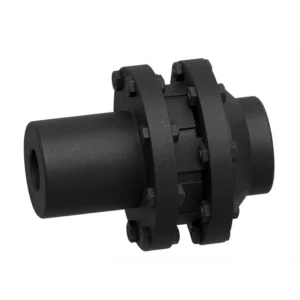
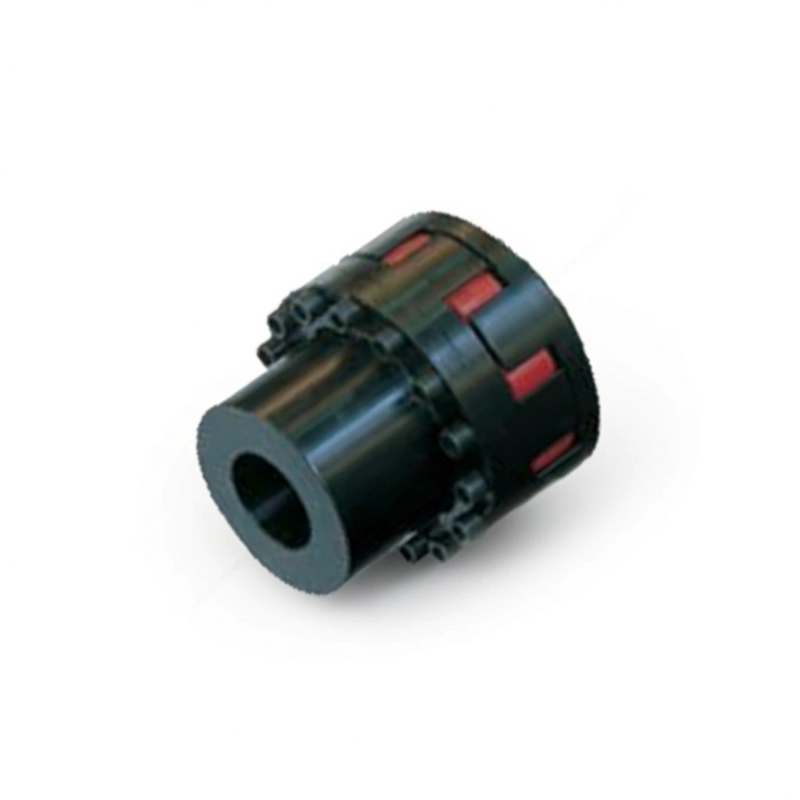
DF Type Double Flanged Flexible Jaw Coupling
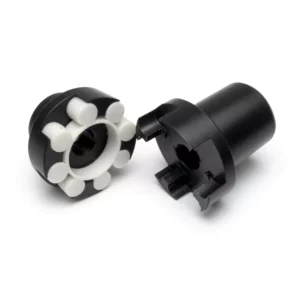
The DF Type Double Flanged Flexible Jaw Coupling uses removable flanges on both ends for the fastest possible in-situ elastomer replacement on heavy machinery drives. Torque range 35–19,650 N·m, bore to Ø200 mm. Designed for symmetrical drive trains where both the motor and driven machine have flanged connection interfaces.
DF Type Double Flanged Flexible Jaw Coupling
Dual removable flange design for symmetrical heavy-duty drive trains — maximum axial retention, in-situ spider replacement from either side, and elastomeric isolation between two flanged machines.
The Most Accessible Heavy-Duty Jaw Coupling Configuration
The DF Type Double Flanged Flexible Jaw Coupling takes the maintenance accessibility advantage of the SF Type one step further. With removable flanges on both sides of the coupling, the elastomeric spider can be accessed from whichever end of the drive is more convenient — a significant advantage in complex plant layouts where physical access is restricted to one side.
The DF Type is the natural selection when connecting two machines that both have flanged output interfaces — such as gearbox-to-gearbox connections, flanged motor outputs to flanged hydraulic drives, or flanged pump inputs to flanged gearbox outputs. The symmetric double-flange geometry provides equal axial retention and structural rigidity at both coupling ends.
Torque range and bore capacity are identical to the SF Type, spanning 35 N·m to 19,650 N·m with bore diameters up to Ø200 mm. The DF Type is shorter overall than the SF Type for each model size — verify the available installation envelope during drive design using the specification table values.
Engineering Advantages of the Double Flange Configuration
Spider Access from Either End
Both flanges are independently removable. Maintenance personnel can access the spider from whichever side provides better physical access — critical in cramped plant layouts, underground installations, or drives mounted against structural columns.
Symmetric Axial Retention
Equal flange connections on both sides provide balanced axial retention forces, eliminating asymmetry in the coupling's resistance to axial loads — particularly important in drives subject to alternating axial thrust from connected machinery.
Flange-to-Flange Drive Connection
When both connected machines have flanged interfaces, the DF Type provides a direct, clean connection without adapters or intermediate shaft stubs, reducing overall drive complexity and alignment requirements.
Elastomeric Isolation Between Rigid Housings
Rigid gearbox-to-gearbox connections transmit high-frequency vibration and gear mesh noise through the drive train. The DF Type's polyurethane spider provides an elastomeric break, attenuating vibration and noise between the two housings.
No Drive Repositioning for Maintenance
As with the SF Type, spider replacement on the DF Type requires no axial movement of either connected machine. Only the flange bolts are removed, the flange is pulled off radially, and the spider is extracted and replaced with the drive locked out but physically undisturbed.
98 ShA High-Torque Spider Option
Upgrading from 92 ShA to 98 ShA spider hardness increases torque capacity by approximately 70% with no change to the flanged hubs — a cost-effective torque upgrade path when application loads increase after initial installation.
DF Type Series — Technical Specifications
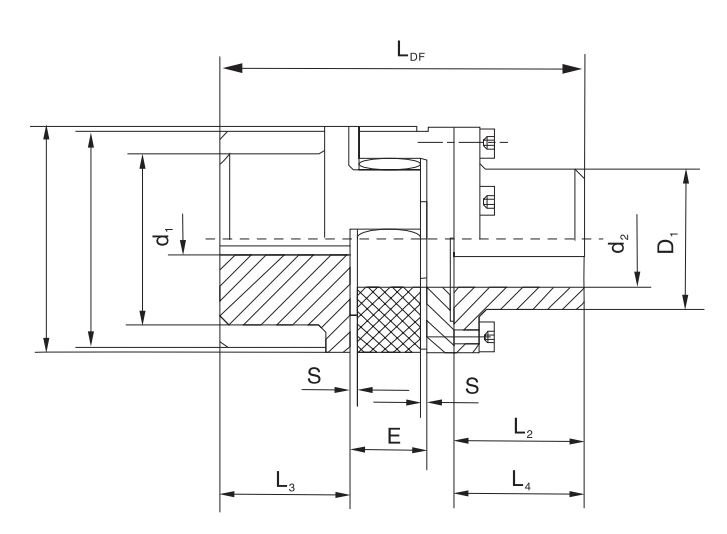
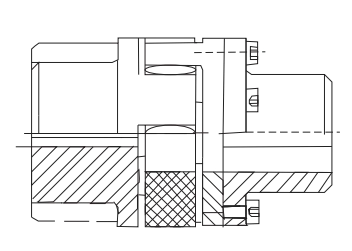
| Model | Nom. Torque (N·m) | Max Speed (rpm) | Bore (mm) | D (mm) | D₁ (mm) | D₂ (mm) | D₃ (mm) | E (mm) | L_DF (mm) |
|---|---|---|---|---|---|---|---|---|---|
| TS24 DF | 35 | 14000 | 8–24 | 55 | 36 | 40 | 55 | 18 | 86 |
| TS28 DF | 95 | 11800 | 8–28 | 65 | 42 | 48 | 65 | 20 | 100 |
| TS38 DF | 190 | 9500 | 10–38 | 80 | 52 | 66 | 78 | 24 | 124 |
| TS42 DF | 265 | 8000 | 10–42 | 95 | 62 | 75 | 94 | 26 | 138 |
| TS48 DF | 310 | 7100 | 10–48 | 105 | 70 | 85 | 104 | 28 | 152 |
| TS55 DF | 410 | 6300 | 15–55 | 120 | 80 | 98 | 118 | 30 | 176 |
| TS65 DF | 625 | 5600 | 15–65 | 135 | 94 | 115 | 134 | 35 | 201 |
| TS75 DF | 1280 | 4750 | 20–75 | 160 | 108 | 135 | 158 | 40 | 229 |
| TS90 DF | 2400 | 3750 | 30–90 | 200 | 142 | 160 | 180 | 45 | 265 |
| TS100 DF | 3300 | 3350 | 30–115 | 225 | 158 | 180 | 200 | 50 | 295 |
| TS110 DF | 4800 | 3000 | 40–125 | 255 | 178 | 200 | 230 | 55 | 321 |
| TS125 DF | 6650 | 2650 | 40–145 | 290 | 206 | 230 | 265 | 60 | 370 |
| TS140 DF | 8600 | 2360 | 40–160 | 320 | 235 | 256 | 300 | 65 | 409 |
| TS160 DF | 12800 | 2000 | 60–180 | 370 | 270 | 290 | 345 | 75 | 463 |
| TS180 DF | 19650 | 1800 | 85–200 | 420 | 315 | 325 | 400 | 85 | 515 |
Customer Reviews & Case Studies
🇦🇺 Australia — Sugar Milling
A sugar mill in Queensland installed TS140 DF couplings to connect flanged gearbox outputs to flanged mill roller drives. The symmetric double-flange configuration matched the existing flanged interfaces on both sides without adapters. Spider replacement during the inter-season maintenance window was completed from the more accessible gearbox side in under one hour per coupling position.
★★★★★
"Fitted straight to our existing flanges with no adapters. Spider replacement from the accessible side took under an hour."
🇮🇹 Italy — Printing Machinery OEM
A web-offset printing press manufacturer in Milan integrated TS38 DF and TS42 DF couplings into the print unit drive trains of their flagship press platform. The DF Type's elastomeric isolation attenuated gear mesh frequency vibration between adjacent print unit gearboxes, reducing register errors at high print speeds — a measurable quality improvement at 60,000 sheets per hour.
★★★★★
"Isolating gear mesh vibration between units was the missing piece. Register errors dropped immediately."
🇦🇺 Australia — Mining Processing (Pilbara)
An iron ore processing facility in the Pilbara region fitted TS160 DF couplings on primary crusher drive gearbox-to-motor connections. Operating in ambient temperatures up to 50°C, the polyurethane spider maintained dimensional stability across seasonal temperature variation. The symmetric flange arrangement allowed the crew to approach from the motor side — the platform with better access — during each quarterly inspection.
★★★★☆
"Works in 50°C without complaint. Access from whichever side we need is a genuine advantage up here."
🇧🇪 Belgium — Chemical Processing
A specialty chemical plant near Antwerp used TS90 DF couplings on reactor agitator drives connected to flanged speed reducers. The balanced double-flange geometry was specified to avoid asymmetric loading on the speed reducer output shaft bearings, and the polyurethane spider withstood incidental exposure to cleaning solvents throughout 18 months of operation.
★★★★★
"Symmetric loading on both output bearings was the engineering requirement. The DF Type is the only design that delivers it."
Frequently Asked Questions
For drives requiring brake drum or brake disc integration with the coupling assembly, explore the Z Type Drum Brake and P Type Disc Brake Flexible Jaw Couplings, which combine the standard elastomeric jaw coupling with an integrated braking surface on a single hub.
Connecting Two Flanged Machines? The DF Type Is Your Solution.
GBC supplies DF Type double flanged flexible jaw couplings to plant engineers, gearbox OEMs, and industrial procurement teams throughout Australia and internationally. Provide your flange pattern, bore sizes, torque, and speed — our technical team will confirm the correct model and configuration within one business day.
The DF Type Double Flanged Flexible Jaw Coupling uses removable flanges on both ends for the fastest possible in-situ elastomer replacement on heavy machinery drives. Torque range 35–19,650 N·m, bore to Ø200 mm. Designed for symmetrical drive trains where both the motor and driven machine have flanged connection interfaces.